
You Have the Treats. You Have the Clicker. Your Dog Is Staring at You. Now What?
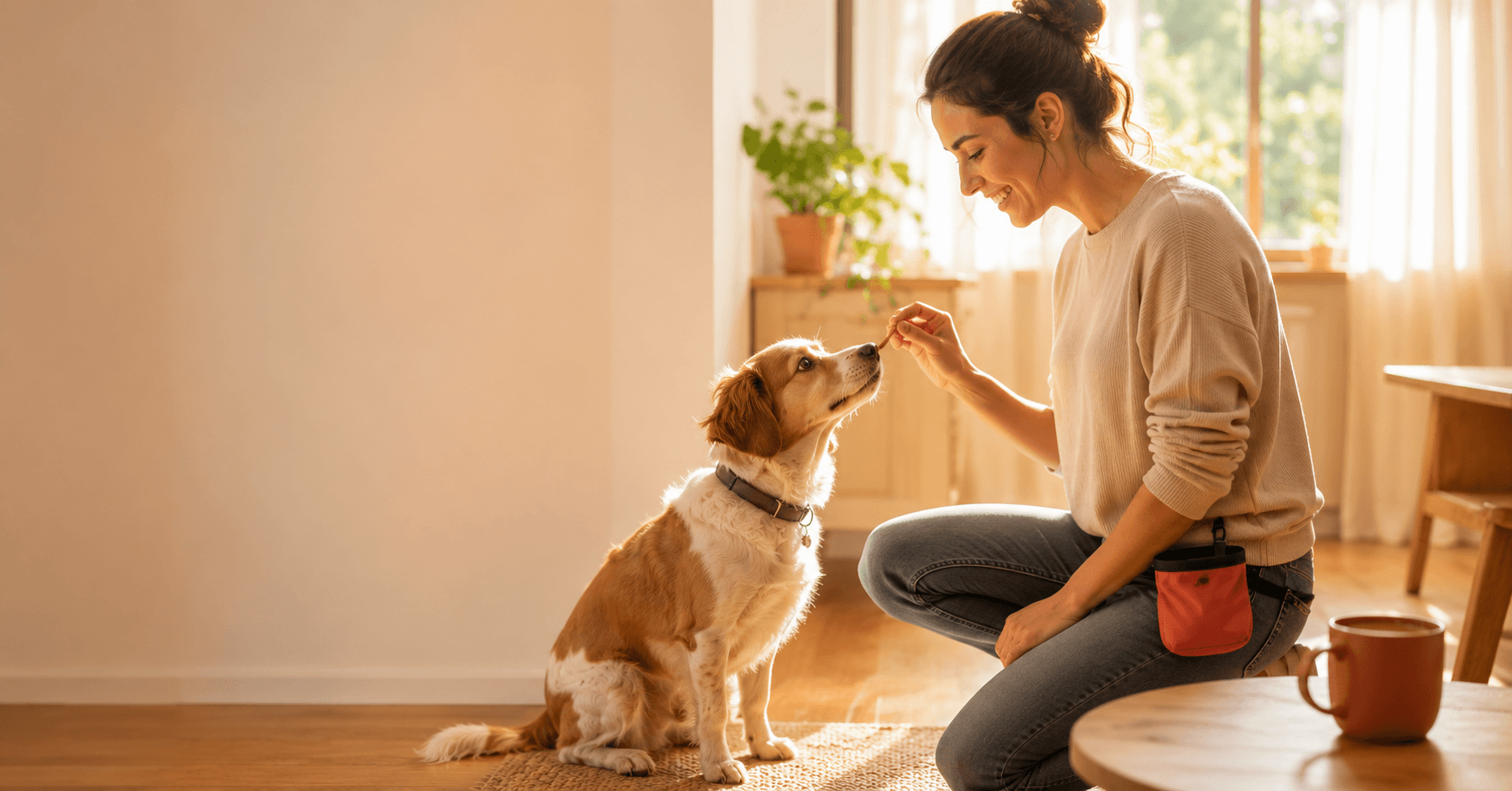
You’ve done the research. You’ve bought the treats and the pouch. Your dog is sitting in front of you with that look on their face: the one that’s either incredibly eager or completely confused, and honestly, you’re not sure which. This is the moment most first-time owners freeze.
Take a breath. You’re more prepared than you think. This article walks you through your entire first week of training, exactly what to teach, when to teach it, how to manage your treats, and how to avoid the three mistakes that trip up almost every beginner. Let’s start with the very first command.
Before You Start: 3 Golden Rules
Training is a marathon, not a sprint. Your dog isn’t going to sit reliably in a crowded park after three sessions, and that’s completely fine. Positive reinforcement training builds a relationship first and skills second, and the relationship lasts a lifetime.
Before your first session, lock in these three rules:
| The 3 Golden Rules Rule 1: Set your dog up for success. Don’t test your dog, train them. Start easy. Make it nearly impossible to fail. Rule 2: End every session on a win. Even if it’s the easiest thing they know. The last experience sets the emotional tone for next time. Rule 3: If you’re frustrated, stop. Your dog reads your body language and tone of voice constantly. Frustration = stress = worse performance. Two minutes of frustrated training undoes ten minutes of good training. |
| What You’ll Learn in This Article Section 1: How to teach ‘sit’ in 5 steps (force-free) Section 2: A 10-minute morning training routine you can start tomorrow Section 3: The 3-Treat Rule: how many treats per session Section 4: Treat vs. toy, when to use each Section 5: 3 common mistakes and their exact fixes Section 6: How to layer training into daily walks Section 7: The best time to train by your dog’s age |
Section 1: How to Teach ‘Sit’ in 5 Steps (No Force, No Pushing)
Sit is the perfect first command for three reasons: it’s a natural position dogs already do on their own, it’s easy to capture and reward, and succeeding at it builds your dog’s confidence for everything that follows. Here’s the method that works on every dog, every breed, every age.
Step 1: Capture, Don’t Force
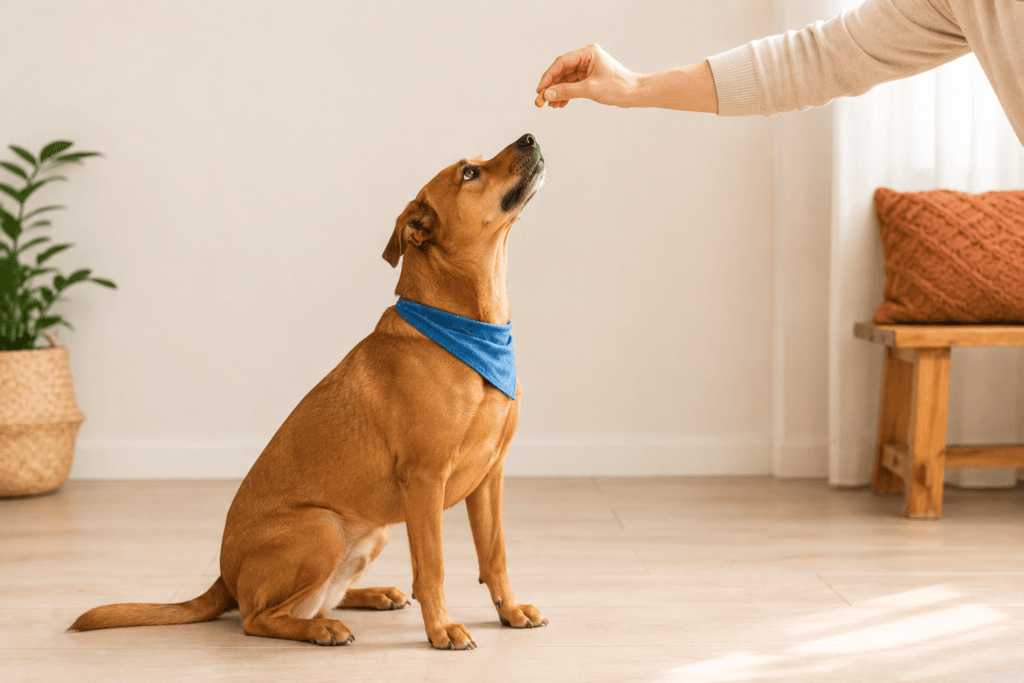
Hold a treat right at your dog’s nose level so they can smell it. Let them sniff. Do not push their bottom down, ever. Pushing can trigger opposition reflex (they push back), and it removes their choice from the equation. Positive reinforcement works because dogs make decisions. Keep that agency intact.
Step 2: Lure Slowly Upward
With the treat at nose level, slowly move it upward and slightly backward over the top of their head. As their nose follows the treat up, their weight naturally shifts backward, and their hips lower toward the floor. Keep the movement slow and smooth. If your dog jumps, you’re moving the treat too high too fast.
Step 3: Mark the Moment
The second: the exact second, your dog’s bottom touches the floor, mark it. Say “Yes!” or click. Not a moment later. Timing is everything in positive reinforcement first commands because your dog is learning to connect the behavior with the reward. A half-second delay means you’re marking something different.
Step 4: Reward Immediately
Deliver the treat within 1 second of your mark. Reach into your pouch before your dog has a chance to stand back up. Repeat the lure 5-10 times in a row, then take a short break. This rapid repetition builds the neural pathway quickly.
Step 5: Add the Cue Word
This is the step most beginners rush, and it causes confusion. Only add the word “Sit” once your dog is reliably going into the position from the lure alone. Say “Sit” calmly just before you begin the lure motion. After 20-30 successful reps with the word, test it: say “Sit” without luring. Does your dog respond? If yes: celebrate. That’s a trained behavior.
Common Problems and Fixes:
- My dog backs up instead of sitting Practice against a wall so they can’t move backward. Their weight will have nowhere to go but down.
- My dog jumps for the treat Lower the treat slightly and slow down your upward movement. The treat should be barely above nose height.
- My dog sits but immediately pops back up Start marking the sit with a 1-second hold before rewarding. Gradually extend to 2, then 3 seconds.
| Example: Leo, a 9-week-old Golden Retriever, was jumping constantly at his first training session. His owner slowed down the lure to a near-crawl, keeping the treat just barely above nose level. On the fifth attempt, Leo’s bottom touched the floor. His owner said “Yes!” immediately and gave the treat. Leo sat four more times in the next two minutes. That’s all it took. |
Section 2: The 10-Minute Morning Training Routine
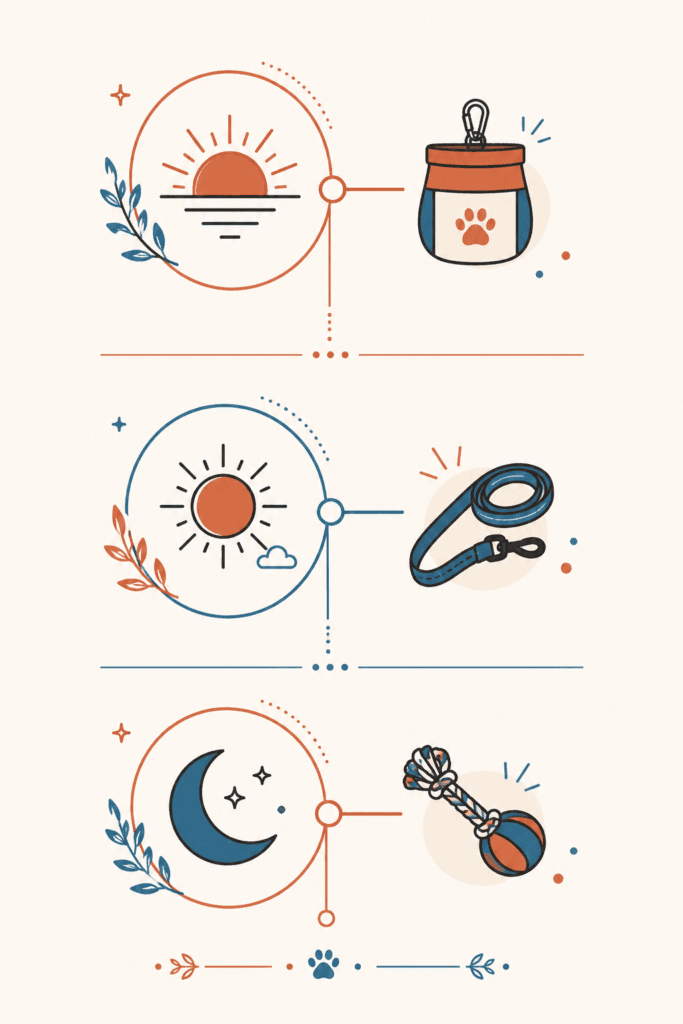
Morning is the single best time to train for most dogs. They’re rested, slightly hungry, and haven’t yet burned through their mental energy on the day’s distractions. Here’s exactly how to use those 10 minutes.
Why Morning Training Works:
- Your dog wakes up with a clean slate, no accumulated arousal from the day
- They’re food-motivated before breakfast (train before you feed, not after)
- A positive training session first thing sets a calm, connected tone for the rest of the day
The Minute-by-Minute Breakdown:
| Time | Activity | What You Do |
| 0–2 min | Warm-up | Practice ‘sit’ 5x with treats, easy, low-pressure, build momentum |
| 2–4 min | Name Recognition | Say name dog looks at you mark “Yes!” treat. Repeat 8–10x. |
| 4–6 min | Sit with Hold | Ask for ‘sit’ but wait 2 seconds before marking. Build duration gradually. |
| 6–8 min | Play Break | Tug or chase a toy. Reward engagement. This recharges drive for the second half. |
| 8–10 min | Cool Down | Easy ‘sit’ and name recognition. End on the easiest success you can guarantee. |
The 3 Commands to Focus on in Week 1:
- Name recognition, Your dog looks at you when you say their name. This is the foundation of everything else. A dog who isn’t connected to their name won’t respond to any other cue reliably in a distracting environment.
- ‘Sit’, Reliable in your home with no distractions. Don’t take it outside yet. Make it automatic indoors first.
- Hand target (touch), Your dog touches their nose to your open palm when you present it. This builds focus, gives you a tool for guiding movement, and is easy to teach in one session.
| Week 1 Goal By the end of your first week, your dog should: respond to their name 8 out of 10 times indoors, offer a sit from a lure 90% of the time, and touch your hand on cue consistently in a quiet space. If you’re hitting these marks, you’re ahead of most beginners. If you’re not: that’s also fine. Add another week. |
Section 3: How Many Treats Per Training Session? The 3-Treat Rule
Overfeeding during training is a real problem. A dog who’s full loses motivation mid-session. A dog who’s been overtreated all day gains weight and starts treating food as less special. The 3-Treat Rule is a practical framework that prevents both.
What the 3-Treat Rule Means:
- Train until your dog has earned 3 correct responses and received 3 treats
- Then take a 5-10 minute break (play, free time, or a rest)
- Repeat 3-5 times across the day
This approach keeps sessions short enough to respect puppy attention spans (2-3 minutes maximum), prevents both you and your dog from getting frustrated, and spaces reinforcement across the day to maintain motivation.
Daily Treat Limits by Dog Size:
- Small dog (under 15 lbs): 10-15 training treats per day maximum
- Medium dog (15-40 lbs): 15-25 training treats per day
- Large dog (40+ lbs): 20-30 training treats per day
| Important Subtract your training treat calories from your dog’s regular meals. If you gave 20 pieces of chicken during training, reduce their dinner portion slightly. This keeps total calorie intake balanced without requiring complex math. |
What to Do When Your Dog Stops Taking Treats:
- Sign 1: They’re full. Solution: Train before meals, not after.
- Sign 2: The treat is boring. Solution: Upgrade to boiled chicken or freeze-dried liver immediately.
- Sign 3: They’re too stressed (too many distractions). Solution: Move to a quieter space and simplify the task.
- Sign 4: They’re tired. Solution: End the session. A tired dog learns nothing.
Section 4: Treat vs. Toy, When to Use Each for Reinforcement
Most beginners default to treats because they’re easier to manage, and that’s completely fine, especially for new behaviors. But understanding when a toy outperforms a treat will make you a significantly more versatile trainer.
| Factor | Treats | Toys/Play |
| Speed | Very fast, consumed in 1–2 seconds | Slower, play takes 10–60 seconds |
| Best for | Teaching new behaviors, rapid reps | Building drive, rewarding sustained effort |
| Satiety | Fills dog up over time | Zero calories |
| Engagement level | Medium (food-motivated dogs) | High (toy-motivated dogs) |
| Portability | Easy, in your pouch | Bulky, requires space to play |
| Interrupts rhythm? | No | Yes, plan for it |
| Best timing | Any new behavior | End of session, jackpot rewards |
When to Use Treats (Most of the Time):
- Teaching any brand new behavior for the first time (sit, down, name, touch)
- High-repetition practice (20+ reps in a single session)
- Distraction-proofing, gradually adding challenges requires fast, frequent rewards
- Working with a dog who needs confidence-building (fearful dogs, rescue dogs)
When to Use Toys (As a Bonus Reinforcer):
- Your dog is toy-obsessed and treat-indifferent, toys become your primary reinforcer
- You’re rewarding duration or intense effort (a really solid 3-second ‘stay’, a perfect recall)
- As an intermittent jackpot at the end of a great session, surprise play breaks build drive
- Rewarding engagement during walks where food is less practical
What Most Beginners Get Wrong:
- Using a toy and forgetting to mark first. The marker (“Yes!” or click) still comes before the toy throw: the dog needs to connect the marker to the specific behavior, not just the fun that follows.
- Letting the dog grab the toy before the mark. This teaches the dog that lunging at the toy is what earns play. Mark first. Throw second. Always.
- Treating toy play as optional. If your dog is toy-motivated and you’re only using treats, you’re leaving motivation on the table.
| Example: Kira, a 6-month-old Border Collie, was completely indifferent to every treat her owner tried. But her eyes lit up the moment a tennis ball appeared. Her trainer had her owner switch to a short game of fetch as the primary reinforcer. Kira went from distracted and disengaged to laser-focused in a single session. |
Section 5: 3 Common Training Mistakes (And 3 Easy Fixes)
Every trainer has made all three of these mistakes, including professional trainers on their very first dog. Knowing them doesn’t mean you won’t make them, but it means you’ll recognize them faster and fix them sooner.
Mistake #1: Repeating Cues Over and Over
“Sit. Sit. Sit, Buddy. Sit. I said sit.” We’ve all done it. And every repetition teaches your dog that they have multiple attempts before a response is needed. This is called a “nagged cue”, and fixing it is critical.
The Fix:
- Say the cue exactly once. Wait 3 full seconds in silence.
- If there’s no response, reset: walk away, get a new treat, and start over from scratch.
- Never repeat the cue. One cue, one opportunity, one outcome. Your dog will learn very quickly that the cue means “now.”
Mistake #2: Training When You’re Frustrated
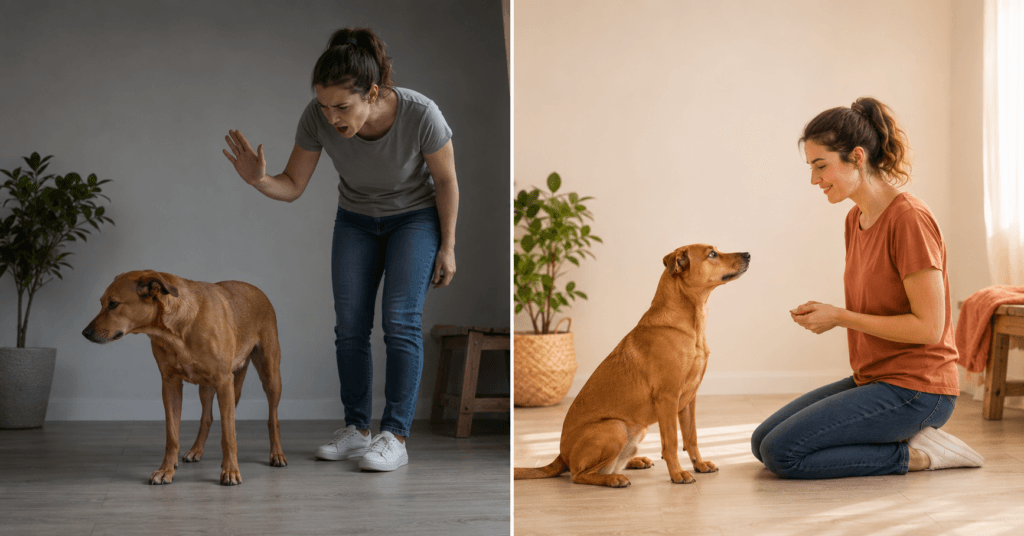
Your dog isn’t responding, you’ve said “Sit!” four times, and you can feel yourself getting annoyed. This is the exact moment to stop, because frustration leaks through your voice, your posture, and your timing, and your dog absorbs all of it.
The Fix: The 2-Minute Rule
- If you feel frustrated within the first 2 minutes of a session, stop completely.
- End on the easiest win you can manufacture (lure a sit, reward generously, session over).
- Come back in 2 hours. Your dog will perform significantly better when you’re calm and patient.
Mistake #3: Moving Too Fast to Distractions
Your dog sits perfectly 20 times in your living room. You take them to the park. They look at you like you’ve never met. This isn’t stubbornness or stupidity, it’s a predictable consequence of advancing too fast.
The Fix: The 3 D’s of Dog Training
When building any behavior, change only ONE of these variables at a time:
- Duration, How long your dog holds the behavior (1 second 2 seconds 5 seconds)
- Distance, How far away from your dog you are when asking (beside them 1 step away 10 feet)
- Distraction, The difficulty of the environment (silent room TV on low yard park)
The Proper Progression for ‘Sit’:
- Quiet room, no distractions, lure in hand
- Same room, add 1-second duration before marking
- Add low-level distraction (TV on low volume)
- Take one step back before asking
- Another person enters the room
- Outside in your yard (no other dogs nearby)
- Quiet park with distance from other people
- Real-world distractions (busy park, pet store)
| The Rule to Remember If your dog can’t respond correctly in a new context, the environment is too advanced, not the dog. Step back one level, rebuild confidence there, and advance again. Regression is not failure. It’s information. |
Section 6: How to Layer Positive Reinforcement with Daily Walks
Your daily walk isn’t just exercise, it’s one of the richest training opportunities in your dog’s day. Here are two simple, proven methods for building a dog who stays connected to you on leash without any corrections.
Method 1: The Engagement Walk
Goal: Your dog voluntarily checks in with you during the walk.
- Every time your dog looks up at your face during the walk, without you asking, mark it (“Yes!”) and give a treat.
- Don’t ask for attention. Wait for it to happen naturally, then reward it generously.
- After 5-7 days, most dogs start walking beside you and glancing up regularly, anticipating the reward.
| One owner tried the Engagement Walk with her 5-month-old Beagle, historically the most nose-driven dog breed in existence. Within a week, her Beagle was checking in every 15-20 seconds and pulling had dropped by 80%. She hadn’t corrected the pulling once. |
Method 2: The Pattern Game
Goal: Your dog learns that when you pause, looking at you is the right response.
- Walk 3 steps. Stop completely. Say nothing. Wait.
- The moment your dog looks at you, mark and treat.
- Walk 3 more steps. Stop. Wait. Mark the look. Repeat.
- After 2-3 sessions, your dog will pause and look at you automatically every time you stop, at crosswalks, doorways, before approaching other dogs.
Combining Both Methods:
- First 5 minutes of walk: Engagement Walk (reward every voluntary check-in to build focus early)
- Middle of walk: Pattern Game (use stops to maintain connection during the busiest part of the walk)
- Last 5 minutes: Free sniff time, let your dog follow their nose freely. This is a powerful reinforcer for the good walking behavior that came before.
| Pro Insight Free sniffing is one of the most underused reinforcers in dog training. Letting your dog sniff freely after good loose-leash behavior actually makes the behavior stronger over time, because sniffing access becomes the reward. (seeLoose-Leash Walking with Positive Reinforcement) |
Section 7: Morning vs. Evening Training, When Is Best by Age?
Timing isn’t just a preference, it affects how much your dog can focus, how motivated they are, and how much they retain. Here’s a practical guide by age:
Puppies Under 4 Months:
- Best time: Morning, immediately after their first potty break
- Why: They wake up hungry, rested, and genuinely curious. Everything is new.
- Avoid evening: Young puppies get overtired and cranky after about 4-5pm, like toddlers who need a nap
- Session length: 1-2 minutes maximum, 4-5 times per day
Adolescent Puppies (4–8 Months):
- Best time: Morning AND late morning (two sessions before noon)
- Why: Adolescent dogs have energy spikes and longer attention spans, but can still crash hard in the afternoon
- Train BEFORE zoomie time hits (usually mid-morning for most adolescent dogs)
- Session length: 3-5 minutes, 3-4 times per day
Adult Dogs (1+ Years):
- Best time: Morning before breakfast (food-motivated, alert, fresh)
- Also good: Late afternoon after their midday nap, before dinner
- Avoid: Immediately after a big meal (they’re sleepy) or late at night
- Session length: 5-10 minutes, 2-3 times per day
| Universal Rule Train when YOUR specific dog is most alert and food-motivated. For 90% of dogs, that’s first thing in the morning. But if your dog is sluggish at 7am and sharp at 6pm, train at 6pm. Watch your dog, they will show you their optimal training window clearly. |
FAQ: Real Questions from Trainers-in-Progress
“My dog knows ‘sit’ at home but ignores me outside. What do I do?”
This is the most common question we get, and the answer is always the same: your training environment jumped too far ahead of your dog’s skill level. Go back to the last environment where they were reliable (your living room), and rebuild from there using the 3 D’s progression above. Outdoors is a hard distraction environment, earn it gradually.
“How long should each training session actually be?”
Under 4 months: 1-2 minutes. Four to eight months: 3-5 minutes. One year+: 5-10 minutes. These limits feel comically short until you watch what happens at minute six with a puppy, and realize that ending at minute two would have produced better results. Short sessions build enthusiasm. Long sessions burn it.
“What if my dog only performs when he sees a treat?”
This is a management problem, not a training problem. The solution is to fade the visible treat gradually: keep treats in your pouch (out of sight) rather than in your hand. Start asking for the behavior with an empty hand, then reward from the pouch after success. Once behavior is consistent with an empty hand, begin intermittent reinforcement (reward every 2nd, then every 3rd, then randomly).
“Can I train my dog without treats eventually?”
Yes, but “eventually” means after the behavior is solidly conditioned, not after three sessions. Behaviors that have been reliably reinforced hundreds of times with treats can eventually be maintained with intermittent food rewards, praise, life rewards (walks, play, access to sniff), and social connection. The treats don’t disappear entirely, they become random and less frequent.
“How many commands can I teach at once?”
In Week 1, stick to three. Name recognition, sit, and one more (hand target or ‘down’). More than three and your dog’s sessions get scattered, sessions run long, and neither of you builds the repetitions needed for any behavior to become reliable. Depth beats breadth, especially in the first month.
“My puppy bites me during training, help!”
Puppy biting during training is almost always an arousal or frustration response. End the session immediately (no drama, no punishment, just stop), wait 2 minutes, then resume with something easier. If biting is persistent throughout sessions, your treats are too exciting (causing over-arousal) or your session is running too long. SeeSolving Common Behavior Problemsfor a full strategy.
“What’s a good training schedule if I work during the day?”
Three short sessions work beautifully: one before you leave in the morning (5 minutes, before breakfast), one at lunchtime if you work from home or have someone who can help, and one in the early evening before dinner. If you can only do two, morning and evening. Two quality sessions per day still produce excellent results. Consistency matters more than frequency.
“My dog is scared of the clicker. What should I use instead?”
Switch to a marker word (“Yes!”) immediately and don’t introduce the clicker again until your dog is comfortable with training sessions generally. Some trainers use a mouth click (the sound made with your tongue and cheek) as a middle ground, softer than a mechanical clicker, more consistent than a spoken word. Any consistent sound your dog can learn to associate with reward will work.
One Session at a Time
Here’s your first week in one paragraph: Teach sit using the 5-step lure method. Run a 10-minute morning routine with name recognition, sit, and play. Follow the 3-Treat Rule, short sessions, frequent breaks, adjusted meals. Know when to use treats vs. toys. Avoid the three classic mistakes. Add training to your daily walks. Train at the time of day when your dog is freshest and most food-motivated.
Every trainer started exactly where you are right now, with a dog who barely knows their name, treats in their pocket, and a lot of questions. Your dog is not broken. You are not failing. The only thing that separates a beginner from an experienced trainer is time, consistency, and the willingness to keep showing up. Consistency beats perfection every single time.
| Download the Free Weekly Training Tracker Want a printable weekly training tracker to log your sessions, track which commands you’re working on, and celebrate every small win? Enter your email below, we’ll send it straight to your inbox along with the Positive Reinforcement 101 starter kit. |
Affiliate Links
A daily training journal like this one helps you track sessions, commands learned, and progress week to week, genuinely useful during your dog’s first weeks of training.

Want extra accountability while you work through these commands? Some owners get better follow-through from our roundup of the best dog training apps and online courses than from a printable checklist alone.
Resources & Series Links
Positive Reinforcement 101 Series
10 Comments