

“Won’t My Dog Only Listen for Treats?” Here’s the Honest Answer.
One of the most common objections to positive reinforcement is also one of the easiest to solve. The honest answer is, only if you never learn how to fade them. Done correctly, treat fading is a built-in, planned part of positive reinforcement, not something bolted on afterward.
This guide covers exactly how professional trainers fade treats without losing reliability, including the science of why unpredictable rewards actually work better than constant ones, a full troubleshooting section for when things don’t go smoothly, and the specific signals that tell you your dog is ready to move to the next phase.
What’s Covered in This Article
- Section 1: Bribery vs. reinforcement: the difference that changes everything. Why so many owners get stuck here
- Section 2: When is it time to start fading treats?Signs fading is actually working
- Section 3: The 4-phase treat-fading method
- Section 4: Variable reinforcement schedules explained
- Section 5: Replacing treats with life rewards
- Section 6: Different behaviors, different fading speeds. A realistic example: fading treats for ‘sit’ over three weeks
- Section 7: Troubleshooting: what if my dog stops listening?
- Section 8: Maintaining behavior for the long term
Section 1: Bribery vs. Reinforcement, The Difference That Changes Everything
Bribery means showing the treat before the behavior, to lure compliance in the moment. Reinforcement means the treat shows up after the behavior, as a consequence of it. This sequencing difference is why positive reinforcement was never designed to require treats forever: the treat is a teaching tool for the learning phase, not a permanent prerequisite for the behavior to happen.
Many owners unintentionally slip into bribery without realizing it, holding a treat up before asking for a sit, for instance, rather than asking first and rewarding after. This isn’t a moral failing, it’s just an easy habit to fall into, especially in the early stages when you’re trying to get any response at all. The good news is it’s fixable at any point: simply start asking for the behavior first, with empty hands, and reward as the consequence rather than the lure.
It also helps to understand why this distinction matters biologically, not just semantically. A behavior that’s lured tends to only occur reliably when the lure is visible, because the dog has learned to respond to the sight of the treat rather than to the verbal or visual cue itself. A behavior that’s reinforced after the fact is tied to the cue instead, which is exactly why properly reinforced behaviors survive treat fading while lured ones tend to collapse the moment the treat disappears from view.
Why So Many Owners Get Stuck Here
It’s worth naming directly why treat dependency happens so often, even among owners who genuinely understand the theory: rewarding every single time is simply easier in the moment, and fading requires a level of intentionality that’s easy to skip when a dog is already responding well. There’s also a natural fear of “breaking” something that’s currently working, if sit is reliable with a treat every time, why risk it?
The answer is that a behavior maintained purely through continuous reinforcement is actually more fragile than one that’s been properly faded, not less. A dog who’s only ever known 100% reinforcement can fall apart the very first time a treat isn’t available, no pouch, out of treats, hands full of groceries, precisely because the pattern has never been tested any other way. Fading isn’t extra work layered on top of good training; it’s the step that makes training genuinely durable rather than only conditionally reliable.
Section 2: When Is It Time to Start Fading Treats?
- Your dog performs the behavior reliably in a low-distraction environment, most of the time, without hesitation
- You’ve practiced the behavior across several different locations, not just one familiar room
- Your dog responds to the verbal cue alone, before seeing any treat appear
If any of these aren’t true yet, that’s a signal to keep reinforcing consistently rather than start fading, moving too early is the single most common reason owners feel like fading ‘didn’t work.’ A useful rule of thumb some trainers use: if a dog gets a behavior right roughly 8 or 9 times out of 10 across multiple locations, that’s usually a solid signal readiness has arrived.
It’s worth resisting the urge to fade every behavior at the same time just because one is ready. Fading works best applied behavior-by-behavior: a dog might be fully ready to fade treats for “sit” while still needing continuous reinforcement for a newer skill like “stay” under distraction. Treating training as a single global switch to flip, rather than a series of individual behaviors each on their own timeline, is a common source of frustration.
Signs Fading Is Actually Working
Because fading happens gradually, it can be hard to tell in the moment whether it’s succeeding or quietly failing. A few signals suggest things are on track:
- Your dog still responds promptly even on the reps where no treat appears afterward
- Enthusiasm for the behavior stays roughly consistent, rather than visibly dropping once treats become less frequent
- Your dog starts offering the behavior in new contexts without you needing to re-teach it from scratch each time
If instead you’re seeing hesitation, a need to repeat the cue multiple times, or a dog who visibly checks your hands for a treat before responding, these are signs the fade moved faster than the dog was ready for, not signs that fading itself is the wrong approach.
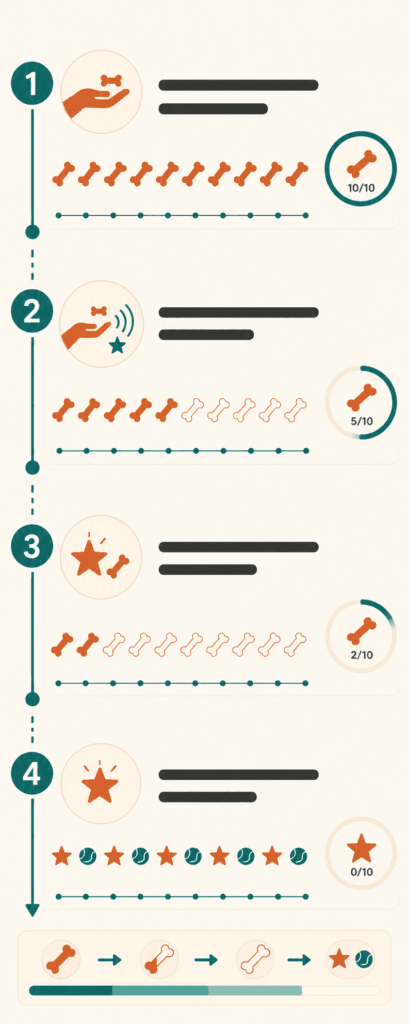
Section 3: The 4-Phase Treat-Fading Method
This progression matches how the American Kennel Club describes moving from continuous to intermittent reinforcement: start by rewarding every correct response, then introduce unpredictability on purpose once the behavior is solid, since random rewards are what actually keep a learned behavior durable over time.
- Phase 1, Continuous reinforcement: reward every single correct response while the behavior is being learned
- Phase 2, Predictable fading: reward every other correct response, then every third, gradually stretching the ratio
- Phase 3, Variable reinforcement: reward at random, unpredictable intervals, sometimes the first try, sometimes the fifth
- Phase 4, Real-life rewards: replace food with praise, play, or access to something your dog wants
Each phase typically takes anywhere from several days to a couple of weeks, depending on the behavior’s complexity and how established it already is. Simple behaviors like “sit” often move through all four phases faster than something like “stay” under distraction, which may need to stay in phase 1 or 2 much longer before moving on.
Section 4: Variable Reinforcement Schedules Explained (Simply)
This is the same principle that makes slot machines compelling, unpredictable rewards create stronger, more persistent behavior than a reward every single time. Once your dog can’t predict exactly when the reward is coming, they tend to keep offering the behavior reliably, hoping this might be the time it pays off.
This isn’t just a training trick, it’s one of the most well-documented findings in behavioral psychology, sometimes called the “partial reinforcement extinction effect.” Behaviors reinforced on a variable schedule tend to be more resistant to disappearing entirely, compared to behaviors that were always reinforced continuously and then suddenly stopped. In practical terms: a dog trained through phase 3 properly will keep performing reliably even through the occasional treat-free session, precisely because they’ve learned rewards are unpredictable rather than guaranteed.
It’s worth noting this effect has been observed across a wide range of species, not just dogs, it’s a fundamental feature of how reinforcement learning works generally, which is part of why it transfers so reliably into dog training practice.
Section 5: Replacing Treats With Life Rewards
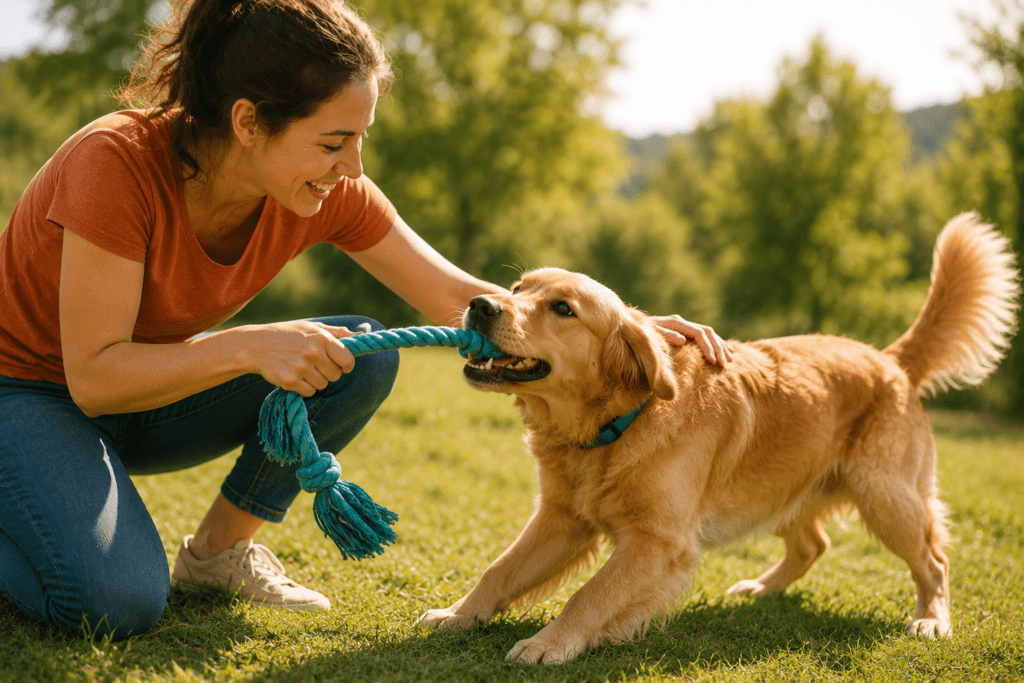
Treats are just one category of reinforcement, not the only one. A game of tug, a favorite toy, access to sniff a specific spot, or simply enthusiastic praise can all function as genuine reinforcement once the behavior is established, many owners find their dog responds just as strongly to these as to food, especially for everyday commands.
- Access rewards: opening the door to go outside, letting your dog greet a person or another dog
- Play rewards: a quick game of tug or fetch immediately after a correct response
- Praise and touch: enthusiastic verbal praise paired with petting, especially effective for dogs who are naturally affection-motivated
- Life rewards: anything your dog already wants in that moment can double as reinforcement: a walk continuing, a toy being thrown, a leash being clipped on
Section 6: Different Behaviors, Different Fading Speeds
Not every behavior should be faded at the same rate. High-stakes or safety-related behaviors, recall away from a road, staying put near a hazard, are worth keeping on a richer reinforcement schedule indefinitely, simply because the cost of an unreliable response is much higher than with something like “sit.”
- Fade quickly: casual everyday cues like sit, down, and basic loose-leash walking in familiar environments
- Fade slowly: behaviors around high distraction, like recall at the dog park or leaving something valuable the dog picked up
- Consider never fully fading: recall in unfenced or high-risk environments, where a lapse could mean real danger
This isn’t a contradiction of the fading method, it’s an intentional application of it. The goal was never to eliminate treats everywhere; it’s to eliminate dependency where dependency isn’t necessary, while keeping the highest-value reinforcement available for the behaviors where reliability matters most.
A Realistic Example: Fading Treats for ‘Sit’ Over Three Weeks
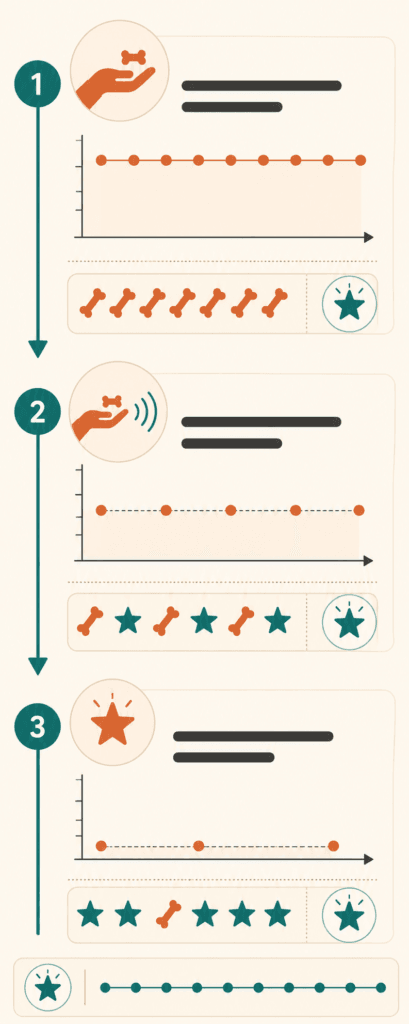
To make the four phases concrete: imagine a dog who’s just learned to sit reliably in the kitchen. Week one stays in phase 1, every single sit gets a treat, building a strong, confident association between the cue and the reward. By the start of week two, once sit is happening instantly and consistently, phase 2 begins: every other sit gets rewarded, then gradually every third, spaced out over several days rather than jumping straight to a big gap.
By week three, the dog has moved into phase 3, rewards now come unpredictably, sometimes on the first attempt, sometimes after four or five repetitions in a row. This is often the point where owners get nervous, worried the dog will stop responding without a visible treat every time. In practice, most dogs at this stage respond just as reliably, precisely because the unpredictability itself has become motivating. By the end of week three or into week four, praise alone maintains the behavior in low-distraction settings, with treats reserved for higher-distraction practice or as an occasional bonus.
This three-week timeline is illustrative, not a strict rule, simpler dogs and simpler behaviors sometimes move faster, while more complex behaviors or more distractible dogs may need double this timeframe at each phase. The trajectory (gradually widening gaps, not a single sudden jump) is what matters more than hitting an exact day count.
Section 7: Troubleshooting, What If My Dog Stops Listening?
If responses fall apart during fading, it usually means the schedule moved faster than the dog was ready for. The fix is simple: go back one phase, reinforce consistently again for a few days, then re-attempt the fade more gradually. This isn’t a failure in the dog, it’s a normal, expected part of the process.
- If the behavior disappears completely, you likely skipped a phase, return to continuous reinforcement briefly before trying again
- If the behavior gets slower or less enthusiastic, this often signals the reward value dropped too fast, increase treat value again before continuing the fade
- If the behavior only happens with visible treats in hand, you may have stayed in a lure-heavy pattern too long, start hiding treats out of sight before asking for the behavior
Section 8: Maintaining Behavior for the Long Term
Even after full fading, an occasional treat now and then helps maintain reliability over months and years: this isn’t backsliding, it’s simply good long-term maintenance. Many experienced trainers keep treats on hand indefinitely for a dog’s absolute best behaviors, using them intermittently as a kind of ongoing bonus rather than a requirement.
A helpful long-term habit: periodically “refresh” a fully faded behavior with a short run of higher-frequency reinforcement, especially after a long gap in practice, a house move, or any other disruption to routine. This isn’t starting over: a well-learned behavior comes back quickly under a brief refresher, but it does help maintain sharpness in behaviors that don’t get practiced daily, like a rarely-used “stay” or a seasonal cue that only comes up occasionally.
FAQ: Honest Answers to Real Treat-Fading Questions
“Will my dog ever get treats again?”
Yes, occasional treats even after full fading help maintain the behavior long-term. It’s constant dependency that’s being phased out, not treats altogether.
“How long does fading take?”
This varies by dog and behavior, but most well-established behaviors can begin phase 2 fading within a few weeks of reliable performance.
“Does this work for all commands?”
Yes, though high-value behaviors around distractions (like recall near other dogs) often benefit from staying on a higher reward rate for longer, sometimes indefinitely.
“Should I fade treats the same way for puppies and adult dogs?”
The phases are the same, but puppies often need longer at each stage simply because behaviors are newer and less proofed across environments.
“What if I’ve been using treats as bribes this whole time?”
It’s fixable, start by asking for the behavior first, treat as a consequence rather than a lure, and rebuild from there. It takes a few weeks to shift the pattern, but the underlying learning still holds.
“Is it bad to still use treats years into owning my dog?”
Not at all, many well-trained dogs still get occasional treats for their best responses. The concern is dependency for basic compliance, not treats existing at all in your relationship with your dog.
“Can I skip straight to variable reinforcement without the earlier phases?”
It’s generally not recommended, jumping straight to unpredictable rewards before a behavior is well-established tends to produce inconsistent results, since the dog hasn’t built enough confidence in the behavior yet to tolerate reward uncertainty.
“My dog seems to work harder for treats now than when we started. Is that normal?”
Yes: this is actually a sign that variable reinforcement is doing its job. Once rewards become unpredictable, many dogs offer behaviors more enthusiastically, similar to how unpredictable payouts keep gamblers engaged. It’s a feature of the schedule, not a red flag.
“Do professional trainers ever fully stop using treats?”
Rarely entirely, most keep treats available for high-value or safety-critical behaviors indefinitely, even with dogs who are otherwise fully trained. The goal was never zero treats forever, just zero dependency for basic compliance.
The Bottom Line
Treat fading isn’t about taking anything away from your dog, it’s about proving the training actually stuck. Handled with patience, most dogs reach a point where a simple ‘good dog’ does exactly what the treat used to, while the treats that remain become a bonus rather than a requirement.
If you take away one thing from this guide, let it be this: the fear that positive reinforcement creates permanent treat dependency is almost always a fading problem, not a method problem. The four-phase approach above exists precisely to prevent that outcome, and if you’re already noticing a dog who seems glued to the treat pouch, it’s never too late to start fading properly from wherever you are right now.

| Download the Only Training Cheat Sheet You’ll NeedWant a printable reference covering reward schedules, treat fading, and quick command cues in one place, so you always know exactly which phase you’re on? Enter your email below and we’ll send the Cheat Sheet straight to your inbox. |
Resources & Series Links
Positive Reinforcement 101 Series