
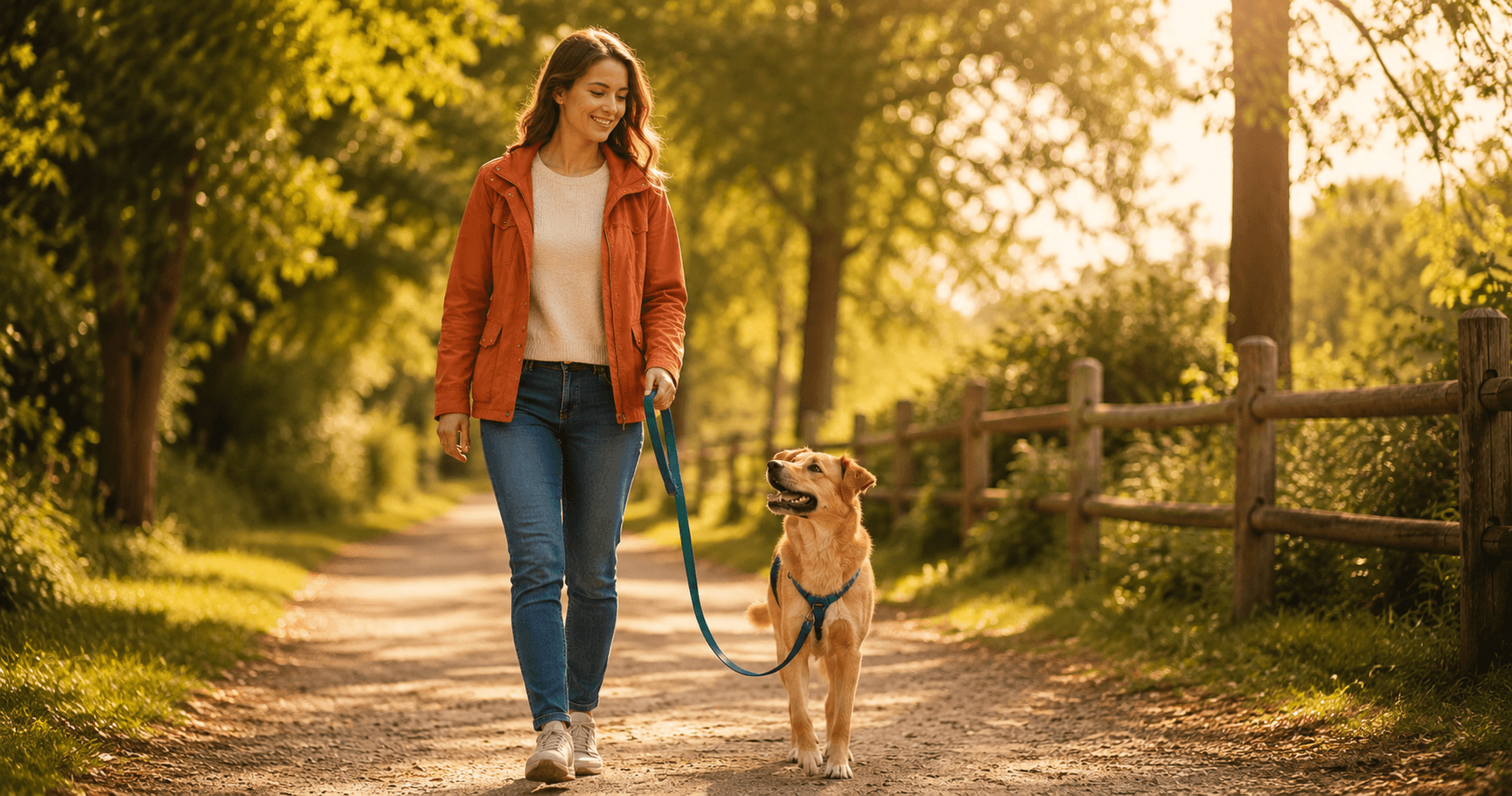
Stop Dreading Walks. Start Enjoying Them.
Leash pulling is one of the most common complaints first-time dog owners bring up, and also one of the most misunderstood. Pulling isn’t defiance. It’s simply a dog moving at the pace their nose and curiosity naturally set, with zero built-in understanding that a human is supposed to slow that down.
The fix isn’t correction. It’s teaching a new default: staying near you is more rewarding than forging ahead. This guide covers the full method from first principles through troubleshooting, plus the gear that makes the whole process dramatically easier, and a realistic timeline so you know what progress should actually look like.
Whether you’re starting with a new puppy who’s never worn a leash before, or you’ve been fighting the same pulling battle with an adult dog for years, the underlying method is the same, it just takes longer to unwind an established habit than to build a fresh one.
What’s Covered in This Article
- Section 1: Why dogs pull (and why punishment makes it worse)
- Section 2: Gear that sets you up for success, 4 harnesses compared
- Section 3: The step-by-step loose-leash method
- Section 4: The ‘. Be a Tree’ and reverse direction techniques
- Section 5: Adding distractions gradually
- Section 6: Troubleshooting reactive or overexcited dogs
- Section 7: Signs your training is actually working
- Section 8: Common setbacks and how to handle them
- Section 9: How long does it take?
Section 1: Why Dogs Pull (and Why Punishment Makes It Worse)
Dogs pull because moving forward gets them where they want to go faster, pulling is already being reinforced by the environment before training even enters the picture. Every time a dog pulls and successfully reaches whatever they were after (a smell, another dog, a patch of grass), that pulling behavior gets a tiny boost of reinforcement, completely independent of anything the owner does.
Leash corrections add discomfort without teaching an alternative behavior, and can create reactivity toward whatever the dog happened to be near during the correction: a dog corrected near another dog may start associating other dogs with discomfort, which can create a reactivity problem where none existed before. Positive reinforcement approaches solve the actual mechanism driving the pulling, rather than just suppressing the visible symptom of it.
Section 2: Gear That Sets You Up for Success, 4 Harnesses Compared
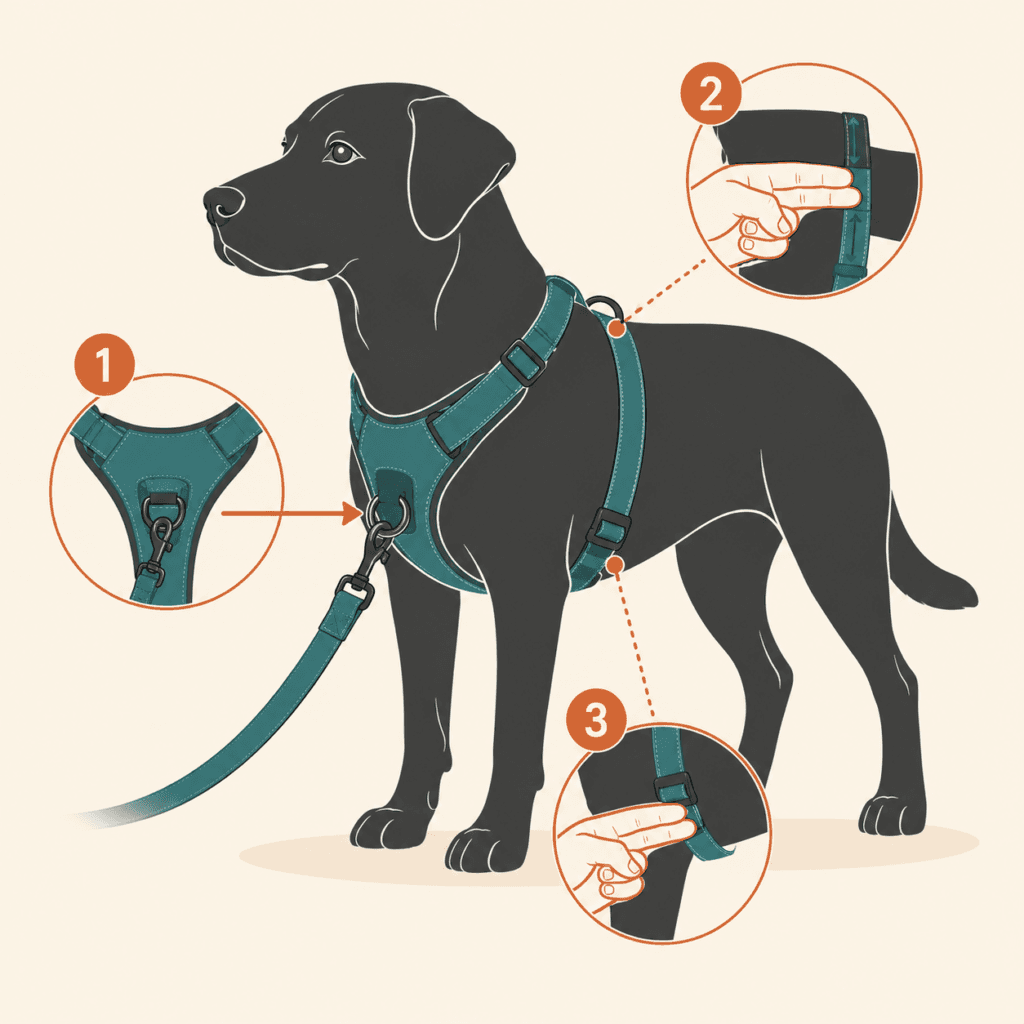
A front-clip harness changes the physics of pulling, when a dog pulls forward, it gently redirects them sideways instead of letting them drive forward with their full body weight. This alone doesn’t train anything, but it removes the mechanical advantage a dog has when pulling against a back-clip harness or collar, making every other technique in this guide easier to apply.
| BEST NO-PULLDual-Clip Front & Back Harness (Freedom-style)$30–40 | 5/5Pros:Dual front and back clip, padded chest panel, martingale loop for extra security, durable hardwareCons:More expensive than budget options, sizing can take one return to get rightBest for:Pullers, reactive dogs, daily walkers, anyone prioritizing loose-leash training | ||||
| BUDGET FRONT-CLIPBasic Front-Clip Harness$15–20 | 4/5Pros:Includes front and back clip, lightweight, widely available, does the essential job affordablyCons:Less padding than premium options, may chafe on dogs with sensitive skin during long walksBest for:Beginners, small to medium dogs, owners starting loose-leash training | ||||
| ADVENTURE PICKLightweight Trail Harness (Ruffwear Front Range-style)$25–35 | ½ 4.5/5Pros:Extremely durable, padded, excellent for running and hiking, multiple attachment points on most modelsCons:Some adventure models omit the front clip, check before purchasing if pulling is a concernBest for:Active dogs, trail runners, hiking companions, high-activity owners | ||||
| BASIC OPTION (Not Recommended for Pullers)Basic Step-In Back-Clip Harness$10–15 | 3/5Pros:Cheap, very easy to put on, fine for calm adult dogs who don’t pullCons:No front clip means zero pulling reduction, actually makes pulling worse for some dogs by giving leverageBest for:Non-pullers only, well-trained adult dogs, short casual outings | ||||
| Harness | Price | Front Clip | Rating | |
| Dual-Clip (Best No-Pull) | $30–40 | Yes | 5/5 | |
| Budget Front-Clip | $15–20 | Yes | 4/5 | |
| Adventure/Trail | $25–35 | Varies | 4.5/5 | |
| Basic Back-Clip Only | $10–15 | No | 3/5 | |
| What to Avoid in a HarnessNo front clip, you’ll get no pulling reduction and may make it worseStraps that cross over the shoulder joint: this restricts natural movement and can cause long-term gait issuesAnything that takes more than 15 seconds to put on, if it’s complicated, you won’t use it consistentlyPoor-quality hardware on the clips, check reviews specifically for clip durability if your dog is a strong puller |


Best Training Gear Reviews 2026
Section 3: The Step-by-Step Loose-Leash Method
- Start in a low-distraction space (your hallway or backyard) before ever attempting a real walk
- The instant there’s slack in the leash, mark it (click or ‘yes’) and reward
- The moment the leash goes tight, stop moving completely, become perfectly still and boring
- Wait for your dog to turn back toward you or create slack on their own, then mark, reward, and resume walking
- Repeat relentlessly: this technique works through repetition, not one dramatic correction
This is slow at first. Some walks in week one might take three times as long to cover the same distance. That’s normal, you’re not walking for exercise yet, you’re training, and the payoff compounds fast once the habit sets in. Many owners find it helpful to mentally separate ‘training walks’ (short, focused, treat-heavy) from ‘exercise walks’ (longer, more relaxed) during the first couple of weeks.
Section 4: The ‘Be a Tree’ and Reverse Direction Techniques
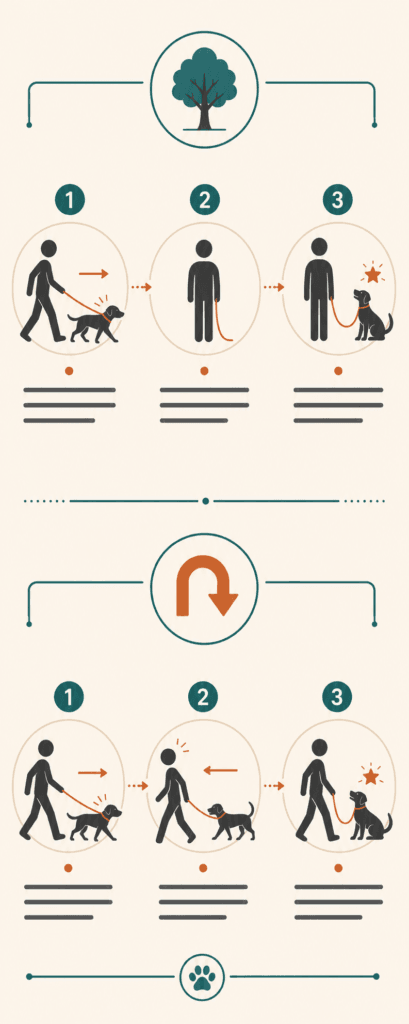
“Be a Tree” is exactly what it sounds like: the moment your dog pulls, you stop dead and wait, arms close to your body, saying nothing. No pulling back, no yanking, just stillness until your dog offers slack. This works because it removes the reinforcement pulling normally provides (forward motion) without adding any punishment: the walk simply pauses until the dog chooses differently.
Reverse direction training goes a step further: the instant your dog forges ahead, calmly turn and walk the opposite way. Your dog quickly learns that pulling ahead doesn’t get them anywhere, it actually costs them ground, since the walk is now heading the other direction entirely. Many trainers use these two techniques interchangeably depending on the situation: “Be a Tree” works well in open space, while reverse direction can be more practical on a narrow sidewalk.
Section 5: Adding Distractions Gradually
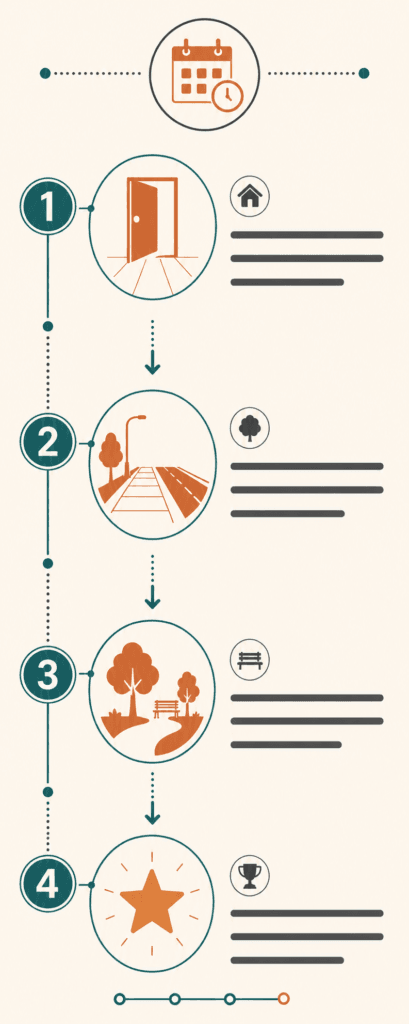
Once your dog is reliably loose-leash walking in a quiet space, the next step is deliberately increasing difficulty in small increments: a slightly busier street, then a park with other people at a distance, then closer proximity to mild distractions. Jumping straight from a quiet backyard to a crowded farmers market is a common reason owners feel like the training “stopped working”: the skill was never actually proofed against that level of distraction yet.
- Week 1–2: quiet hallway or backyard only
- Week 2–3: quiet street, low foot traffic, minimal other dogs
- Week 3–4: moderate distractions: a park with people around, but not directly engaging your dog
- Month 2+: busier environments, other dogs at closer range, real-world unpredictability
A Realistic Example: What Week One Actually Looks Like
To make this concrete: imagine a one-year-old Labrador who’s never had any leash training. Day one in the hallway might involve twenty or more stop-and-wait repetitions in a ten-minute session, with the dog only managing a few steps of slack at a time before hitting the end of the leash again. That’s not a bad start: that’s exactly what learning looks like in progress. By day four or five, the same dog is often covering the same hallway distance with only two or three stops. By the end of week one, many owners report their dog starting to glance back periodically before the leash even goes tight, which is an early sign the new default is taking hold.
The pace above is a typical example, not a guarantee, some dogs, especially those with months or years of reinforced pulling behind them, take meaningfully longer. The trajectory (frequent stops early on, gradually spacing out) is the pattern to watch for, more than the exact number of days.
Section 6: Troubleshooting Reactive or Overexcited Dogs
If your dog’s pulling is driven by excitement or fear toward specific triggers, other dogs, bikes, strangers, straight loose-leash technique alone often isn’t enough, because the pulling is emotional, not just habitual. That situation needs a slightly different toolkit focused on distance and desensitization, since asking a dog to walk politely while emotionally over threshold rarely succeeds no matter how good the mechanical technique is.
A useful way to tell the difference: habitual pullers generally settle back into a loose leash within a few seconds once you stop moving, while emotionally-driven pullers often stay fixated, vocalize, or escalate even after you’ve stopped. If you’re seeing the second pattern consistently, it’s worth addressing the emotional response directly before expecting the mechanical loose-leash method to hold up around that specific trigger.
Our Leash Reactivity 101 guide covers that distance-and-desensitization approach in full.
Section 7: Signs Your Training Is Actually Working
Progress on loose-leash walking can be gradual enough that it’s hard to notice day-to-day, so it helps to know what early wins actually look like rather than waiting for a perfect walk to feel like success.
- Your dog checks in with you periodically without being asked: a glance back, a slight pause
- The leash goes tight less often, even if it’s not yet consistently loose the entire walk
- Recovery time after a distraction gets shorter, your dog refocuses on you faster than it used to
- You notice yourself relaxing your grip, because you’re not bracing for a pull as often
These smaller signals usually show up well before a walk feels completely transformed, and they’re worth celebrating as genuine progress rather than waiting for perfection before feeling like the method is working.
Section 8: Common Setbacks and How to Handle Them
Progress on loose-leash walking is rarely a straight line. A dog who’s doing beautifully in week two might suddenly seem to forget everything in week three: this is normal and usually tied to a new environment, a change in routine, or simply a particularly exciting day (a squirrel, an unfamiliar dog, a new smell). Rather than assuming the method has failed, treat a bad walk as a signal to temporarily dial back distraction level, not abandon the approach.
- If pulling suddenly reappears after being resolved, check for a new variable, new route, new season, new distraction, rather than assuming a full regression
- If your arm is tired and you’re tempted to just let your dog drag you the last stretch home, resist it, every ‘give in’ moment reinforces pulling and slightly undoes recent progress
- If multiple family members walk the dog, make sure everyone uses the same technique, inconsistency between walkers is one of the most common reasons training stalls
Section 9: How Long Does It Take?
Most dogs show noticeable improvement within 2–3 weeks of consistent daily practice, though full reliability in high-distraction environments (busy streets, other dogs) can take a couple of months. Consistency matters more than duration, five focused minutes daily outperforms one long weekly session every time.
FAQ: Honest Answers to Real Leash Walking Questions
“Do I need a special leash?”
A standard 4–6 foot leash works best, retractable leashes actively work against this training since they reward pulling with more leash length.
“What if my dog just sits down and refuses to move?”
This is common with sensitive or anxious dogs. Reward any small forward movement rather than waiting for full compliance, and check that the environment isn’t simply too overwhelming for this stage.
“Can I still let my dog sniff on walks?”
Absolutely, build in dedicated ‘sniff breaks’ with a release cue, so your dog learns there’s a difference between structured walking time and free exploration time.
“How tight should a front-clip harness fit?”
You should be able to fit two fingers flat between the straps and your dog’s body at every point, snug enough to prevent slipping, loose enough not to restrict movement.
“My dog pulls even with a front-clip harness. What am I doing wrong?”
The harness alone doesn’t train anything, it just changes the physics. Pair it with the step-by-step method and the stop-and-wait technique above. The harness and the training method together produce results; either alone produces limited change.
“Should I train loose-leash walking on both sides, or just one?”
Most owners only need one consistent side (traditionally the left), but if you want flexibility for running or crowded environments, it’s worth briefly practicing both.
“Is it normal for progress to be faster with a puppy than an adult dog?”
Yes, puppies haven’t practiced pulling for years yet, so there’s less established habit to unwind. Adult dogs can absolutely learn this too; it just may take a bit longer.
“Does dog size make loose-leash training harder or easier?”
Larger, stronger dogs make pulling more physically taxing for the owner, but the training method itself doesn’t change based on size: the harness recommendation matters more for bigger dogs, since mechanical advantage becomes a bigger factor.
“What if my dog walks perfectly at home but pulls the second we hit the street?”
This is extremely common and just means the behavior hasn’t been proofed in a more distracting environment yet, go back to a lower-distraction version of that same environment (a quiet driveway before a busy sidewalk) rather than assuming the training failed.
Your 2026 Loose-Leash Walking Starter Kit
Here’s what you need and what to spend: a front-clip harness ($15–40 depending on tier), a standard 4–6 foot leash, high-value treats for the first few weeks, and 10–15 minutes a day of focused practice. Skip the retractable leash entirely while you’re building this habit, you can reintroduce more freedom-of-movement tools later, once loose-leash walking is fully established.
| Download the Free Training Gear ChecklistWant a printable checklist covering harness fit, leash length, and the full loose-leash training schedule? Enter your email below and we’ll send it straight to your inbox. |
If your dog is fine on a loose leash but tenses up or lunges specifically around other dogs or fast movement, that’s a different problem to solve. Our guide to managing a reactive dog covers the distance-based approach that works alongside these walking basics.
Resources & Series Links
Positive Reinforcement 101 Series
Where to Buy (Affiliate Links)
- Amazon, Widest harness selection, best for comparing prices quickly.
- Chewy, Good for auto-ship on leashes and accessories.
Recommended Brands to Explore