

This Isn’t Just “The Nice Way to Train.” It’s Backed by Decades of Research.
“Positive reinforcement is just the nice way to train” is a common assumption, and it undersells what’s actually going on. This isn’t a philosophy or a trend; it’s an application of operant conditioning, one of the most extensively studied areas in behavioral science, with a growing body of dog-specific research backing it up directly.
This guide walks through the foundational science, traces exactly where the popular but incorrect “dominance” model came from, reviews the specific studies comparing training methods head-to-head, and gives you a clear, evidence-based way to explain all of this to someone who’s still skeptical.
What’s Covered in This Article
- Section 1: Operant conditioning: the foundation. Why timing and consistency matter scientifically
- Section 2: The alpha/dominance myth: where it came from, and why it’s wrong. Why the myth persisted so long
- Section 3: What the research shows about aversive vs. reward-based training
- Section 4: Does punishment actually work faster? What the data says
- Section 5: Why this matters beyond ‘being nice’
- Section 6: What professional organizations say
- Section 7: How to explain this to skeptics
Section 1: Operant Conditioning, The Foundation
The core framework behind all reward-based training traces back to B.F. Skinner’s research on operant conditioning in the mid-20th century: behaviors followed by a rewarding consequence are more likely to be repeated, while behaviors followed by an unpleasant consequence tend to be suppressed, though suppression isn’t the same as teaching an alternative. Punishment can stop a behavior in the moment without ever teaching the dog what to do instead.
Operant conditioning identifies four basic mechanisms: positive reinforcement (adding something good to increase a behavior), negative reinforcement (removing something unpleasant to increase a behavior), positive punishment (adding something unpleasant to decrease a behavior), and negative punishment (removing something good to decrease a behavior). Modern reward-based dog training relies primarily on the first mechanism and occasionally the last, deliberately avoiding the addition of unpleasant consequences wherever possible.
It’s worth being precise about terminology here, since “positive” and “negative” in this framework don’t mean “good” and “bad”, they mean “adding” and “removing.” A common confusion is assuming positive reinforcement simply means “nice training” in a general sense, when it specifically refers to this one quadrant: adding a desirable consequence immediately following a behavior, which increases the likelihood of that behavior happening again.
Why Timing and Consistency Matter Scientifically
Two additional findings from operant conditioning research directly shape how effective reward-based training is in practice: the timing of the reinforcement, and the consistency of its delivery. Reinforcement delivered within roughly half a second to two seconds of the target behavior is dramatically more effective at building a clear association than reinforcement delivered even a few seconds later: this is the entire reason marker words and clickers exist, since they bridge that timing gap by marking the exact moment a treat is coming, even if the treat itself takes a moment longer to arrive.
Consistency matters similarly: a behavior reinforced unpredictably during the learning phase (rather than the maintenance phase covered elsewhere in this series) tends to be learned more slowly and with more variability than one reinforced every time while it’s still new. This is why professional trainers distinguish clearly between the learning phase of a new behavior (where continuous reinforcement is appropriate) and the maintenance phase of an already-learned behavior (where variable reinforcement becomes appropriate instead).
Section 2: The Alpha/Dominance Myth, Where It Came From, and Why It’s Wrong
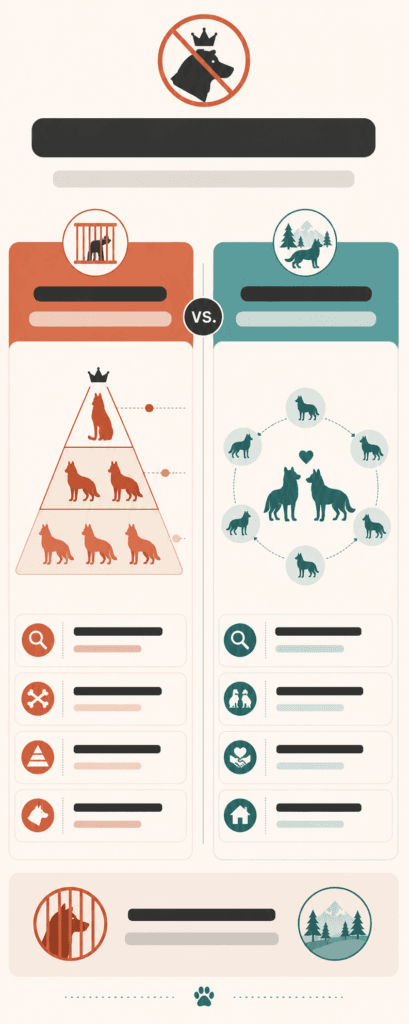
Much of “dominance-based” training traces back to captive wolf studies from the mid-20th century, which observed unrelated wolves forced together in captivity forming a strict, often aggressive hierarchy. Later research on wild wolf packs, most notably by biologist L. David Mech, found that natural wolf packs actually function as family units led by breeding parents, not as unrelated animals fighting for dominance. Mech himself publicly moved away from applying “alpha” terminology once this became clear.
The dominance model that shaped decades of dog training advice was built on a flawed premise from the start: captive, unrelated wolves under stress don’t behave the same way wild family groups do, and dogs themselves are not wolves, thousands of years of domestication have shaped meaningfully different social behavior even where ancestral parallels exist. Two separate layers of the original argument turned out to be shaky: the wolf-pack model itself was based on an unnatural captive situation, and dogs don’t map directly onto wolf behavior anyway.
Why the Myth Persisted So Long
Popular ideas can outlast their scientific basis for a long time, especially when they’re intuitive and widely repeated in mainstream media. “Dominance” as a framework offered a simple, appealing explanation for confusing behavior: a dog pulling on the leash or jumping on furniture could be framed as “testing who’s in charge,” which felt satisfying even though it wasn’t an accurate description of what was actually happening functionally.
The correction within the scientific and professional training community happened well before it filtered into mainstream awareness, which is common with behavioral science generally, academic consensus typically shifts years before popular understanding catches up. This gap is part of why so much dominance-based advice is still circulating in casual conversation and older training books, even though the professional consensus moved past it some time ago.
Section 3: What the Research Shows About Aversive vs. Reward-Based Training
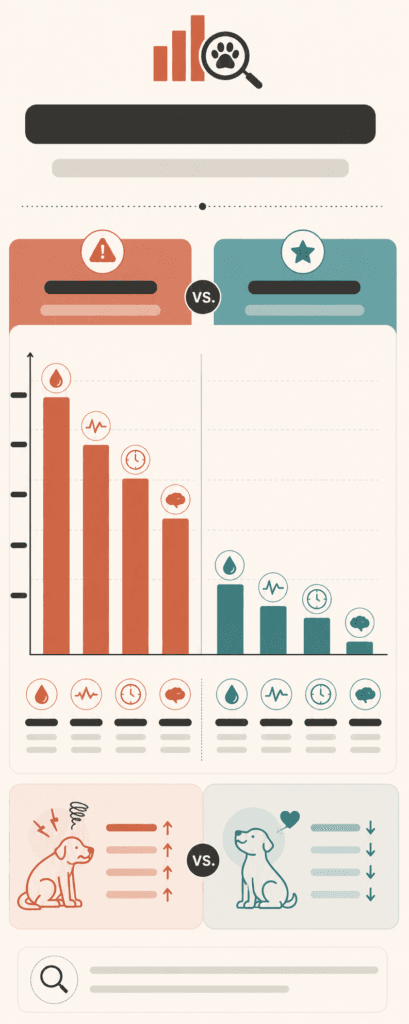
A widely cited 2020 study published in PLOS ONE (Vieira de Castro et al.) compared companion dogs trained with aversive methods against those trained with reward-based methods, and found the aversive-trained group showed measurably higher cortisol increases after training sessions, along with more stress-related behaviors such as lip-licking, panting, and lowered body posture.
A related study from the same research group found dogs trained with aversive methods showed more pessimistic responses in a cognitive bias test, essentially, a more anxious outlook, compared to reward-trained dogs. Cognitive bias testing works by training an animal to associate one location with something positive and another with something neutral or negative, then observing how the animal responds to an ambiguous, in-between location; animals in a more anxious or pessimistic state tend to treat the ambiguous stimulus as more likely to be negative.
Separately, research from Cooper et al. (2014) on training with and without remote electronic collars found reward-based training achieved comparable or better efficacy on measures like response speed, without the associated welfare costs.
Taken together, these studies point toward a consistent pattern across multiple independent research groups: aversive methods carry measurable welfare costs, physiological stress markers, behavioral stress signals, and shifts toward more pessimistic emotional states, without a corresponding, reliable advantage in training outcomes to justify that cost. This convergence across separate studies, using different methodologies and measuring different things, is part of why the findings are taken seriously in the professional behavior community rather than dismissed as a single study’s limitation.
Section 4: Does Punishment Actually Work Faster? What the Data Says
A common assumption is that corrections simply get faster results, even if they’re less pleasant for the dog. The research doesn’t support this trade-off as clearly as popular belief suggests. In several comparative studies, reward-based training groups matched or outperformed aversive-trained groups on measures like obedience task completion and response latency, without the accompanying stress indicators.
Part of the explanation may be that aversive methods can suppress a wider range of behavior than intended, including behaviors the dog would otherwise offer while trying to figure out what’s being asked. A dog operating under stress or uncertainty about what triggers a correction sometimes becomes more hesitant to offer any behavior at all, which can look like slower learning even when compared to a reward-based dog actively experimenting to find the rewarded response.
There’s also a selection and reporting consideration worth being aware of: much of the available research relies on dogs already living in homes using one method or another, rather than randomly assigning dogs to training approaches from scratch. This means some caution is warranted in interpreting causation versus correlation, but the convergence of findings across multiple studies with different designs strengthens confidence that the pattern is real rather than a single study’s artifact.
Section 5: Why This Matters Beyond ‘Being Nice’
- Lower stress during training is linked to better learning and retention, not just better welfare
- Dogs trained with aversive methods have shown more pessimistic, fear-based responses that can generalize beyond the training context
- Positive reinforcement builds an association between the owner and safety/reward, which supports the human-dog bond long-term
There’s also a practical household argument worth making to skeptics: a dog who associates training sessions with something enjoyable is simply easier to live with day to day, more willing to engage, less anxious around handling, and generally more resilient in novel situations. This isn’t just an ethical argument, it’s a quality-of-life argument for both the dog and the owner.
Section 6: What Professional Organizations Say
Major veterinary and animal behavior organizations have increasingly published formal position statements favoring reward-based training and cautioning against aversive methods, reflecting the accumulated research above. These statements typically cite both welfare concerns and the lack of clear efficacy advantage for aversive techniques as the basis for their recommendations.
This kind of organizational consensus tends to develop gradually as evidence accumulates across many independent studies rather than resting on any single piece of research: which is part of why it carries weight in conversations with skeptics. It reflects a broad professional judgment call, not one advocacy group’s preference.
If you’re building a case with a skeptical family member, pointing to a named professional organization’s position statement often carries more weight than a general appeal to kindness, it reframes the conversation from “my personal preference” to “the current professional consensus.” The American Veterinary Society of Animal Behavior’s position statement on humane dog training is a good one to point to directly, since it names the specific research this consensus is built on.
Section 7: How to Explain This to Skeptics
Many people default to older training advice simply because it’s what they grew up with, not because they’ve seen the research. Framing positive reinforcement as evidence-based, not just “the gentle option”, tends to land better with skeptical family members than an appeal to kindness alone.
- Lead with the outcome data, not just the welfare argument, comparable or better results with less stress is a compelling combination
- Address the “old dog new tricks” and “bribery” objections directly, since these are the two most common pushbacks
- Offer to demonstrate rather than just explain: a short, visible training session often does more convincing than any amount of discussion

It also helps to acknowledge genuine common ground rather than framing the conversation as one side being simply wrong. Most skeptics of positive reinforcement aren’t opposed to their dog being happy, they’re often worried about permissiveness, or genuinely believe corrections are more effective based on what they’ve seen work in the past. Meeting that concern directly (“this isn’t about permissiveness, it’s about a different mechanism for building reliable behavior”) tends to be more persuasive than treating the disagreement as purely about kindness versus cruelty.
5 Reasons PR Works Better Than Punishment
FAQ: Honest Answers to Real Questions About the Research
“Is positive reinforcement slower than correction-based training?”
Research doesn’t generally support this, reward-based methods have shown comparable or faster acquisition of behaviors in multiple studies, without the welfare costs of aversive methods.
“Does this mean punishment never works?”
Punishment can suppress a behavior, but it doesn’t teach an alternative and carries welfare risks that reward-based methods don’t: which is why professional behavior organizations widely recommend reward-based approaches as the standard.
“Where can I read the original research?”
The primary study referenced here is Vieira de Castro et al., 2020, PLOS ONE, and it’s open-access, so you can read the full methodology and results yourself.
“Is the ‘alpha wolf’ theory completely disproven?”
The specific dominance-hierarchy model from captive wolf studies has been widely corrected by subsequent wild-pack research, though debate continues in some corners of the training world: the scientific consensus has shifted substantially away from it.
“Do professional organizations have an official position on this?”
Yes. The American Veterinary Society of Animal Behavior’s position statement on humane dog training is the most frequently cited example, and it explicitly recommends reward-based methods for all dog training, including behavior problems.
“What is cognitive bias testing, and why does it matter here?”
It’s a method researchers use to infer an animal’s emotional state indirectly, by seeing how they interpret ambiguous situations. A more “pessimistic” interpretation pattern is associated with poorer welfare, which is why its use in training-method comparisons is considered meaningful evidence rather than just a curiosity.
“Does breed affect how much these findings apply?”
The core learning mechanisms studied apply across breeds, though individual temperament and breed-typical sensitivity levels can affect how strongly a dog reacts to aversive methods specifically, some breeds and individuals show stress responses more visibly than others, but the underlying welfare concern is not breed-specific.
“Why do some trainers still use aversive methods if the research favors reward-based training?”
Reasons vary, some trainers were educated before this research became widely available, some work with clients seeking fast fixes over process, and some genuinely disagree with how the research is interpreted. The professional consensus has shifted, but individual practice doesn’t always shift at the same pace as the underlying evidence.
“Is there research specifically on children’s involvement in positive reinforcement training?”
Less directly, though the general principles of clear timing and consistent reinforcement apply regardless of who is delivering it, supervised, age-appropriate involvement can be a valuable way for children to build a positive relationship with a family dog using the same evidence-based methods.
“How confident should I be that this research applies to my specific dog?”
Group-level research findings describe averages and tendencies across many dogs, not guarantees for any individual animal, but the consistency of findings across multiple independent studies gives reasonable confidence that the general pattern (reward-based methods matching or exceeding aversive methods without the stress costs) applies broadly across the dog population.
The Bottom Line
Positive reinforcement isn’t a trend or a soft option, it’s the method with the evidence behind it. If you’re building the case for this approach with a skeptical friend or family member, this is the article to send them.
None of this research suggests training has to be effortless or that positive reinforcement guarantees instant results, it simply shows that the reward-based approach doesn’t trade away effectiveness for kindness. You genuinely can have both, which is precisely why this method anchors everything else in this series.
As with any area of behavioral science, research continues to evolve, and specific findings may be refined or expanded over time. The broad pattern across the studies referenced here, however, has held up consistently across multiple independent research groups, which is about as strong a form of evidence as this kind of applied behavioral research typically produces.
| Download the Free 5-Step Positive Reinforcement Starter KitWant to put the research into practice? Enter your email below and we’ll send our Starter Kit straight to your inbox. |
Resources & Series Links
Positive Reinforcement 101 Series