

You Started with a New Dog and a Lot of Questions. Here Are the Answers.
You brought home a new puppy or a rescue dog. You were excited and nervous. You knew you wanted to train with kindness, but you weren’t sure where to start, what to buy, or who to trust. You probably Googled “best dog training method” and got 47 conflicting opinions.
Over the last 11 articles, this series has covered everything: why positive reinforcement works, what gear to buy (and what to avoid), how to teach first commands, what motivates different dogs, how to solve common behavior problems, how to navigate seasonal challenges, how to build sustainable training routines, and how to stay consistent with free printable tools. This is the complete summary. Bookmark this page. Share it with a fellow first-time owner. Everything you need is right here.
| �� Table of Contents Section 1: Best Positive Reinforcement Tools for Beginners (12 Products, 4 Categories) Section 2: Everything I Learned in 90 Days (7 Key Takeaways) Section 3: The 5 Tools I Actually Use on My Own Dog (Real Routine) Section 4: Which Training Method Is Right for Your Dog? (4 Questions) Section 5: 12 Most-Asked Questions Answered (Complete FAQ) Section 6: The Beginner’s Complete Guide (7 Chapters Summary) Section 7: My Top 4 Positive Reinforcement Starter Kits (All Budgets) Each section stands alone. Jump to what you need right now. |
| SECTION 1: Best Positive Reinforcement Tools for Beginners 12 Products Across 4 Categories, Tested, Ranked, Honest |
You don’t need 50 things. You need 5-7 core items that do specific jobs reliably. These 12 recommendations are distilled from 11 articles, 90 days of real-world testing, and significant personal expense. Full reviews are linked for each category.
Category 1: Treat Pouches
Seethe 90-Day Treat Pouch Testfor the full 90-day methodology. SeeBudget vs. Premium Dog Training Gearfor the complete price comparison.
| Product | Price | Best For | Link |
| Best Overall Magnetic Pouch | $20–30 | Daily training, most first-time owners | |
| Best Budget Magnetic Pouch | $10–15 | Beginners, tight budget, occasional training | |
| Best Convertible Pouch | $15–20 | Walk + train simultaneously, phone carriers |
Category 2: Training Treats
SeeThe Beginner’s Toolkitfor treat sizing, calorie math, and rotation strategy.
| Product | Price | Best For | Link |
| Boiled Chicken Breast (DIY) | $3–5/week | Highest value for any dog, any scenario | DIY, boil plain, shred, refrigerate |
| Freeze-Dried Liver (PureBites) | $8–12 | Distracted puppies, picky eaters | |
| Zuke’s Mini Naturals | $6–8 | Everyday home training, convenient |
Category 3: Training Tools
SeeThe Beginner’s Toolkitfor clicker setup andthe 90-Day Treat Pouch Testfor the long line underrated tool section.
| Product | Price | Best For | Link |
| Standard Box Clicker | $2–5 | Precision marking, most beginners | |
| Long Line Leash (15–30 ft) | $10–20 | Recall training, distance work, nervous dogs | |
| Front-Clip Harness | $20–30 | No-pull walking, daily use |
Category 4: Enrichment
SeeDaily Training Routinesfor the hyperactive dog enrichment protocol andSeasonal & Situational Dog Trainingfor frozen Kong uses.
| Product | Price | Best For | Link |
| Kong Classic (Stuffable) | $8–15 | Frozen treats for alone time, crate training | |
| Snuffle Mat | $15–25 | Nose work, mental stimulation, calming | |
| Flirt Pole | $10–20 | High-energy dogs, prey drive, impulse control |
The ‘Buy This, Not That’ Summary:
- Buy a magnetic treat pouch ($12–25). Not velcro or zipper.
- Buy boiled chicken or freeze-dried liver. Not hard/crunchy treats.
- Buy a front-clip harness ($20–30). Not a back-clip for pulling dogs.
- Buy a long line leash ($10–20). Not a retractable leash (actively dangerous).
- Buy a box clicker ($2–5) or use your voice. Not an overpriced electronic trainer.
| SECTION 2: 7 Key Takeaways from 90 Days of Positive Reinforcement Training The most important lessons distilled from the full series |
| Takeaway #1: Consistency Beats Intensity Two minutes of training every day produces better results than 30 minutes once a week. Dogs learn through repetition across time, not marathon sessions. Short, frequent sessions respect your dog’s attention span and build habits in both of you. If you can only commit to one principle from this entire series, make it this one. |
| Takeaway #2: Your Dog’s Currency Is Unique Some dogs would sell you out for a piece of chicken. Some go completely haywire for a tennis ball. Some just want you to tell them they’re good. Using the wrong reinforcer is the most overlooked reason training stalls. Do the Reinforcer Test (Article 5, Section 4) to find what truly motivates your specific dog before spending a week wondering why sessions aren’t landing. |
| Takeaway #3: Punishment Suppresses, It Doesn’t Teach Yelling, leash pops, and alpha rolls stop a behavior temporarily, while your dog is watching and while the consequence is present. But they don’t teach what TO do instead. And they have documented side effects: increased anxiety, increased aggression, learned helplessness, and a damaged relationship. If a training method is safe and effective without punishment, there is no reason to add punishment. |
| Takeaway #4: Set Up for Success, Don’t Test Your Dog A dog who fails at the park isn’t stubborn. They haven’t been prepared for that environment yet. Training is about setting up situations where your dog can succeed, not testing how well they perform under difficult conditions. Every time your dog succeeds and gets rewarded, the behavior strengthens. Every time they fail with no guidance, you lose ground. |
| Takeaway #5: Gear Matters Less Than You Think A $12 magnetic pouch works almost as well as a $50 professional bait bag. Boiled chicken (cost: $3/week) outperforms most $15 premium treat bags for training motivation. Your timing, your consistency, and your relationship with your dog matter exponentially more than your equipment budget. Buy the minimum viable gear and spend your energy on showing up daily. |
| Takeaway #6: Regressions Are Normal, Not Failure Your dog will forget things during adolescence. After moves. During the holidays. In summer heat. After you return from a week-long vacation. That is not failure: that is being a dog. The response to regression is always the same: go back to basics, lower your expectations in the new context, and rebuild. Regression is information, not a verdict. |
| Takeaway #7: Your Relationship Is the Goal Training isn’t about obedience. It’s about communication. A dog who trusts you wants to work with you. A dog who fears you will comply when you’re watching and ignore you when you’re not. Every treat you give at the right moment, every patient redirection, every session that ends with a win, these build a relationship that makes every subsequent training session easier and every moment of daily life together more joyful. |
| SECTION 3: The 5 Training Tools I Actually Use on My Own Dog No product recommendations I’ve never personally used |
I’ve tested more products than I can count. Most of them are sitting in a drawer or donated. Here are the 5 I reach for every single day, and exactly why.
Tool #1: Magnetic Treat Pouch ($20-30)
- Why I use it: Fast one-handed access (magnetic closure), waterproof liner means no smell after a week of chicken, belt clip stays secure through running and crouching
- Where it lives: Clipped to my belt loop from the moment I wake up until I go to sleep on training days
Tool #2: Boiled Chicken Breast (Weekly Prep, ~$3-4)
- Why I use it: My dog’s hierarchy of reinforcement: 1st chicken, 2nd chicken, 3rd also chicken. Highest value at the lowest cost. Nothing commercial competes in high-distraction environments.
- How I prep: Two chicken breasts every Sunday, boiled plain, shredded into pea-sized pieces, stored in a sealed container in the fridge. Lasts 5 days.
Tool #3: Wrist Clicker ($5-8)
- Why I use it: Always on my wrist, I literally cannot forget it. Consistent click sound regardless of my mood or tone of voice. Faster marking than my vocal reaction time on average.
- Alternative: Marker word “Yes!” works equally well for most owners. Start with your voice, add a clicker when you want more precision.
Tool #4: 15-Foot Long Line Leash ($15)
- Why I use it: Recall practice outdoors without risk of runaway. Distance command proofing (sit from 12 feet). Building confidence in nervous rescue dogs by giving them freedom to choose their distance from things.
- How I use it: I let it drag. Never wrapped around my hand. Step on it to stop forward movement gently when needed.
Tool #5: Frozen Kong ($10)
- Why I use it: Counterconditioning alone time, my dog gets the frozen Kong exclusively when I leave the house. After 3 weeks, she walks to her crate voluntarily when she sees me picking up my bag.
- How I prep: Fill with wet food mixed with peanut butter (xylitol-free). Freeze overnight. Takes 30 seconds of prep.
| Total cost of this entire kit: under $100 across everything listed. These 5 tools cover 100% of my daily training, management, recall work, and enrichment needs. I haven’t needed anything else. |
| SECTION 4: Which Training Method Is Right for Your Dog? 4 Questions That Identify Your Optimal Approach |
Positive reinforcement is the method. But the strategy within that method varies significantly by dog. Answer these 4 questions to find your specific approach.
Question #1: What motivates your dog most?
- Treats Use food-based positive reinforcement as your primary tool. All 11 articles apply directly.Treats vs. Toys vs. Praise
- Toys Use toy play as your primary reinforcer for known behaviors and as a jackpot for hard work.the Toy-Motivated section of Treats vs. Toys vs. Praise
- Praise You have a rare, wonderful dog. Use enthusiastic praise as primary, treats as occasional jackpots.the Praise-Motivated section of Treats vs. Toys vs. Praise
- Nothing yet Upgrade your treats to boiled chicken, train before meals, and reduce distractions. Every dog is motivated by something, you haven’t found it yet.
Question #2: What is your dog’s energy level?
- Low energy (mostly naps) Short sessions, high reward value, reward calm behavior generously.Daily Training Routines
- Average energy (typical family dog) 5-10 minute sessions, mix of treats and play, the 5-Minute Morning Routine works well.Daily Training Routines
- High energy (working or sport breed) Exercise before training, use toys as reinforcers, prioritize impulse control games.the Hyperactive Dog section of Daily Training Routines
- Hyperactive (seems non-stop) Flirt pole, snuffle mat, puzzle toys, nose work, physical AND mental stimulation together.the Hyperactive Dog section of Daily Training Routines
Question #3: What is your dog’s fear or anxiety level?
- Confident and social Standard positive reinforcement works great. Proceed at a normal pace.
- Moderately anxious (startles, avoids some things) Go slower, higher treat value, build confidence with easy wins first.Daily Training Routines
- Severely fearful (rescue with trauma, hides, shakes) Never use punishment of any kind. Consult an IAABC behavior consultant before starting formal training. Go entirely at your dog’s pace.Solving Common Behavior Problems
Question #4: What does your actual schedule look like?
- Under 5 minutes/day The Minimalist Routine: name recognition + sit + leave it. 23 minutes per week total.the Minimalist Routine in Daily Training Routines
- 15 minutes/day 5-Minute Morning Routine + evening walk training. Working owner plans available.Daily Training Routines
- 30+ minutes/day Weekly Balanced Routine: training sessions + play sessions + outdoor adventure + rest day.Daily Training Routines
- Unpredictable schedule Capture training: reward behaviors your dog offers naturally throughout the day (sit voluntarily mark and treat). No formal schedule required.
The Recommendation Matrix:
| If You Have… | Start With… |
| Treat-motivated dog + busy owner | Minimalist Routine (Article 8) + treat pouch + boiled chicken |
| Toy-motivated dog + high-energy | Toy reinforcers + flirt pole + impulse control games (Articles 5 & 8) |
| Fearful rescue dog + patient owner | Slow desensitization + high-value treats + safe space (Article 7) |
| Average dog + average schedule | 5-Minute Morning Routine + Weekly Balanced Schedule (Article 8) |
| SECTION 5: 12 Most-Asked Questions Answered Complete positive reinforcement FAQ for first-time owners |
Q1: Is positive reinforcement really enough for stubborn dogs?
Yes. “Stubborn” almost always means the reinforcer isn’t motivating enough for the environment you’re training in, or the environment is too distracting for your dog’s current skill level. Upgrade treats, reduce distractions, and go slower. “Stubborn” is a story about the human’s approach, not the dog’s character.5 Reasons Positive Reinforcement Works Better Than Punishment
Q2: How do I phase out treats without losing my dog’s attention?
Shift to variable (intermittent) reinforcement, reward every 2nd success, then every 3rd, then randomly. Add life rewards (sit before going outside, down before dinner). Use toys and praise as occasional jackpots. Variable reinforcement is actually more resistant to extinction than consistent treating.Variable Reinforcement Schedules
Q3: My dog ignores treats outside. What do I do?
Your treats aren’t high-value enough for that distraction level. Upgrade immediately: if kibble was working at home, use soft commercial treats outside. If commercial treats were working outside, use boiled chicken. Additionally, practice the Engagement Walk: reward every voluntary glance at your face during the walk.Loose-Leash Walking with Positive Reinforcement
Q4: My dog knows ‘sit’ at home but ignores me at the park. Why?
Dogs don’t generalize well. A behavior trained at home is neurologically a different response than the same behavior in a new environment. You need to re-teach ‘sit’ in the park starting from the lure, in a quiet corner with high-value treats, before expecting reliability in that context. This isn’t regression, it’s how learning works.First Commands & Daily Routines
Q5: Is it ever okay to say ‘no’?
Yes, as an interrupter, not a punishment. “No” said calmly and immediately, followed by a redirect and reward for the correct behavior, is a useful communication tool. “No” screamed at a dog after the fact teaches nothing except that you’re unpredictable. The difference is timing and tone.First Commands & Daily Routines
Q6: How long until I see results?
Simple behaviors (sit, name recognition): 3-7 days. Complex behaviors (recall in distraction, loose-leash walking): 4-6 weeks. Behavior problems (biting, jumping): 2-4 weeks with consistency. Relationship-level trust (a fearful rescue choosing to approach you): weeks to months. These are realistic timelines, not promises, every dog learns at a different pace.Puppy vs. Adult Dog Training
Q7: My dog is 5 years old. Is it too late to start positive reinforcement?
Not even close. Adult dogs often train faster than puppies because they can focus longer and aren’t distracted by everything. The brain’s plasticity for learning new behaviors doesn’t decline significantly until very old age. Your 5-year-old dog is absolutely trainable. Start today.5 Reasons Positive Reinforcement Works Better Than Punishment
Q8: What’s the best treat pouch for beginners in 2026?
The $20-30 magnetic closure pouch with a waterproof liner. Don’t buy velcro (fails in days), zippers (too slow), or anything over $35 (unnecessary features for beginners). The $12 budget magnetic pouch is fine for occasional training; upgrade to the waterproof liner version if you train daily.the 90-Day Treat Pouch Test
Q9: How many treats can I give my puppy in one day?
Training treats should not exceed 10% of total daily caloric intake. For small dogs (under 15 lbs): 10-15 training treats. Medium dogs (15-40 lbs): 15-25. Large dogs (40+ lbs): 20-30. If you train multiple sessions, subtract training treat calories from regular meals to keep total intake balanced.First Commands & Daily Routines
Q10: What’s the difference between a clicker and a marker word?
Clicker: consistent mechanical sound regardless of mood, very fast (under 0.1 seconds), must carry it. Marker word (“Yes!”): always with you, can vary in tone, equally effective with practice. Start with your voice. Add a clicker if you want more precision, train two dogs, or if precision shaping interests you.The Beginner’s Toolkit
Q11: How do I train when I’m exhausted or sick?
You don’t. A sick or exhausted owner has imprecise timing, thin patience, and high frustration risk, all of which produce poor training sessions that can undo recent progress. Rest. Give your dog a frozen Kong or puzzle toy for mental stimulation. One day off will not cause regression. A bad training session might.Daily Training Routines
Q12: What’s the one thing I should NEVER do?
Never punish fear. Don’t yell at, physically correct, or force a scared dog to “face their fears.” Fear is not a choice and cannot be punished away. The inevitable outcomes are: the behavior escalates, the dog shuts down, or they redirect aggression. Comfort your scared dog. You cannot reinforce fear by offering safety.Solving Common Behavior Problems
| SECTION 6: The Beginner’s Complete Guide: 7 Chapters The full 11-article series summarized as a book |
If you’re new here and want to read the series from the beginning, here’s how it’s structured. Each chapter links to the full article for the deep dive.
This isn’t just our own preference. The American Veterinary Society of Animal Behavior recommends reward-based methods for all dog training, based on the accumulated evidence that they’re both more effective and lower-risk than corrections-based approaches.
| Chapter 1: Why Positive Reinforcement Works �� Key takeaway: Punishment suppresses behavior temporarily. Positive reinforcement changes behavior permanently. Trust is the foundation of all training. �� Full article:“5 Reasons Positive Reinforcement Works Better Than Punishment” |
| Chapter 2: Essential Tools & Setup �� Key takeaway: You need 5-7 core items: treat pouch, high-value treats, marker, front-clip harness, long line leash, and enrichment toys. Everything else is optional. �� Full articles:Essential Toolkit|Gear Reviews|Budget vs. Premium |
| Chapter 3: First Commands & Daily Routines �� Key takeaway: Start with name recognition and sit. Use the 5-Minute Morning Routine. Follow the 3-Treat Rule. Consistency beats intensity, always. �� Full articles:First Commands|Daily Routines |
| Chapter 4: Understanding Your Dog’s Motivations �� Key takeaway: Find your dog’s currency (treats, toys, or praise) using the 3-bowl Reinforcer Test. Match your reinforcer to your dog’s personality, not a generic recommendation. �� Full article:“Treats vs. Toys vs. Praise: What Really Motivates Your Dog?” |
| Chapter 5: Solving Common Behavior Problems �� Key takeaway: Puppy biting, leash pulling, separation anxiety, housebreaking, fireworks fear, deaf dog training, and nervous rescue dogs all have positive, force-free solutions. �� Full articles:Behavior Problems|Seasonal & Situational|Leash Reactivity(Seasonal & Situational) |
| Chapter 6: Seasonal & Life Transitions �� Key takeaway: Prepare in advance for every challenge: summer heat, winter cabin fever, holidays, moving, fireworks, back-to-work, and road trips. Regression is normal. Go back to basics. �� Full article:“Seasonal & Situational Dog Training”, ‘Seasonal & Situational Dog Training’ |
| Chapter 7: Staying Consistent (Printables & Tracking) �� Key takeaway: Printables close the gap between knowing and doing. 7 free tools: starter kit, pouch comparison chart, mistakes fix-it guide, 30-day tracker, cheat sheet, reinforcer worksheet, weekly planner. �� Full article:“Free Printable Training Resources”(email opt-in for PDF library) |
| SECTION 7: My Top 4 Positive Reinforcement Starter Kits Every budget level. Honest recommendations. No filler items. |
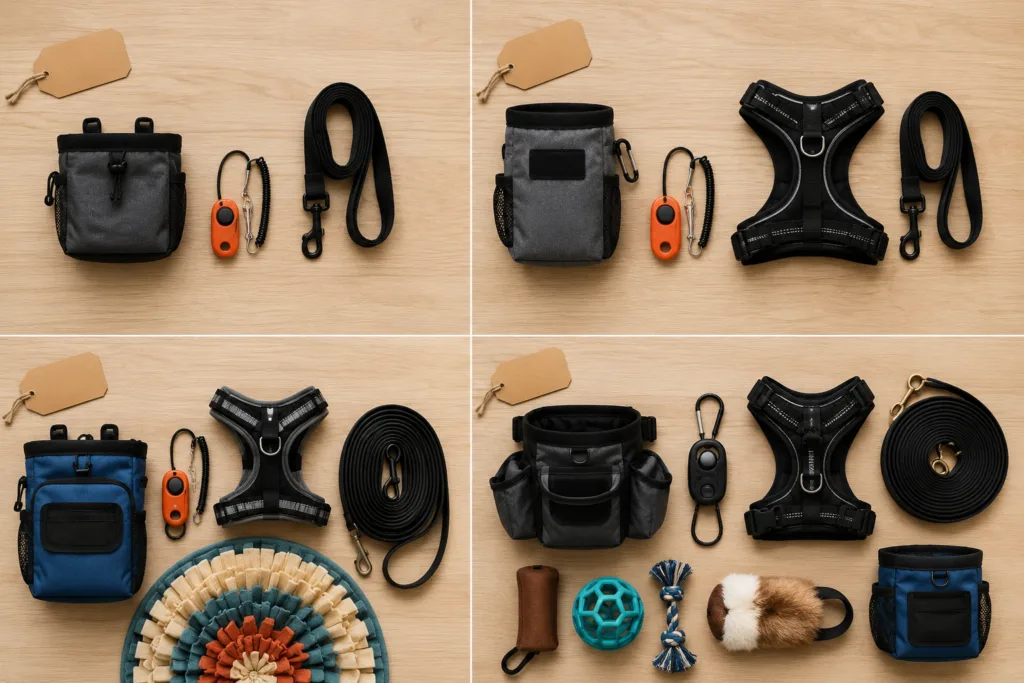
These 4 kits are built from real product testing across the entire series. Every item earns its place, nothing is included to inflate the price or pad an affiliate recommendation.
| Starter Kit #1: The Bare Minimum $30–40 • Treat pouch: $10–15 (magnetic, basic nylon) • Treats: $3–5 (boiled chicken, DIY)• Marker: $0 (marker word “Yes!”, free) • Harness: $15–20 (basic front-clip) Total: $30–40 total �� Best for: Tight budget, occasional training, owners who want to try before committing |
| Starter Kit #2: The Smart Spender (Recommended for Most) \$60–75 • Treat pouch: $20–25 (magnetic + waterproof liner) • Treats: $8–12 (freeze-dried liver)• Marker: $2–5 (standard box clicker) • Harness: $20–30 (front-clip, padded straps) • Long line leash: $10–15 (15-30 feet) Total: $60–75 total �� Best for: Most first-time dog owners: the sweet spot of quality and value |
| Starter Kit #3: The Enthusiast $100–$130 • Treat pouch: $25–30 (best overall, waterproof) • Treats: $8–12 freeze-dried + $3-4/week chicken • Marker: $5–8 (wrist clicker) • Harness: $30–40 (best no-pull, dual clip) • Long line: $15–20 (30 feet) • Enrichment: $10–15 (Kong Classic )Total: $100–$130 total �� Best for: Daily trainers, high-energy dogs, owners who plan to train long-term |
| Starter Kit #4: The Buy Once, Cry Once $150–$180 • Treat pouch: $25–30 (best overall) • Treats: $8–12 freeze-dried + $3–4/week chicken • Marker: $8–12 (i-Click for two sounds/two dogs) • Harness: $40–50 (crash-tested no-pull) • Long line: $20–25 (30 feet, durable biothane or cotton) • Enrichment: $15–25 (Kong + snuffle mat) • Note: Car safety harness ($40–60) not included in total Total: $150–$180 total (+ car safety separately) �� Best for: Serious hobbyists, multiple dogs, competition handlers, working breed owners |
| �� Which Kit Should You Buy? Tight budget, Kit #1 works. You can start training today with boiled chicken and your voice. First-time owner, daily training, Kit #2 is the sweet spot. Best value for the most common owner. High-energy working breed, Kit #3. The flirt pole and snuffle mat are non-negotiable for these dogs. Multiple dogs or serious hobby, Kit #4. Quality gear that lasts and covers complex scenarios. |
You Already Have Everything You Need.
Here’s the truth about everything you’ve read: the most important ingredient in positive reinforcement training isn’t a $50 treat pouch or a premium clicker or a specific brand of freeze-dried liver. It’s you showing up. Consistently. With patience. With treats in a pouch of some kind. With a dog who’s trying to figure out what earns the good stuff.
You don’t need to be perfect. You don’t need expensive gear. You don’t need to follow a rigid schedule or use the exact right words. Your dog isn’t trying to be difficult, they’re trying to understand you. Every treat, every gentle redirection, every moment of patience, every session that ends on a small win is building a relationship that will last their entire life. Bookmark this page. Share it with someone who needs it. And go train your dog.
| �� Complete the Journey �� Bookmark this page, every recommendation links to the full article for deeper dives. �� Share this guide with a first-time dog owner who needs it. �� Download thefree printables libraryto track your progress. �� Sign up for weekly training tips below, practical, science-based, no spam. Want a free printable Weekly Positive Reinforcement Routine + Planner? Enter your email below to download instantly. |

The Complete Positive Reinforcement 101 Series
All 12 Previous Articles:
- 5 Reasons Positive Reinforcement Works Better Than Punishment
- What Is Positive Reinforcement? 3 Simple Dog Training Examples
- The Beginner’s Toolkit: Essential Gear for Positive Reinforcement Training
- First Commands & Daily Routines: How to Start Training Today
- Best Training Gear for Positive Reinforcement: Reviews 2026
- Treats vs. Toys vs. Praise: What Really Motivates Your Dog?
- Solving Common Dog Behavior Problems with Positive Reinforcement
- Budget vs. Premium Dog Training Gear: What’s Worth It? (2026)
- Daily Training Routines That Actually Work: Schedules for Every Lifestyle
- I Tested 12 Training Treat Pouches for 90 Days: Honest Reviews
- Seasonal & Situational Dog Training: Summer, Winter, Holidays & More
- Free Printable Training Resources: Starter Kit, Trackers & Cheat Sheets
- Best Dog Training Apps & Online Courses (Reviewed)
Recommended Products Roundup (Affiliate Links)
- Best Overall Treat Pouch:
- Best Budget Treat Pouch:
- Freeze-Dried Liver (PureBites):
- Standard Box Clicker:
- Wrist Clicker:
- Long Line Leash (15-30 ft):
- Front-Clip No-Pull Harness:
- Kong Classic:
- Snuffle Mat:
- Flirt Pole:
4 Comments