
There’s Too Much to Remember. Stop Trying.
Which treats are high-value? How many repetitions of ‘sit’ did we do today? What’s the difference between a marker word and a bridge cue again? How long is a puppy supposed to train before I stop? At what point do I fade the treats?
If you’ve had any of those thoughts mid-session while your puppy is sitting in front of you staring at your treat pouch, this article is for you. You don’t need to keep all of this in your head. You need printables. This page gives you 7 free ones.
Why Printables Work for Dog Training
Training is a skill that develops through consistent practice, not through reading about it or knowing the theory. The gap between understanding positive reinforcement and applying it daily is consistency. Printables close that gap. If you would rather have that structure built into an app instead of a printout, our roundup of the best dog training apps compares the top options.
Here’s what the 7 printables in this library do for you:
- Track progress, so you actually know what’s working instead of guessing
- Build habits: a checklist you complete every day becomes a training routine
- Reduce decision fatigue: a cheat sheet answers the questions before you have to ask them
- Celebrate small wins, seeing 30 days of sessions logged on paper is genuinely motivating in a way that memory isn’t
How to use this article: read about each printable below and decide which one you need most right now. Then enter your email at the bottom to download the full 7-printable library (14 pages total) as a single PDF. Start with one. Print it tonight. The rest will be there when you need them.
| Printable #1: 5-Step Positive Reinforcement Starter Kit The complete beginner’s first-week guide 5 Pages, Print all. Work through one page per day. |
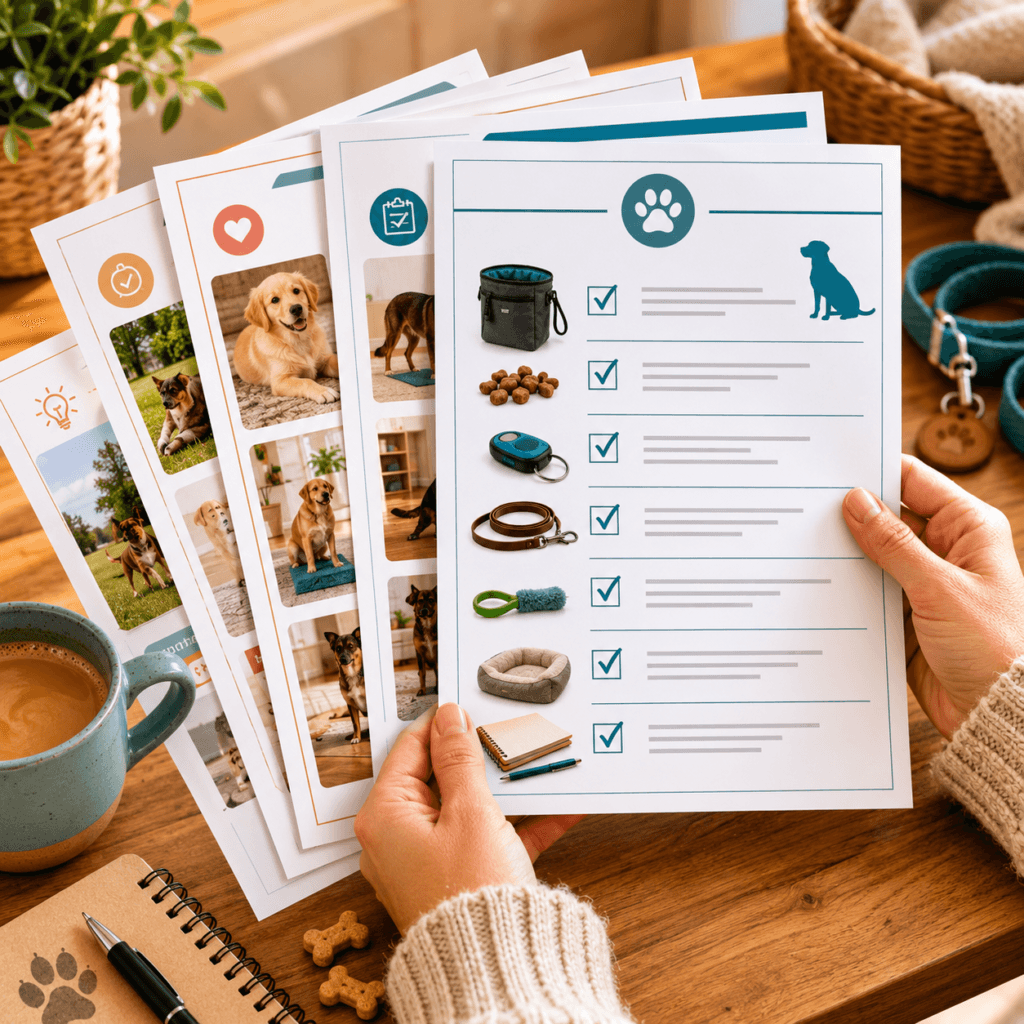
This is the printable for the owner who just picked up their puppy and doesn’t know where to start. Five pages. Five days. One printable that walks you from zero to a trained marker, a reliable ‘sit,’ and a working daily schedule.
What’s Inside:
Page 1: Gear Checklist
- High-value training treats (boiled chicken or freeze-dried liver)
- Treat pouch with magnetic closure, see Printable #2 for comparison chart
- Marker: clicker OR marker word “Yes!”, choose one
- Front-clip harness (for dogs who pull on leash)
Page 2: Train the Marker (5-Minute Protocol)
- Say “Yes!” (or click) give treat immediately. Repeat 20 times.
- Do this BEFORE any other training. This is the foundation of everything.
- “This is the most important 5 minutes of your training journey. Do not skip.”
Page 3: Teach Your First Command (‘Sit’)
- Luring diagram (described in text): treat at nose level, move upward and back, hips lower naturally
- Step-by-step with illustrations and common problem/fix pairs
- Expected timeline: most puppies get reliable sit within 3-5 sessions
Pages 4 & 5: Schedule + Tracker
- Blank weekly schedule with morning/afternoon/evening slots and example fill-in
- Simple daily log: date, behavior, success rate (1-5 stars), notes
| By Day 5 with this printable, you’ll have: a conditioned marker, a reliable ‘sit,’ a working schedule, and 5 days of training logged. That’s a more solid foundation than most first-time owners build in their first month. |
| Printable #2: Treat Pouch Comparison Chart 8 pouches compared across 6 criteria, one printable page 1 Page, Laminate or open on your phone while shopping |
This is the printable that eliminates the Amazon review paralysis. Eight treat pouches, six criteria, every verdict at a glance. The green cells tell you what to buy. The red cells tell you what to avoid. See the comparison below:
| Pouch | Price | Closure | Liner | Speed | Smell | Verdict |
| Budget Magnetic | $12 | Magnetic | Nylon | Fast | Absorbs | Good for beginners |
| Best Overall | $25 | Magnetic | Waterproof | Fast | No | Best for daily use |
| Convertible | $18 | Magnetic | Waterproof | Fast | No | Best for walks |
| Velcro Pouch | $8 | Velcro | Nylon | Slow | Absorbs | Avoid |
| Zipper Pouch | $10 | Zipper | Nylon | Slow | Absorbs | Avoid |
| Premium Bait Bag | $45 | Magnetic | Waterproof | Fast | No | Overkill for beginners |
| Cheap Magnetic | $10 | Magnetic | Nylon | Fast | Absorbs | Good backup |
| Fanny Pack | $15 | Zipper | Nylon | Slow | Absorbs | Not recommended |
The 6 Criteria Explained:
- Price: What you’ll pay (range $8-45)
- Closure: Magnetic, zipper, or velcro. Magnetic wins, always.
- Liner: Waterproof or basic nylon. Waterproof liner = easy cleaning + no smell retention.
- Clip: Belt clip, crossbody, or full waist belt. Belt clip is sufficient for most owners.
- Speed: How fast you can access a treat with one hand. Fast = under 1 second. Slow = 2+ seconds.
- Smell: Does the pouch retain odor after a week of soft treat use? A waterproof liner means no.
| How to Use This Printable Take a photo of this chart on your phone. Open it at the pet store. Compare the pouch in front of you to the chart. Seethe 90-Day Treat Pouch Testfor the full 90-day testing methodology behind every verdict in this chart. |
| Printable #3: 5 Training Mistakes Fix-It Guide Common errors + specific fixes, post on your fridge 2 Pages, Print and stick on your training area wall |
This printable is for every moment you feel stuck mid-training and can’t figure out why it’s not working. Five of the most common positive reinforcement training mistakes are documented here, each with a name, a description, and a fix you can implement immediately.
Mistake #1: Repeating Cues Over and Over
- Problem: “Sit. Sit. Buddy, sit. SIT.” Your dog learns they have multiple attempts before a response is required.
- Fix: Say the cue exactly once. Wait 3 full seconds of silence. If no response: reset (move away, shake off, get a new treat, start the lure again from the beginning). Never nag.
Mistake #2: Training When Frustrated
- Problem: Frustration leaks through your voice, your body language, and your timing. Your dog reads all of it. Sessions trained while frustrated produce worse results than no training at all.
- Fix: The 2-Minute Rule. If you feel frustrated within 2 minutes of starting, stop completely. End on the easiest win you can manufacture. Try again in 2 hours.
Mistake #3: Advancing to Distractions Too Fast
- Problem: Dog sits perfectly 20 times at home, fails completely at the park. Owner gets frustrated. Dog gets confused. Relationship erodes.
- Fix: Change only ONE of the 3 D’s at a time: Duration (how long they hold it), Distance (how far you are), Distraction (difficulty of environment). SeeFirst Commands & Daily Routinesfor the full 3 D’s progression.
Mistake #4: Using Low-Value Treats for Hard Behaviors
- Problem: Kibble at the dog park. Squirrels exist. The math doesn’t work.
- Fix: Treat value must match difficulty. Kibble for easy home behaviors. Boiled chicken or freeze-dried liver for new behaviors, outdoor work, and high-distraction environments.Treats vs. Toys vs. Praisefor the full treat value hierarchy
Mistake #5: Delivering Treats Too Slowly
- Problem: Dog sits you fumble in pouch dog stands up treat arrives. Dog learned that standing gets rewarded. Timing is everything.
- Fix: Treat must arrive within 1 second of the mark (“Yes!” or click). Practice treat retrieval with one hand before adding a dog to the equation. Use a magnetic closure pouch that opens with a thumb movement.
| Printable #4: 30-Day Positive Reinforcement Tracker Daily log + weekly wins for your first training month 2 Pages, Print one for each new training phase |
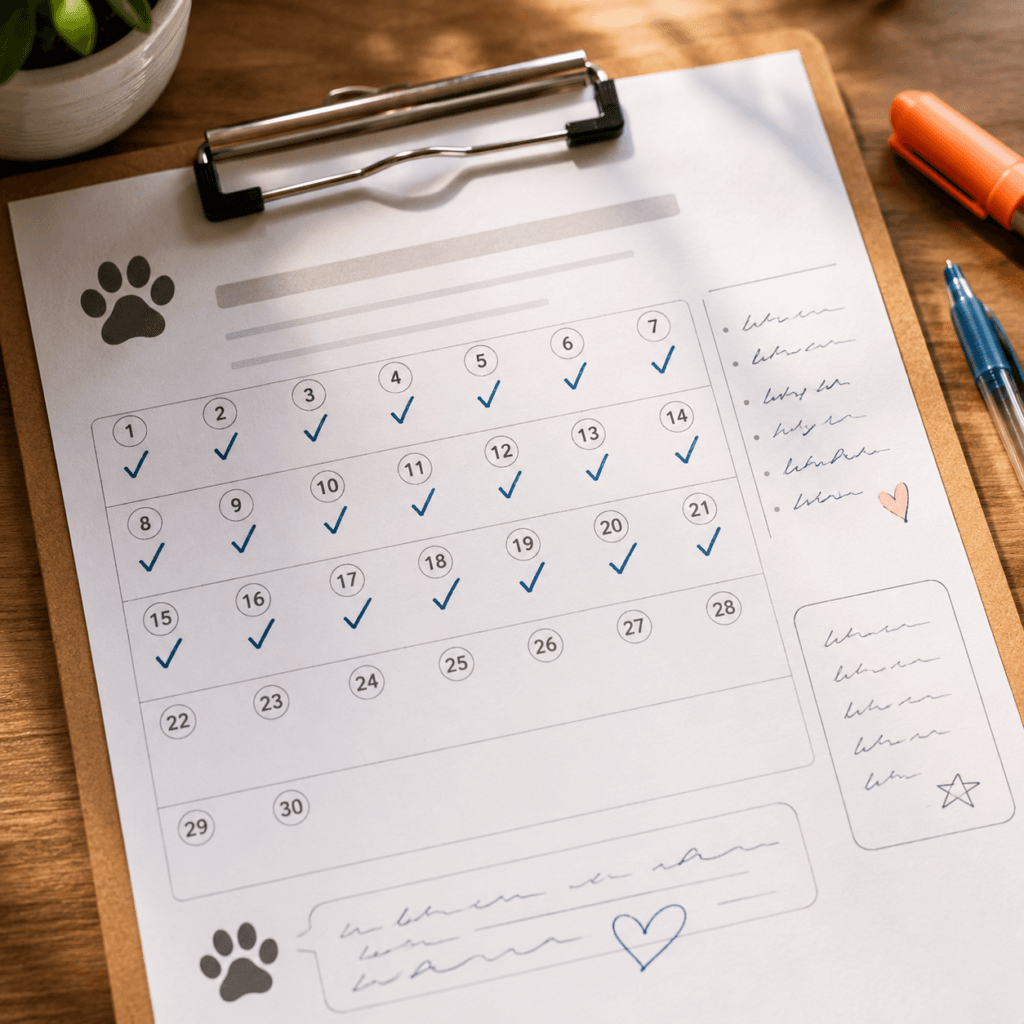
Consistency is the entire game in dog training, and this tracker makes consistency visible. Thirty days of daily sessions logged in one place. Success rates. Behaviors practiced. What worked. What didn’t. Looking at 28 consecutive training days logged is a genuinely powerful motivator.
Page 1 Preview: Daily Training Log (First 5 Rows Shown)
| Day | Date | Behaviors Practiced | Success (1–5) | Minutes | Notes |
| 1 | ___ | Sit (5x), Name (5x) | 4 | 5 | Good focus |
| 2 | ___ | Sit (5x), Name (5x) | 5 | 5 | Nailed it! |
| 3 | ___ | _____________ | ___ | ___ | ___ |
| 4 | ___ | _____________ | ___ | ___ | ___ |
| 5 | ___ | _____________ | ___ | ___ | ___ |
Page 2 Preview: Weekly Summary Section
- Week 1 wins: ________________________________
- Week 1 challenges: ________________________________
- Behavior breakthroughs this month: ________________________________
- Treats that worked best: ________________________________
- Photo/milestone notes: ________________________________
| How to use: Fill out the log immediately after every session (takes 30 seconds). Review the weekly summary on Sunday. Adjust the following week’s sessions based on what’s working. Seeing progress on paper is more motivating than any Instagram training account. |
| Printable #5: The Only Training Cheat Sheet You’ll Need Quick-reference guide for daily training, laminate-worthy 1 Page (2 sides), Laminate or use a sheet protector. Keep near your pouch. |
This is the printable that answers every mid-session question without requiring you to Google anything. One page, two sides. Side 1: the commands, their cue words, and their hand signals. Side 2: everything else you need to remember. Here’s a preview of both sides:
Side 1: Command Reference Chart
| Behavior | Cue Word | Hand Signal | Key Notes |
| Sit | “Sit” | Palm up, move upward | Lure treat from nose over head |
| Down | “Down” | Point toward floor | Lure from sit position to floor |
| Name | Dog’s name | None | Reward any eye contact |
| Touch | “Touch” | Open palm presented | Nose presses to open palm |
| Leave it | “Leave it” | Closed fist | Trade for different treat from other hand |
| Place | “Place” | Point to mat | Send dog to designated mat or bed |
Side 2: Quick Reference Rules
- Marker word: “Yes!”, same bright tone, every single time
- Treat size: Pea-sized or smaller (swallowed in under 2 seconds)
- Session length: 2–5 min for puppies; 5–10 min for adult dogs
- Session frequency: 3–5 short sessions per day beats 1 long one
- High-value treats: Boiled chicken, freeze-dried liver, string cheese
- Low-value treats: Kibble, basic biscuits (for home training, easy behaviors only)
- Upgrade treat value when: teaching a new behavior, training in a new environment, dog seems bored
- Phase treats out when: behavior is solid (80%+), switch to life rewards (door opening, toy throw)
| How to Use This Printable Laminate it or slide into a sheet protector. Clip it to your treat pouch bag or stick to your refrigerator with a magnet. Glance at it before each session. Within 2 weeks, you won’t need it anymore, but it’ll be there until then. |
| Printable #6: Find Your Dog’s Perfect Reinforcer Worksheet 3-step test to identify what truly motivates your dog 1 Page, Retest every 3 months as your dog develops |
Not every dog is treat-motivated. Using the wrong reinforcer is the single most overlooked reason training sessions stall. This 3-step worksheet identifies your dog’s primary reinforcer with a simple test and gives you an action plan built around the result.
Step 1: The Reinforcer Test (5 Minutes)
Set up 3 options in front of your dog:
- Bowl A: High-value treat (boiled chicken or freeze-dried liver)
- Bowl B: Favorite toy or tug rope
- Bowl C: Your open hand (for petting and praise)
Release your dog without a cue. See what they approach first. Record the result. Repeat 3 times on 3 different days.
Step 2: Calculate Your Dog’s Primary Reinforcer
- Chose treats 2–3 times Treat-motivated (most common)
- Chose toy 2–3 times Toy-motivated
- Chose praise 2–3 times Praise-motivated (rare and wonderful)
- Different each time Combination dog
Step 3: Your Action Plan
If treat-motivated:
- Treats work for all new behaviors. Use kibble for easy home training, chicken/liver for hard environments.
- Gradually build value for praise by pairing it with treats 50+ times (praise first, then treat).
If toy-motivated:
- Teach new behaviors with treats (fastest for new learning). Then swap: mark behavior throw toy.
- Keep a small tug toy in your treat pouch alongside treats.
- SeeTreats vs. Toys vs. Praisefor the full toy training protocol.
If praise-motivated:
- You have a unicorn dog. Use enthusiastic “Yes! Good dog!” as your primary reinforcer.
- Keep treats as occasional jackpots for breakthrough moments.
If combination dog:
- Treats for teaching (low arousal, high repetition).
- Toys as jackpot rewards after exceptional reps or for proofing difficult behaviors.
- Praise for maintaining known behaviors in calm environments.
| Printable #7: Weekly Positive Reinforcement Routine Planner Example schedule + blank 7-day tracker 2 Pages, Print at the start of each week |
Training without a weekly plan is how consistency slips. This 2-page planner gives you an example of a well-balanced training week and a blank version to fill in for your specific schedule, lifestyle, and goals.
Page 1: Sample Filled-In Weekly Schedule
| Day | Morning (5 min) | Afternoon (2 min) | Evening (10 min) |
| Monday | Name recognition | Potty break + cue review | Training session: new behavior |
| Tuesday | Name recognition | Potty break + cue review | Play session: tug with rules |
| Wednesday | Name recognition | Potty break + cue review | Training session: practice |
| Thursday | Name recognition | Potty break + cue review | Play session: fetch with sits |
| Friday | Name recognition | Potty break + cue review | Training session: proofing |
| Saturday | Adventure (new place) | Rest | Rest |
| Sunday | Rest | Rest | Rest |
Page 2: Blank Weekly Planner
The blank version includes the same structure with empty cells for your schedule, plus:
- Weekly wins section (what progress did you notice this week?)
- Challenges section (what didn’t work? why?)
- Treat inventory (what treats were most motivating this week?)
- Behavior breakthroughs (any moment worth recording?)
| How to use: Print on Sunday. Fill in your training slots for the coming week (be realistic about your schedule). Check off each completed session. Review at the end of the week. Adjust next week based on what you learned. This process alone, not the training itself, is what separates owners who see progress from those who feel stuck. |
Download All 7 Printables, Free
All 7 printables are available as a single downloadable PDF library. Enter your email below and receive all 14 pages instantly.
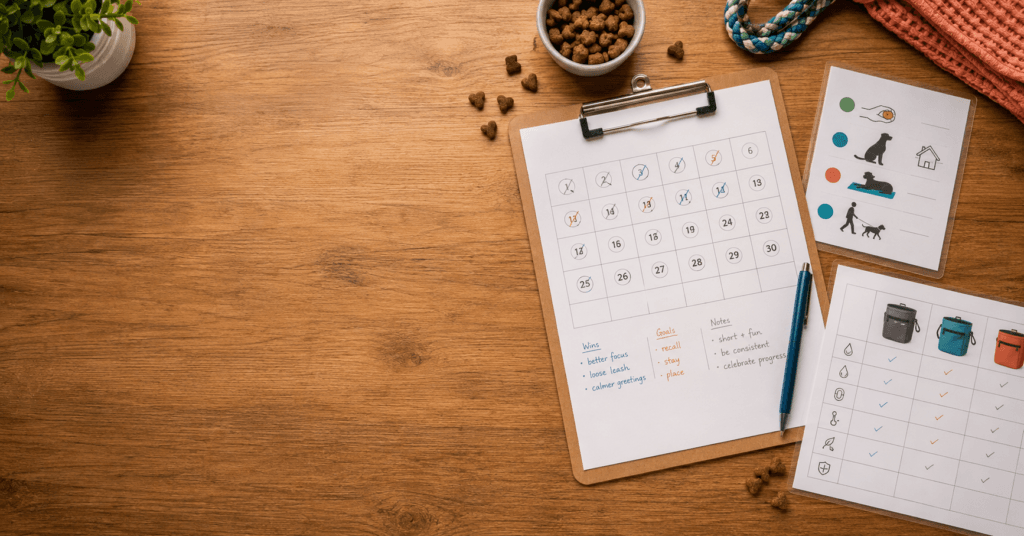
| What’s in Your Free Library Printable #1: 5-Step Positive Reinforcement Starter Kit (5 pages) Printable #2: Ultimate Treat Pouch Comparison Chart (1 page) Printable #3: 5 Training Mistakes Fix-It Guide (2 pages) Printable #4: 30-Day Positive Reinforcement Tracker (2 pages) Printable #5: The Only Training Cheat Sheet You’ll Need (1 page) Printable #6: Find Your Dog’s Perfect Reinforcer Worksheet (1 page) Printable #7: Weekly Positive Reinforcement Routine + 7-Day Tracker (2 pages) Total: 14 printable pages |
| Get Your Free Library Enter your email above to receive all 7 printables as a single PDF library, instantly delivered to your inbox. We’ll also send you our Positive Reinforcement 101 welcome sequence with practical tips for your first 30 days of training. We respect your privacy. You can unsubscribe at any time. |
FAQ: Printable Training Resources
“Do I need to print all of these?”
No. Start with the one most relevant to where you are right now. If you’re a complete beginner: Printable #1 (Starter Kit). If you’re buying a treat pouch: Printable #2 (Comparison Chart). If something isn’t working: Printable #3 (Fix-It Guide). Add printables as you need them, not all at once.
“Can I fill these out on my phone or iPad?”
The PDF library is designed primarily for printing, but most devices can annotate PDFs using the native markup tools (iPhone: Files app open PDF pencil icon; iPad: Markup tool; Android: various PDF readers). For the tracker and weekly planner specifically, printing is more practical for daily use.
“How often should I use the 30-day tracker?”
After every training session, same day. The log takes 30 seconds to fill in. Waiting until the end of the week means forgetting the detail that makes the tracking useful (what specifically happened in that session, what the dog’s engagement level was, which treat worked best). Daily, immediately after the session.
“My dog doesn’t like toys. Should I still do the reinforcer test?”
Yes. The test includes treats, toys, and praise, and if your dog ignores the toy, that’s valuable information. It means you have either a treat-motivated or a praise-motivated dog, and the action plan in Printable #6 will point you to the right training approach for that specific profile. The test is worthwhile even when the result seems obvious.
“What if I lose my printables? Can I download them again?”
Yes. When you sign up, we send you an email with the PDF download link. That email stays in your inbox and can be re-opened anytime. We also recommend saving the PDF to your phone camera roll or a Google Drive folder as a permanent backup.
“Are these printables suitable for adult rescue dogs or just puppies?”
All 7 printables work for dogs of any age. The 30-Day Tracker and Weekly Planner are useful for any new training phase, not just puppy months. The Starter Kit’s pacing (one step per day) works just as well for a 3-year-old rescue learning their first commands as for an 8-week puppy. The reinforcer test in Printable #6 is actually especially useful for rescue dogs, where you may not know yet what motivates them.
Affiliate Links
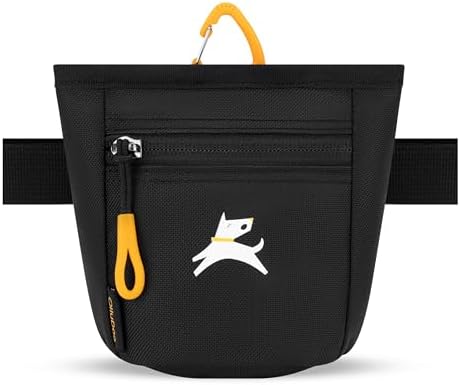
Gear featured in these printables, all available on Amazon.


One Printable. One Week. Then the Next One.
Here’s what the full printable library gives you: a structured path through your first week (Starter Kit), a smarter gear purchase (Comparison Chart), a self-diagnostic when you’re stuck (Fix-It Guide), a consistency system for 30 days (Tracker), a quick reference for every session (Cheat Sheet), a motivational profile of your specific dog (Reinforcer Worksheet), and a weekly planning structure that balances training with play and rest (Weekly Planner).
You don’t have to use all 7 this week. Print one. Use it for seven days. See what changes. Then come back for another. Training is a long game, and the right tools make the game significantly more enjoyable for both of you.
| Get Your Free Printable Library Enter your email above to download all 7 free printables (14 pages) as a single PDF. Start training with clarity and consistency today. |
Resources & Related Articles
Articles Linked in This Printable Library
2 Comments