
You’re Not Failing. You’re Just Looking at the Wrong Schedule.
You read online that you need to train your dog for 30 minutes every day. You work full time. You have kids, or a partner, or a commute, or you’re just exhausted by 7pm. The idea of 30 minutes of structured training feels like one more thing you’re not doing well enough. And now, on top of everything else, you feel guilty about your dog.
Here’s the truth that actually matters: perfect training schedules don’t exist. Sustainable ones do. Two minutes of focused, consistent training every morning will produce better results than one 45-minute weekend session driven by guilt. This article gives you 7 different routines, from 5-minute mornings to working owner plans to a minimalist 23-minutes-per-week schedule. Find the one that fits your actual life, and start there.
The 3 Principles of Sustainable Training
Before we get into routines, three principles apply to every schedule in this article. Understanding them changes how you think about training time.
Principle #1: Short Sessions Beat Long Sessions
Two to three minutes of focused, positive training is more effective than 20 minutes of frustrated, distracted training. Dogs, especially puppies, have attention spans measured in seconds, not minutes. When a session runs past their capacity, they stop learning and start offering random behaviors hoping something works.
| Five one-minute sessions spread through a day produce better retention than one five-minute session. Frequency beats duration. |
Principle #2: Consistency Beats Intensity
Training every day for 2 minutes builds stronger neural pathways than training once a week for 30 minutes. Dogs learn through repetition across time, not marathon sessions. A behavior trained in 30 two-minute sessions over a month is more reliable than the same behavior “trained” in three 30-minute sessions.
Principle #3: Real Life Is Your Training Ground
You don’t need a dedicated training room, a training vest, or 30 minutes of uninterrupted time. The most powerful training moments happen during daily activities: asking for a sit while the coffee brews, practicing name recognition during a commercial break, reinforcing calm behavior before putting on your dog’s leash.
| The goal isn’t to carve out training time. It’s to build training into the time you already have. |
| How to Use This Article Find the section that matches your lifestyle. Read that section. Start that routine tomorrow. Don’t compare yourself to Instagram trainers with 6 hours a day. Every routine here is designed to be done by a real person with a real schedule and a real dog. Article sections: 1. The 5-Minute Morning Routine 2. Working Owner Schedule (Puppy + Adult Plans) 3. Weekly Training + Play Routine 4. Vacation Training Tips 5. The Minimalist Routine (3 commands, 23 min/week) 6. Reinforcing Without Treats 7. Routine for a Hyperactive Dog |
| Section 1: The 5-Minute Morning Routine 4 Steps. Every Lifestyle. Starts Tomorrow. |
Who this is for: Any owner who wants to build a consistent positive reinforcement habit without rearranging their day. Works for busy owners, new owners, and anyone who’s tried longer sessions and abandoned them.
Why Mornings Work:
- Your dog wakes up fresh, not tired from the day’s distractions and stimulation
- They’re food-motivated before breakfast, treats land harder before a meal
- A positive training session in the first 5 minutes sets a calm, connected tone for the next 16 hours
The Minute-by-Minute Breakdown:
| Time | Step | What You Do |
| 0:00–0:30 | Warm-up | Name recognition: say name dog looks treat. Repeat 3x. |
| 0:30–1:30 | Step 1: Easy Command | Ask for ‘sit’ (or any known behavior). Reward 5x. |
| 1:30–2:30 | Step 2: Add Duration | Same ‘sit’ but hold 2 seconds before treating. Repeat 3x. |
| 2:30–3:30 | Step 3: Add Distance | Ask for ‘sit’ from 3 feet away. Mark and treat. Repeat 3x. |
| 3:30–4:30 | Step 4: Play Break | Tug or fetch for 30 seconds of pure fun. |
| 4:30–5:00 | Cool Down | Easy ‘sits’ and name recognition. End on the easiest win you can guarantee. |
What If You Only Have 2 Minutes?
Do Steps 1 and 2 only: warm-up name recognition and five sits. Two minutes is not nothing. Two minutes, every morning, for a month is 60 training sessions. That is more than enough to build a reliable sit, a name response, and a training habit that actually sticks.
| Realistic expectation: After one week of morning routines, most dogs are noticeably more focused and responsive during the rest of the day. The session doesn’t just teach commands, it calibrates your dog’s attention toward you. |
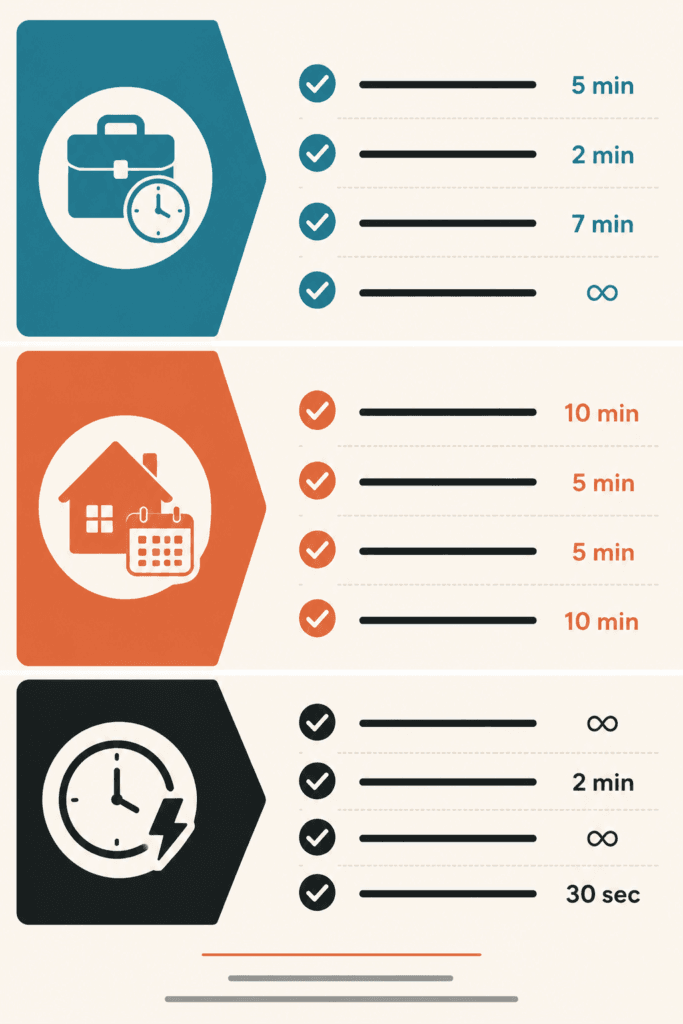
| Section 2: The Best Training Schedule for Working Owners 2 Plans. 15–20 Minutes Total Per Day. |
Who this is for: Owners who leave for work and return 8-10 hours later, worried that their dog is falling behind because of the time gap. Here’s the reality: your dog sleeps the majority of the hours you’re gone. The gap isn’t the problem. What you do before and after is the whole game.
Plan #1: Working Owner Puppy Plan (Under 6 Months)
| Time | Activity | Duration |
| Morning (before work) | 5-minute morning routine (Section 1) | 5 min |
| Mid-day (walker/lunch) | Potty break + 1–2 min name recognition | 2 min |
| Evening (after work) | 5–10 min session (new behavior or proofing) | 5–10 min |
| Before bed | 2-min review of known commands | 2 min |
Total daily training: 14–19 minutes. For context, that’s roughly the length of one TV show commercial break, total, split across your day.
Plan #2: Working Owner Adult Dog Plan (Over 6 Months)
| Time | Activity | Duration |
| Morning (before work) | 3-min mini-routine (warm-up + 1 command) | 3 min |
| Evening (after work) | 10-min walk + engagement walk training | 10 min |
| Before bed | 2-min review of known commands | 2 min |
Total daily training: 15 minutes. Adult dogs can handle slightly longer individual sessions and don’t require mid-day check-ins the way puppies do.
Tips for Working Owners:
- If you hire a dog walker, ask them to do 2 minutes of name recognition during their visit, not just a walk. Most walkers are happy to do this with a simple verbal instruction.
- Frozen Kongs, lick mats, and puzzle toys during the day provide mental stimulation that reduces destructive behavior without requiring your presence. (seeTreats vs. Toys vs. Praisefor enrichment toy picks)
- Don’t feel guilty about the hours in between. A tired, relaxed dog who gets 15-20 minutes of focused positive training per day is learning significantly more than a dog who gets sporadic long sessions driven by weekend guilt.
| Working Owner Reminder Your dog does not experience your absence as abandonment. They nap. They watch the window. They chew something they shouldn’t. The quality of your focused training time matters far more than the quantity of hours you’re present. |
| Section 3: Weekly Training + Play Routine 5 Steps for a Balanced Puppy |
Who this is for: Owners who want a structured weekly plan rather than just a daily one, and who understand that training alone isn’t enough. Relationship building, play, outdoor socialization, and rest are all parts of a complete puppy development plan.
Step 1: Daily Non-Negotiables (Every Day, Every Week)
- Name recognition: 5 repetitions, can be done in 30-second chunks throughout the day
- One known command: 5 repetitions of sit, down, or touch, takes under 1 minute
- Potty schedule: Not training, but non-negotiable structure that prevents housebreaking regression
Step 2: 3 Focused Training Sessions Per Week (15–20 Minutes Each)
Each session introduces or deepens one behavior. A simple 4-week behavior progression:
- Week 1: ‘Sit’ with duration (holding the sit before releasing)
- Week 2: ‘Down’ from a standing position
- Week 3: Hand target (‘touch’, nose to open palm)
- Week 4: ‘Watch me’ (sustained eye contact on cue)
Step 3: 3 Play Sessions Per Week (15–20 Minutes Each)
Play isn’t a break from training, it IS training. Relationship-building through play increases engagement, drive, and cooperation in formal training sessions.
- Tug with rules: dog must ‘drop it’ on cue to restart the game (impulse control)
- Fetch with sits: dog must sit before each throw (impulse control + exercise)
- Hide and seek: you hide, dog finds you (recall foundation + mental engagement)
Step 4: 1 Outdoor Adventure Per Week (30–60 Minutes)
New environments are where training gets real. A dog who sits perfectly at home and ignores you at the park hasn’t been generalized yet. Weekly exposure to new places, with familiar commands practiced in low-pressure ways, builds the kind of reliability that matters in daily life.
- Practice known commands in new places (park, pet store, friend’s yard)
- Let your dog sniff freely for at least 15 minutes, sniffing is mentally exhausting and deeply calming (more inSolving Common Behavior Problems)
- Don’t introduce new behaviors on adventure days. Proof existing ones.
Step 5: 1 Rest Day Per Week (No Formal Training)
Dogs process and consolidate learning during rest. A puppy who never gets a break from structured expectations develops frustration and resistance over time. Rest days are not wasted days.
- Cuddles, massage, free sniff time in the yard
- Coexisting without any formal demands
- Your relationship matters more than your training log
Sample Weekly Calendar:
| Day | Morning (5 min) | Evening (10–15 min) |
| Monday | Name recognition | Training session (new behavior) |
| Tuesday | Name recognition | Play session (tug with rules) |
| Wednesday | Name recognition | Training session (practice) |
| Thursday | Name recognition | Play session (fetch) |
| Friday | Name recognition | Training session (proofing) |
| Saturday | Adventure day (new environment) | Rest |
| Sunday | Rest | Rest |
| Section 4: Vacation Training Tips 3 Ways to Maintain Progress on the Road |
Who this is for: Owners traveling with their dog, or owners leaving their dog with a sitter and worried about regression.
Tip #1: Lower Your Expectations (Temporarily)
Your dog will regress on vacation. New smells, new sounds, new routines, new people, every one of these factors competes with the training cues your dog has learned in familiar environments. That is completely normal and completely temporary.
- Focus on only 1–2 behaviors: name recognition and sit. Let everything else slide.
- Don’t punish regression. Your dog isn’t forgetting, they’re overwhelmed.
- When you return home and resume your normal routine, previously learned behaviors return quickly, usually within 2–3 sessions.
Tip #2: Use Higher-Value Treats Than Usual
A new environment has more distractions than your living room. The reinforcer value needs to scale with the distraction level. If boiled chicken works at home, upgrade to hot dogs at a campsite. If freeze-dried liver works at home, bring extra.
- Pack 2–3 treat types (in case one stops working in the new environment)
- Freeze-dried treats travel well without refrigeration: the best option for trips
- Lower the difficulty of what you’re asking: new environment + familiar, easy behavior + high-value treat = success
Tip #3: Train in Short Bursts Throughout the Day
You won’t have a dedicated 10-minute training block on vacation. That’s fine. Train during natural pauses: waiting for your order at a dog-friendly restaurant, before entering a new space, after potty breaks.
- 1-minute sessions, 3–5 times per day
- End every session on a success, even a single easy sit
- The goal on vacation is maintenance, not advancement
| If You’re Leaving Your Dog With a Sitter Write a 1-page training cheat sheet: list your 3-5 known commands, the cue words, any hand signals, and what treats to use. Record a 2-minute video of you training your dog (so the sitter can see the pace, the markers, the treat delivery). Send your own treats. Don’t assume the sitter has anything your dog finds motivating. Lower your expectations: your dog won’t be perfect without you. Two weeks away rarely causes permanent regression. Your routine resumes when you return. |

| ⏱ Section 5: The Minimalist Training Routine 3 Commands. 23 Minutes Per Week. |
Who this is for: Owners who are truly time-crunched, multiple jobs, young children, caregiving responsibilities, or simply people who are not interested in training as a hobby. You just want a manageable dog.
Here’s the honest truth: you don’t need 20 commands. You need 3. These three commands will keep your dog safe, make daily life calmer, and give you the management foundation to handle 95% of real-world situations.
Command #1: Name Recognition, The Most Important Command
- Why: A dog who looks when you say their name can be redirected from danger, recalled from distance, and managed in any situation
- How: Say name once the moment they look mark (“Yes!”) and treat. Five repetitions. That’s one session.
- Goal: 90% response rate in low distraction within 2 weeks
- Daily time: 2 minutes
Command #2: ‘Sit’, The Universal Reset
- Why: Sit replaces jumping on guests, rushing through doors, demanding attention. A dog who sits on cue can be managed in almost any social situation
- How: Lure with treat from nose upward. The moment hips hit the floor, mark and treat. Three repetitions.
- Goal: Dog sits on cue 80% of the time in familiar environments
- Daily time: 1 minute
Command #3: ‘Leave It’, The Safety Command
- Why: Prevents eating trash, chasing wildlife, grabbing dangerous items off the ground
- How: Close treat in fist. Dog sniffs, paws, licks fist. The moment they back off (even a fraction), mark and give a treat from your other hand. Repeat 3–5 times.
- Goal: Dog backs off from closed fist 80% of the time; then generalize to items on the ground
- Daily time: 2 minutes
The Minimalist Weekly Schedule:
| Day | Time Investment | What You Practice |
| Monday | 5 minutes | Name recognition (2 min), Sit (1 min), Leave It (2 min) |
| Tuesday | 3 minutes | Name recognition only |
| Wednesday | 5 minutes | Name recognition, Sit, Leave It |
| Thursday | 3 minutes | Name recognition only |
| Friday | 5 minutes | Name recognition, Sit, Leave It |
| Saturday | 2 minutes | Quick review of all 3 commands |
| Sunday | 0 minutes | Rest |
| Total weekly time: 23 minutes. Your dog won’t win any competition titles. But they will respond to their name reliably, sit on cue, and leave dangerous items when asked: which is genuinely everything most households need. |
| Section 6: Reinforcing Training Without Treats 4 Methods for Known Behaviors |
Who this is for: Owners who want to phase out treats for known behaviors, dogs who are overweight, or owners who ran out of treats mid-session and want to know what to do.
Important clarification: you will always need treats to teach new behaviors. No-treat reinforcement only works for behaviors your dog already knows fluently. Trying to teach a new behavior without treats significantly slows the learning process.
Method #1: Life Rewards, The Most Powerful Long-Term Reinforcer
Life rewards means your dog works for the everyday privileges they already want. You’re not removing treats, you’re replacing them with things your dog already considers rewarding.
- Sit before going outside: the door opening is the reward
- Down before dinner: the food bowl appearing is the reward
- Name recognition before crate release: freedom is the reward
- Sit at the end of a leash before being allowed to greet another dog: the greeting is the reward
Method #2: Toy Play as Reinforcement
For toy-motivated dogs, a 10-second game of tug or a thrown ball is a more powerful reinforcer than any treat. The marker still applies: dog performs behavior mark (“Yes!”) immediately throw toy or start tug.
- Keep a small tug toy in your pocket or attached to your treat pouch
- The marker must still come before the toy, don’t let your dog grab the toy before the mark
- Best for: toy-obsessed dogs, high-energy breeds, dogs who lose interest in food mid-session (full comparison inTreats vs. Toys vs. Praise)
Method #3: Praise + Petting
Praise is not automatically reinforcing. Some dogs wag and lean in when you say “Good boy!” enthusiastically. Others look mildly confused and walk away. Test it: after a successful sit, say “Good dog!” enthusiastically. Does your dog offer another sit, wag their tail, or lean into you? Those are signs praise is working.
If praise isn’t naturally reinforcing, you can build its value: say “Good!” immediately before every treat for 50 repetitions. Over time, the word becomes a conditioned reinforcer with real value of its own.
Method #4: Environmental Rewards
Your dog has desires that don’t involve you at all: sniffing that bush, approaching that dog, stepping through that open gate. When you give access to these things as a reward for a behavior, you’re using one of the most powerful reinforcers available.
- Dog walks nicely for 10 steps “Yes!” release to sniff freely for 30 seconds
- Dog sits calmly while you put shoes on open the door immediately
- Dog looks at you instead of lunging at another dog allow a brief greeting
| The No-Treat Transition Protocol (For Known Behaviors Only) Step 1: Practice with treats until the dog succeeds 80% of the time consistently. Step 2: Swap one treat reward per session for a life reward (door opening, food bowl, toy throw). Step 3: Use intermittent treats, reward every 3rd success, then every 5th, then randomly. Step 4: Phase treats out entirely for that specific behavior in that specific environment. Always keep treats in your pouch for teaching NEW behaviors. No-treat reinforcement is a maintenance tool, not a teaching tool. |
| Section 7: Positive Reinforcement Routine for a Hyperactive Dog 4 Products + a Daily Schedule |
Who this is for: Owners of high-energy working breeds, Australian Shepherds, Border Collies, Belgian Malinois, Siberian Huskies, Jack Russell Terriers, and any dog who seems to run on an inexhaustible battery.
The challenge: hyperactive dogs need more than training. They need physical exercise, mental stimulation, impulse control practice, and enrichment, and all of those things need to happen in the right order.
Step 1: Exercise Comes First. Always.
A hyperactive dog who hasn’t exercised cannot focus for training. Asking for a sit from a dog whose brain is still fizzing with energy is like asking a 5-year-old to focus on math during recess. Exercise first, every single time.
- 20–30 minutes of genuine physical exercise before any formal training
- Best options: fetch, jogging, swimming, flirt pole, off-leash run in a safe area
- A tired hyperactive dog is a trainable hyperactive dog
Step 2: Keep Training Sessions Short and High-Reward
Five focused minutes of training immediately after exercise is more valuable than 20 frustrated minutes. Use your highest-value treats in these sessions, hyperactive dogs need a reinforcer that competes with their internal drive.
- 5 minutes maximum per formal training session
- Boiled chicken or freeze-dried liver only, kibble will not hold a hyperactive dog’s attention
- End every session before the dog loses focus, not after
Step 3: Impulse Control Games Built into Daily Life
Hyperactive dogs don’t lack intelligence, they lack impulse control. Building that control happens in small moments throughout the day, not in dedicated training sessions.
- “Wait” at every doorway: dog holds position until released
- “Leave it” with treats on the floor: builds the ability to resist immediate impulses
- “Sit” before every toy throw: the most powerful daily impulse control exercise
- These small consistent moments compound over weeks into a dog who can pause before reacting
Step 4: The 4 Enrichment Products That Solve Hyperactivity
| Product #1: Flirt Pole $10–20 Why it works: Satisfies a working dog’s prey drive in a controlled, rule-based context. 5-10 minutes of flirt pole is the physical equivalent of 30 minutes of walking. Additionally, the “wait” before chasing and the “drop it” to restart teach impulse control built into the game itself. How to use: 5–10 minutes before the day’s main training session. Dog must sit and wait before you start moving the pole. Dog must drop it on cue to restart. Available at most pet stores and online. (pick below) |
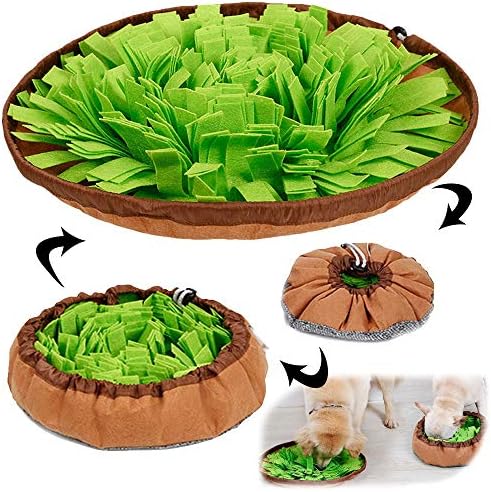
| Product #2: Snuffle Mat $15–25 Why it works: Sniffing activates the parasympathetic nervous system: the calming branch. A hyperactive dog who sniffs for 15 minutes is genuinely mentally tired in a way that physical exercise alone doesn’t produce. How to use: Hide kibble or training treats in the mat. Let your dog sniff to find them. Place this during periods when you need your dog to settle (your lunch break, your Zoom call, your post-walk cooldown). (pick below) |
| Product #3: Treat-Dispensing Puzzle Toy $10–20 Why it works: Dogs who solve puzzles to access food are doing cognitive work that’s genuinely tiring. A 15-minute puzzle session produces similar mental fatigue to a structured training session. How to use: Fill with kibble or small treats. Rotate between 2–3 different puzzle types to maintain novelty. Best options: Kong Wobbler, Outward Hound puzzle feeders, Omega Paw Tricky Treat Ball. (picks below) |
| Product #4: Tug Toy with Rules $5–15 Why it works: Tug is not just exercise, it’s an impulse control training session disguised as play. Your dog must drop the toy on cue to restart the game. They must sit and wait before you begin. The impulse control built here generalizes to all other contexts over time. How to use: Use as the final session before bed. Tug actively for 3–4 minutes with rules. End with a calm down: ask for a sit, a down, give a treat, done. The structured ending teaches the dog to come down from arousal on cue. (pick below) |
The Full Hyperactive Dog Daily Schedule:
| Time | Activity | Duration |
| Morning | Fetch or jogging (exercise FIRST) | 20 min |
| After exercise | 5-min training session (sit, down, name recognition) | 5 min |
| Mid-day | Snuffle mat or puzzle toy (mental work while you’re busy) | 15 min |
| Evening | Flirt pole session (impulse control + exercise) | 10 min |
| Before bed | Tug with rules + calm-down routine | 5 min |
| The Secret to Hyperactive Dogs Hyperactive dogs need a job. When you provide structured exercise, training, enrichment, and impulse control work, you’re giving them what their genetics were built for. A hyperactive dog with a daily job is not a problem dog. They’re a fulfilled dog. The behavior you’re struggling with is almost always a symptom of unmet physical and mental needs, not disobedience. |
FAQ: Real Questions from Busy, Tired, Realistic Owners
“What if I miss a day of training? Will my dog regress?”
Missing one day changes nothing. Missing a week changes very little for behaviors that are already solid. Regression is caused by missing weeks consistently, not by having a bad Tuesday. When you return after a gap, start easier than you think you need to, two easy wins rebuild confidence faster than pushing back to where you left off.
“How do I train when I’m sick or exhausted?”
You don’t. A sick or exhausted owner trains poorly, timing is off, patience is thin, and the session often ends in frustration. Rest. Give your dog a puzzle toy or frozen Kong for mental stimulation, and call it a training rest day. Your dog will benefit more from one skipped day than from a bad session.
“My dog is hyperactive and won’t focus for even 2 minutes. What do I do?”
Exercise first. This is not optional for hyperactive dogs. Thirty minutes of physical exercise before asking for focus isn’t ideal, it’s the prerequisite. If you’ve exercised and the dog still can’t focus, lower the distraction level (go to the quietest room in your house), upgrade the treat value (boiled chicken), and ask for something extremely easy (just their name, just one sit). Build from there. See Section 7 for the full protocol.
“Can I train my dog while watching TV or cooking dinner?”
Yes, for known behaviors. Calling your dog’s name and rewarding the look during a commercial break, asking for a sit before you put the food bowl down, practicing ‘leave it’ with a piece of fallen food, these are all valid, effective training moments. For teaching completely new behaviors, reduce distractions and give it your full attention. Maintenance of known behaviors can absolutely happen while you’re doing something else.
“How long does it take to phase out treats completely?”
For a behavior that’s already solid (90%+ success rate in multiple environments), the treat-fade process takes 2–4 weeks of deliberate intermittent reinforcement. You’re never truly phasing out treats entirely, you’re making them intermittent (random). Intermittent reinforcement is actually more robust than consistent reinforcement. Think of it like a slot machine: the unpredictability makes the behavior more persistent, not less.
“My dog only listens when I have treats. Is that bad?”
It means you haven’t yet faded the visible treat from your training. The fix: move treats from your hand to your treat pouch (out of sight), ask for the behavior with an empty hand, then reward from the pouch after the response. Over repetitions, your dog learns that the treat’s absence doesn’t predict the treat’s absence. Then transition to intermittent rewards as described above. See the full protocol inTreats vs. Toys vs. Praise.
“What’s the best routine for a dog with separation anxiety?”
A dog with separation anxiety needs the desensitization and counterconditioning protocol described in Article 7, short departures, gradually extended, paired with high-value alone-time treats. Add to that: consistent daily exercise (Section 7 protocol reduces overall anxiety), enrichment toys during alone time (frozen Kong before you leave), and independence training (practicing being out of sight while still at home). The training routine isn’t enough on its own; SA requires a dedicated protocol. SeeSolving Common Behavior Problemsfor the full separation anxiety guide.
“How do I train two dogs at the same time with limited time?”
Train separately whenever possible, especially for new behaviors. One dog in a crate with a Kong, one dog training with you. Swap for 5 minutes each. Ten minutes total, both dogs trained. For known behaviors in calm household situations, you can ask both simultaneously (both sit before the door opens), but teaching anything new with two dogs present significantly slows progress for both. Separate sessions are worth the extra 5 minutes.
Your Dog Doesn’t Need Your Perfection. They Need Your Consistency.
Here’s every routine in one paragraph: 5-minute mornings for anyone who wants a daily habit. Working owner plans (15-20 minutes total) for full-time employees. A 5-step weekly balance of training, play, adventure, and rest for structured planners. Vacation tips (lower expectations, upgrade treats, train in short bursts) for travelers. The minimalist 3-command routine (23 minutes per week) for the genuinely time-crunched. No-treat methods for known behaviors. And a 4-step enrichment-heavy protocol for hyperactive dogs.
Pick one. Start tomorrow. Do it for two weeks before deciding whether it’s working. Any of these routines, done consistently, will produce a dog who is safer, calmer, and more connected to you than a dog trained sporadically with guilt. Consistency doesn’t mean perfect. It means showing up. Even when it’s 5 minutes before work. Even when you’re tired. Even when your dog ignores the first three sits. Show up. That’s the whole routine.
| Download the Free Training Routine Planner Want a printable planner that lets you choose your lifestyle, map out your weekly schedule, and track your daily sessions? Enter your email below, we’ll send the Training Routine Planner straight to your inbox. Choose your routine. Fill in your schedule. Start tomorrow. |
Prefer a bit more structure than a printable schedule? Our roundup of the best dog training apps and online courses covers app-based programs that layer neatly on top of any routine above.
Resources & Series Links
Positive Reinforcement 101 Series
- 5 Reasons Positive Reinforcement Works Better Than Punishment
- What Is Positive Reinforcement? 3 Simple Examples
- The Beginner’s Toolkit: Essential Gear
- First Commands & Daily Routines
- Best Training Gear Reviews 2026
- Treats vs. Toys vs. Praise: What Motivates Your Dog?
- Solving Common Behavior Problems
- Budget vs. Premium Dog Training Gear
Recommended Enrichment Products (Affiliate Links)



Recommended Training Apps
- Dogo, Step-by-step training lessons with video guidance
- Puppr, Trick and command training with progress tracking
- GoodPup, Virtual trainer support with weekly check-ins
4 Comments