
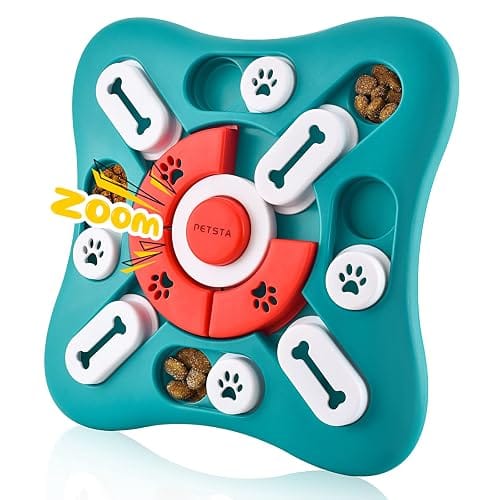
What works well
- Builds problem-solving skills — dog must figure out a manipulation to release each treat
- Keeps dogs occupied longer than scatter-feeding once they engage with it
- Encourages focus and patience rather than just sniffing
Watch out for
- Some dogs give up quickly if the difficulty level is too high — start with easy settings
- Needs supervision until you know your dog won’t chew the plastic pieces
Best for: Dogs that need mental stimulation and are motivated enough to persist at a task | Skip if: Your dog is a determined chewer — opt for a more durable rubber puzzle instead

Recommended enrichment tool in our Daily Training Routines guide for treat-dispensing mental engagement. Unlike a snuffle mat’s scent-based foraging, this style requires the dog to figure out a specific manipulation (nudging, spinning, or sliding a piece) to release each treat, which builds independent problem-solving rather than just occupying time.
Good to know: Start with the easiest difficulty setting if your dog hasn’t used a puzzle toy before — a frustrated dog will disengage rather than learn. Rated 4.4/5 from roughly 9,400 Amazon reviews at the time of writing.
Our experience: I rotate this puzzle toy into our schedule about twice a week. My dog figured out the easiest disc rotation in the first session — I moved to a harder setting immediately. What I didn’t expect: it became a useful indicator of her current stress state. On high-anxiety days she gives up faster; on calm days she works it thoroughly. That information has actually shaped how I calibrate training sessions on a given day.
Listed around $13.99 at the time of writing. Amazon pricing changes frequently — verify the current price before buying.
View on AmazonRead: Daily Training Routines That Actually Work
Affiliate disclosure: This page contains affiliate links. If you buy through them, we may earn a small commission at no extra cost to you — it helps keep the site running. We only link to products featured in our training guides.