
You Walk Into the Pet Store. Your Brain Immediately Shuts Down.
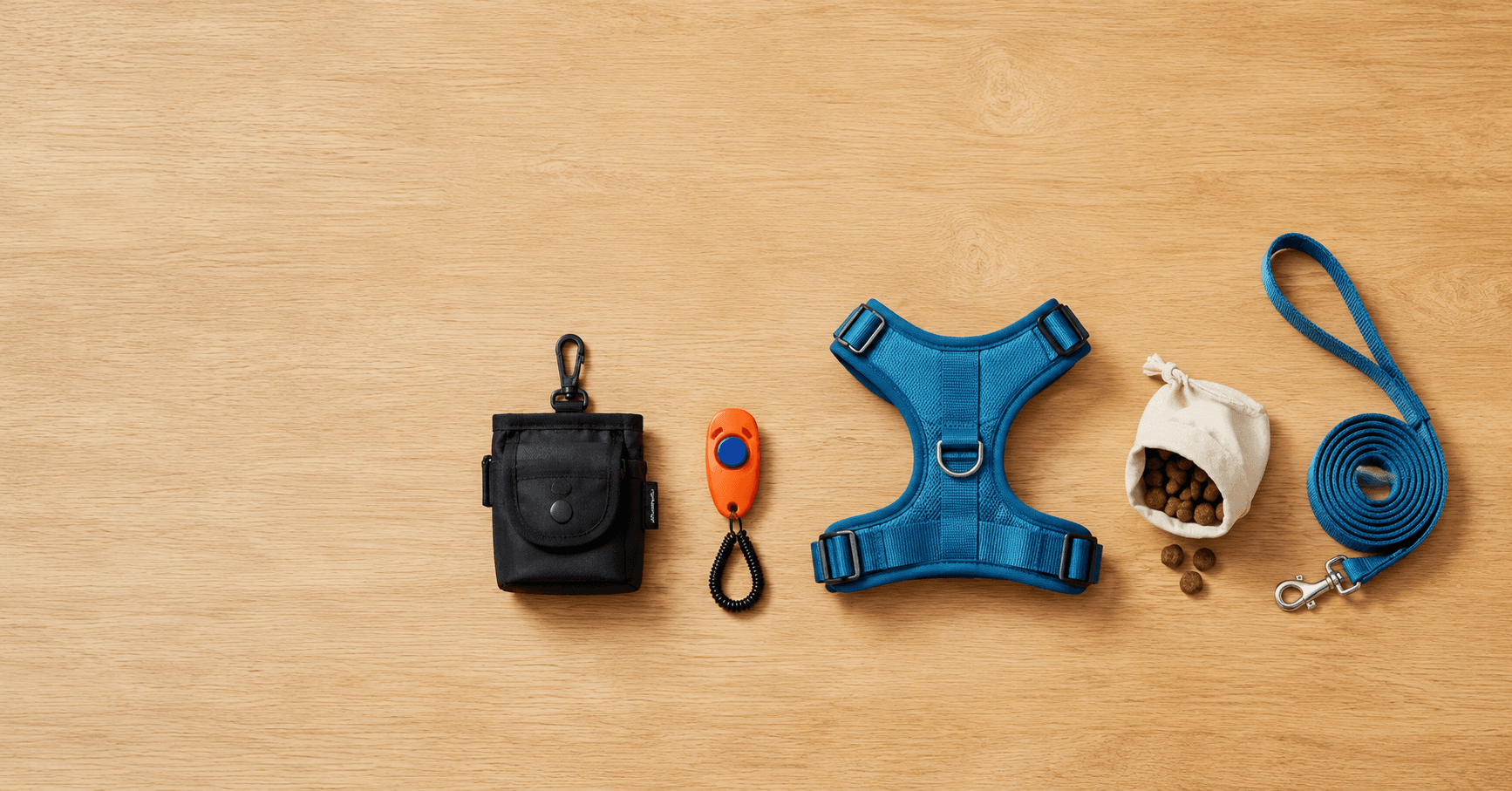
You need “something for training.” That’s all you know. But the pet store greets you with 47 varieties of collars, three walls of treat options, six styles of clickers, and enough harnesses to outfit a sled team. Twenty minutes later you’re standing in the leash aisle holding a prong collar and a squeaky chicken, equally unsure about both.
Here’s the truth that every positive reinforcement trainer will tell you: you don’t need 50 things. You need five to seven core items, and you probably already own some of them. This article tells you exactly which ones to buy, which to skip, and how to set up for success from day one.
| What This Article Covers Section 1: The 3 must-have tools (and how to use each one) Section 2: 2 types of treats to avoid Section 3: Clicker vs. marker word: which is right for you? Section 4: How to set up a distraction-free training space in 4 steps Section 5: The complete beginner’s toolkit checklist Section 6: 3 signs your gear is hurting your progress Section 7: $10 vs. $50 treat pouches: the honest comparison |
Less Gear, Better Training
Before we go tool-by-tool, let’s settle something important: your gear does not train your dog. You do. The best clicker in the world won’t teach recall. The most expensive treat pouch won’t stop jumping. Equipment supports good training, it doesn’t replace it.
With that said, the right gear genuinely helps. A slow treat pouch costs you the exact moment you needed to reward a behavior. Low-value treats mean your dog checks out after three repetitions. A poorly lit, noisy training room adds so many distractions that your puppy can’t focus at all. These things matter: which is exactly why we’re going to get them right, simply and affordably. For the full science behind why positive reinforcement works, readThe Science Behind Positive Reinforcement.
Section 1: The 3 Must-Have Tools

Tool #1: High-Value Training Treats
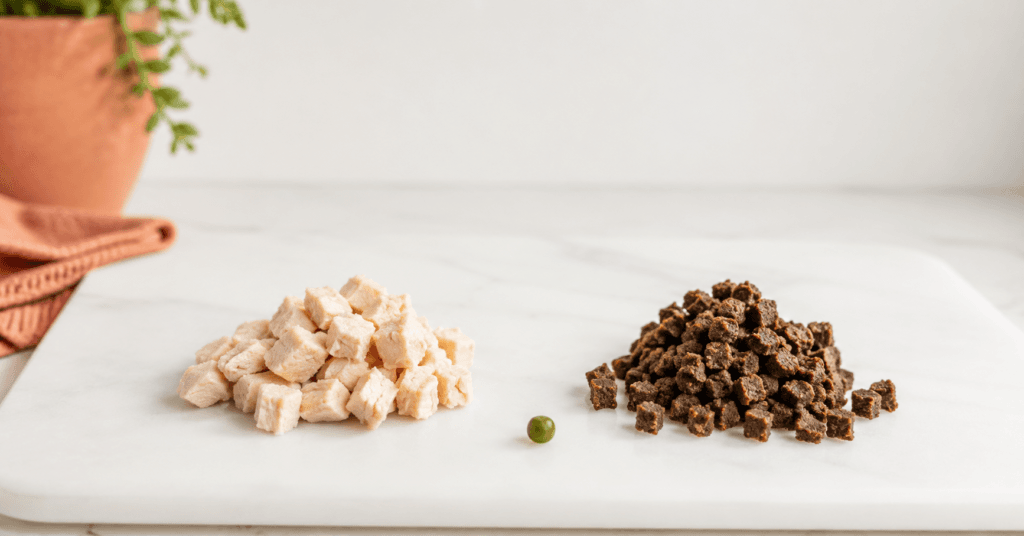
A “high-value treat” simply means a treat your dog finds irresistible, more exciting than whatever they’d rather be doing. High-value treats share four qualities: they’re soft, small, smelly, and quick to consume.
What makes a treat high-value?
- Soft and chewy (swallowed in under 2 seconds, no chewing required)
- Pea-sized or smaller (your dog shouldn’t need a moment to process it)
- Smelly (scent = motivation in dogs, freeze-dried liver is famously effective)
- Novel (something they don’t get in their regular meals)
Best options for beginners:
- Boiled chicken breast, cut into tiny cubes, costs ~$3-4 per batch, wildly effective
- String cheese, tear into tiny pieces, easy to carry
- Freeze-dried liver or salmon, shelf-stable, extremely motivating
- Commercial soft training treats (Zuke’s Mini Naturals, Vital Essentials, Cloud Star Tricky Trainers) (see picks below)
How many treats per day?
A rough guide: treats should not exceed 10% of your dog’s daily calorie intake. For a 20 lb dog eating around 500 calories/day, that’s 50 treat calories. Twenty pea-sized chicken pieces = roughly 20-25 calories. Easy math, and you can subtract that amount from their regular meal.
| Budget Tip Boil a chicken breast at home and freeze in small bags. $3-4 gives you a week’s worth of training treats that outperform most $15 commercial bags. Thaw one bag per day. |

Tool #2: A Treat Pouch
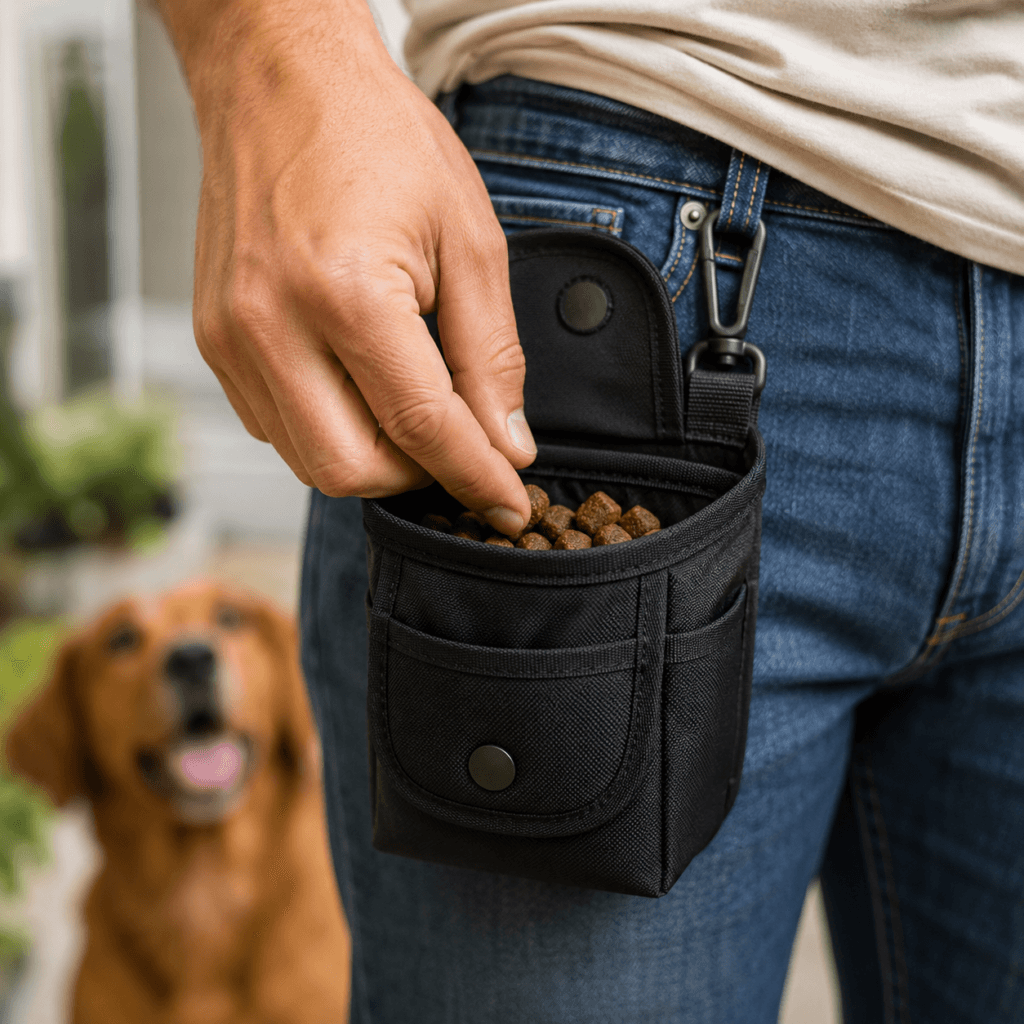
This feels optional until you’ve lost a training moment fumbling in your pocket. Positive reinforcement requires marking and rewarding within 1-2 seconds of the behavior. A treat pouch strapped to your waist means zero fumbling, consistent delivery, and both hands free for leash or lure.
Features to look for:
- One-handed opening (magnetic closure is ideal, open with a thumb, close automatically)
- Belt clip or loop (clips to any waistband, no separate belt needed for basic training)
- Easy to clean (treats get messy, machine washable or rinse-clean lining matters)
- Sized right (large enough for your treat supply, small enough to not swing awkwardly)
What to avoid:
- Zipper closures, too slow; you’ll miss the training window trying to unzip
- Fabric that traps moisture, creates bacteria and smell quickly with soft treats
- Pouches without any closure, treats spill every time you bend over
| Budget pick ($10-15): A basic magnetic bungee pouch from any pet retailer. Works perfectly for 90% of beginners and casual daily training. Premium pick ($25-40): PetSafe treat bag or Doggone Good! Rapid Reward Pouch. Multiple compartments, waterproof liner, full waist belt option. Worth it if you train daily or compete. (see picks below) |

Tool #3: AMarker(Clicker or Word)
A marker is a precise signal that tells your dog: “that exact behavior, right now, earned a reward.” Without a marker, you’re trying to communicate to a dog that the sit they did three seconds ago, before you reached into your pouch, is what earned the treat. Dogs don’t connect cause and effect across multiple seconds without help.
A marker bridges the gap. It captures the behavior at the exact moment it happens, even before the treat arrives.
Clicker pros:
- Completely consistent, always the same sound regardless of your mood or tone
- Distinct from your speaking voice, your dog learns it means exactly one thing
- Dogs typically learn the marker’s meaning in 15-20 repetitions
Marker word pros:
- Always with you, you can’t forget your voice
- One less thing to manage while holding a leash and treats
- Works just as well as a clicker with consistent practice
| Recommendation for Beginners Start with a marker word: “Yes!” said in the same bright, clear tone every time. Train the marker first: say “Yes!” immediately give a treat. Repeat 20 times. Your dog will quickly learn that “Yes!” means a reward is coming. Add a clicker later if you enjoy training as a hobby or want to work on precision shaping. |
Section 2: 2 Types of Treats to Avoid
Treat Type #1: Hard or Crunchy Commercial Treats
Classic dog biscuits: the kind that crunch and take 10-15 seconds to chew, are fantastic for snacking but terrible for training. Every chewing moment is a gap in your session where your dog’s attention drifts. You lose the training rhythm entirely.
Beyond rhythm, hard treats are often high in carbohydrates and low in the protein-driven scent that motivates dogs most. Your dog may take them politely but won’t work especially hard to earn them.
| Use Instead Soft commercial training treats, tiny boiled meat pieces, or freeze-dried single-ingredient treats that dissolve quickly and smell strongly. |
Treat Type #2: Human Junk Food (Cookies, Chips, Bread)
It’s tempting, especially when you’ve run out of dog treats mid-session and there’s a sleeve of crackers on the counter. But most human snack foods are too dry, too large, too salty, and nutritionally empty for regular training use.
More importantly, bread and crackers aren’t particularly motivating to dogs, they’re not smelly enough to compete with environmental distractions. You end up with a dog who’s vaguely interested instead of laser-focused.
| Use Instead Plain boiled chicken, cheese, or a piece of deli turkey in a pinch, all human foods that are safe, soft, smelly, and genuinely motivating for most dogs. |
| Dog with Food Allergies? Look for single-ingredient, limited-protein training treats. Freeze-dried venison, rabbit, or duck are excellent options for dogs who react to chicken or beef. Always check with your vet if you’re unsure. |
Section 3: Clicker vs. Marker Word, Which Should You Choose?
Let’s settle this debate with a clean comparison:
| Feature | Clicker | Marker Word (“Yes!”) |
| Consistency | Identical every time | Can vary in tone |
| Speed | Very fast (≤ 0.1 sec) | Fast with practice |
| Always with you? | No, must carry it | Yes, you always have your voice |
| Learning curve | Dog learns in ~5 minutes | Dog learns in ~5 minutes |
| Best for | Precision shaping, deaf dogs | Everyday training, beginners |
| Cost | $3–$8 per clicker | Free |
Our Recommendation for First-Time Owners:
Start with a marker word. Here’s the three-step setup:
- Choose your word. “Yes!” is the most common. “Good!” also works. Pick one and stick with it.
- Train the marker. Before any other training, do 20 repetitions of: say “Yes!” immediately give a treat. Do nothing else. Your dog is learning that the word predicts the treat.
- Use it immediately. From this point on, every time your dog does something you want, mark it with “Yes!” within 1-2 seconds, then give the treat.
Once you’re training consistently and enjoying it, add a clicker to sharpen your timing and work on more complex behaviors. You’ll find it immediately useful once you have the basics down.
Section 4: How to Set Up a Puppy-Proof Training Space in 4 Steps
Where you train matters as much as how you train. A distracting environment is the #1 reason beginner sessions fail, it’s not the dog, it’s the setting. Here’s how to build the right space in under five minutes:
Step 1: Choose the Right Location
You want a small, quiet area with minimal foot traffic. Think: bathroom, laundry room, a quiet corner of the living room, or the garage. Small spaces naturally keep your dog closer to you and limit their ability to wander.
- Avoid high-traffic areas (near the front door, kitchen during cooking)
- Avoid spaces where other pets roam freely
- Avoid rooms with windows showing busy outdoor activity (squirrels, people, cars)
Step 2: Remove Distractions
Distractions compete with your treats for your dog’s attention. Remove everything that doesn’t need to be there:
- Put away toys (except the one you’re using as reinforcement)
- Move food off counters and tables
- Crate or gate other pets in a separate room
- Close curtains or blinds if outdoor activity is visible
Step 3: Set Up Your Training Station
Think of this as your cockpit before takeoff. Everything you need should be ready before your dog enters the room:
- Treat pouch loaded and on your waist
- Marker (clicker in hand or marker word ready)
- Small mat or specific spot your dog will associate with training
- Water bowl nearby, training is genuinely thirsty work for dogs
Step 4: Prepare for Short Sessions
This is the step most beginners skip, and the one that matters most. Puppies have an attention span of roughly 2 minutes. Adult dogs can typically manage 5 minutes. Training longer creates frustration, not progress.
- Set a timer for 2 minutes (puppies) or 5 minutes (adult dogs)
- Plan 3-5 short sessions spread through the day rather than one long one
- End every single session on a success, even if it’s asking for something easy like sit that you know they can do
| Example: Mia, a first-time owner, was doing 20-minute training sessions with her 10-week-old puppy and wondering why he “refused to learn.” She switched to 2-minute sessions three times a day. Within one week, her puppy was sitting reliably and offering eye contact voluntarily. The puppy hadn’t changed. The session length had. |
Section 5: The Beginner’s Toolkit Checklist
Print this. Take it shopping. Come home with exactly what you need and nothing more.
Essential, Buy Before Day 1:
- High-value training treats (boiled chicken pieces or soft commercial training treats)
- Treat pouch with magnetic or bungee opening and belt clip
- Marker, choose ONE: clicker OR marker word (“Yes!”). We recommend starting with the word.
Nice to Have, Weeks 2-3:
- Second treat pouch dedicated to walks
- Variety of treat types (prevents boredom and maintains motivation)
- Small non-slip mat for “place” training
- Long line (15-30 foot leash) for outdoor recall practice
Skip Entirely, Save Your Money:
- Prong collars, choke chains, or shock collars (not force-free, contraindicated for beginners)
- Treats with artificial colors, BHA/BHT preservatives, or corn syrup
- Bulky treat pouches with zipper closures
- Gadgets that claim to “train your dog automatically” (they don’t)
Section 6: Is Your Training Gear Hurting Progress?
Sometimes training stalls and we blame the dog. Often, the problem is equipment. Here are three gear red flags, and quick fixes for each:
Sign #1: Your Treat Pouch Is Too Slow
If you’re fumbling for treats, your dog has already moved on. The 1-2 second marking window is real, and losing it consistently produces a dog who seems confused about why they’re being rewarded.
- Fix: Switch to a magnetic closure pouch. Practice retrieving a treat one-handed while your other hand holds a leash until it’s automatic.
Sign #2: Your Treats Are Boring Your Dog
Watch how your dog takes the treat. If they sniff it slowly, take it gently, or spit it out: that treat is not high-value in this environment. A dog who spits out a treat is showing you exactly what they think of it.
- Fix: Upgrade immediately to boiled chicken, freeze-dried liver, or small cheese pieces. You’ll see the difference in engagement within one session.
Sign #3: Your Marker Is Inconsistent
Are you sometimes saying “Yes!”, sometimes “Good!”, sometimes clicking, and sometimes forgetting entirely? Your dog is trying to predict what earns the reward, and inconsistency makes that prediction impossible.
- Fix: Pick exactly one marker and use it exclusively. If it helps, put a sticky note on your treat bag: “Yes! Only.” Retrain the marker with 20 rapid “Yes! treat” repetitions before your next session.
Section 7: $10 vs. $50 Training Treat Pouches, The Honest Comparison

We compared budget and premium treat pouches side-by-side. Here’s exactly what you’re getting at each price point:
| Feature | Budget ($10–15) | Premium ($30–50) |
| Price range | $10–$15 | $30–$50 |
| Opening style | Magnetic closure | Bungee, magnetic, or twist-lock |
| Compartments | 1 main pouch | 2–3 (treats, bags, keys) |
| Attachment | Belt clip | Full waist belt + clip |
| Liner | Basic nylon | Waterproof or washable lining |
| Lifespan | 6–18 months daily use | 2–5 years daily use |
| Best for | Beginners, casual trainers | Daily trainers, competition handlers |
| Verdict | Start here | Buy only when you outgrow the budget option |

The 4 Things Both Have in Common:
- Both hold treats. That’s the job. Both do it.
- Both need to be cleaned regularly. Soft treats leave residue that grows bacteria fast. Rinse weekly.
- Both require practice to use one-handed. Budget time in your first week to practice the retrieval motion without your dog present.
- Neither will train your dog for you. You still have to show up, be consistent, and do the work. No pouch changes that.
| Our Verdict Buy the $10-15 budget option first. If you’re still training daily six months later and the pouch is wearing out, upgrade. Most first-time owners get everything they need from the budget option for the first year. |
FAQ: Real Questions from Overwhelmed Beginners
“How many treats can I give my puppy in one day?”
Treats should account for no more than 10% of your dog’s daily calorie intake. For most medium-breed puppies, that’s 40-80 treat calories, roughly 30-50 pea-sized pieces of boiled chicken. If you’re doing multiple training sessions, subtract the treat calories from their regular meal to keep intake balanced.
“My dog ignores treats outside: what do I do?”
Outdoor environments are dramatically more stimulating than indoors. Your dog’s arousal level is high enough that their “threshold” for reward overrides even good treats. Two solutions: upgrade to even higher-value treats (use hot dog outside if chicken works inside), and lower the difficulty of what you’re asking for until their engagement improves. Start with name recognition, not recall past a squirrel.
“Do I really need a treat pouch? Can’t I just use my pocket?”
You can, and your pocket will work until you lose a key training moment fumbling for a treat. A pouch costs $10-15 and saves that frustration. Try pockets for your first few sessions if you want, but most owners switch to a pouch within a week.
“Clicker vs. marker word: which is better for an older rescue dog?”
Marker word. Rescue dogs with unknown histories may have a fear association with sudden sharp sounds (clickers can startle anxious dogs). A calm, consistent marker word (“Yes!”) is lower-stress to introduce. Once your dog is comfortable, relaxed, and engaged in training, you can introduce a clicker if you want to. (see the nervous rescue dog section inSolving Common Behavior Problems)
“What if I can’t afford all this gear?”
Here’s the minimum viable setup: boil a chicken breast ($3-4), use your voice as the marker (“Yes!”, free), and carry treats in your hand or a sandwich bag in your pocket. Total investment: $3-4. The gear helps. It doesn’t determine whether you succeed.
“How do I clean my treat pouch?”
After every few sessions, empty the pouch completely and rinse with warm water. For deeper cleaning, hand-wash with mild dish soap, rinse thoroughly, and air-dry fully before reuse. Soft treats left in a pouch grow mold quickly in warm weather, don’t leave them in overnight.
“My dog is allergic to chicken: what treats should I use?”
Try single-protein alternatives: freeze-dried duck, rabbit, venison, or salmon. Most pet retailers stock these. Avoid anything with chicken by-products in the ingredient list, which appears in many commercial training treats. When in doubt, check with your vet and look for a limited-ingredient treat with a single protein source you know your dog tolerates.
“Can I use kibble as a training treat?”
Yes, in low-distraction environments. Kibble works beautifully for dogs who are very food motivated and for basic behaviors in quiet settings. In higher-distraction environments (outside, near other dogs, new places), kibble usually isn’t exciting enough. Use it for easy behaviors in controlled settings, and upgrade to high-value treats when the environment gets harder.
You Don’t Need 50 Things. You Need 5.
Let’s land this simply: good training treats, a treat pouch that opens in half a second, a consistent marker, and a distraction-free space. That’s your entire toolkit to start. Everything else: the long line, the second pouch, the clicker, the variety of treats, gets added as you need it.
Your dog doesn’t care whether your treat pouch cost $10 or $50. They care about whether you show up consistently, reward the right things at the right time, and make training feel like a game worth playing. Start simple. Stay consistent. The gear will follow your progress, not the other way around.
| Download the Free Beginner’s Toolkit Checklist Want a printable version of the complete toolkit checklist in this article? Enter your email below, we’ll send it straight to your inbox along with our full Positive Reinforcement 101 starter kit. Print it. Take it shopping. Come home with exactly what you need. |
Resources & Recommended Products
Recommended Training Treats (Affiliate Links)
Recommended Treat Pouches (Affiliate Links)
Useful Next Steps
- The Science Behind Positive Reinforcement, Why positive reinforcement works (the science, simply explained)
- Crate Training with Positive Reinforcement, How to use your new toolkit for crate training
- Solving Common Behavior Problems, How to stop puppy biting without punishment
10 Comments