

“You Can’t Teach an Old Dog New Tricks” Is Wrong. Here’s the Actual Science.
This is one of the most persistent, and most wrong, pieces of dog training folklore. Dogs of every age learn through the same basic mechanism: reinforcement. What changes with age isn’t whether a dog can learn, but how quickly, what motivates them, and what baggage (or lack of it) they’re bringing into the process.
This guide breaks down exactly what changes at each life stage, puppy, adolescent, adult, senior, and, just as importantly, what doesn’t change at all. Whether you just brought home an 8-week-old puppy or adopted a 7-year-old rescue, the fundamentals of positive reinforcement apply to both. The difference is in the details.
What’s Covered in This Article
- Section 1: The science: how learning changes with age
- Section 2: Training a puppy: what to prioritize first
- Section 3: The adolescent phase nobody warns you about
- Section 4: Training an adult or rescue dog: what’s different
- Section 5: Training senior dogs: what actually needs to change. How to tell which stage your dog is really in. A realistic example: two very different starting points
- Section 6: Common myths about ‘old dogs’ and training
- Section 7: Adjusting session length, rewards, and pace by age
- Section 8: What stays exactly the same at every age
- Section 9: When to get extra support
Section 1: The Science, How Learning Changes With Age
Puppies are in a critical socialization window roughly between 3 and 14 weeks, during which they form lasting associations with new people, animals, sounds, and experiences unusually fast: this is why early exposure matters so much. The American Veterinary Society of Animal Behavior’s position statement on puppy socialization goes as far as recommending it start before puppies are even fully vaccinated, since the behavioral risk of under-socialization outweighs the disease risk in most everyday environments. Past that window, dogs don’t lose the ability to learn; the underlying learning mechanism (operant conditioning) works identically at every age.
What changes is the presence of prior conditioning. An adult dog may already have strong associations, good or bad, that a puppy simply hasn’t built yet: a rescue who flinches at raised hands has learned something specific, just as a confident adult dog who loves car rides has learned something specific too. Training an older dog often means working with or around existing associations, rather than building purely from a blank slate the way you would with a young puppy.
This is a useful reframe for anyone feeling discouraged about starting training “late.” You’re not starting from zero with an adult dog, you’re starting from wherever their prior experiences left them, which might include plenty of existing skills you can build on, alongside a few habits worth gently redirecting.
Section 2: Training a Puppy, What to Prioritize First
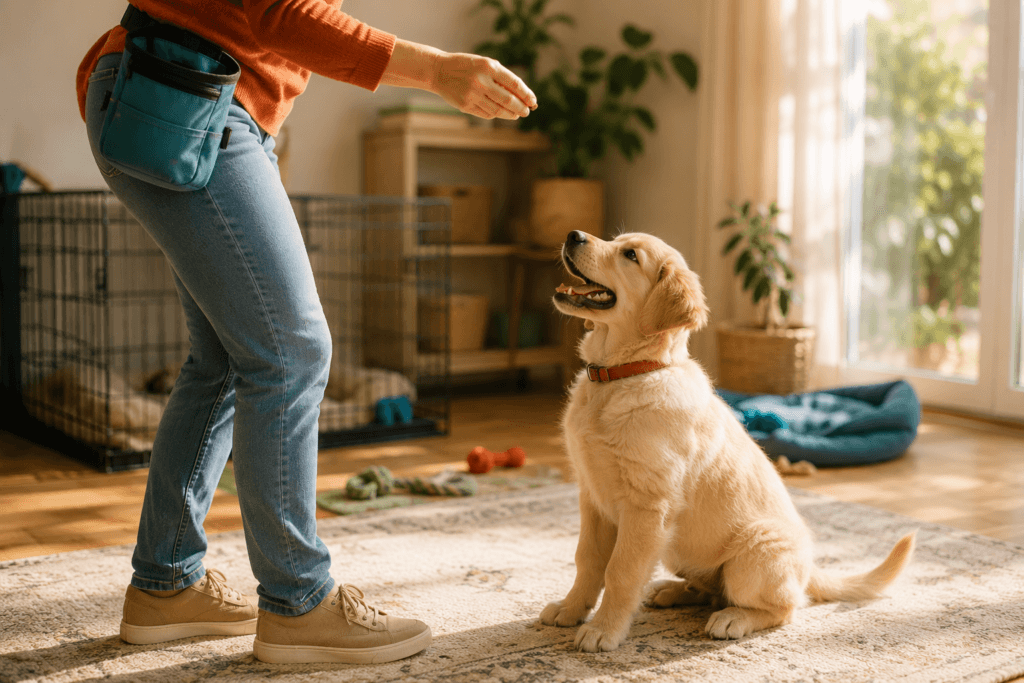
The first few weeks with a new puppy can feel overwhelming precisely because everything is a priority at once, socialization, house training, bite inhibition, basic manners. Trying to tackle all of it with equal intensity usually backfires; a more sustainable approach is sequencing priorities roughly in the order below, while still taking advantage of the socialization window running in parallel.
- Socialization, safe, positive exposure to new people, dogs, sounds, and surfaces during the critical window
- Bite inhibition and mouthing, shaping how hard is ‘too hard’ before adult teeth make it painful
- House training and crate basics, foundational routines that get harder to unlearn the longer they’re delayed
- Short, frequent sessions: a puppy’s attention span is measured in minutes, not blocks of time
It’s worth noting that puppies also need substantially more downtime than most new owners expect: a young puppy can easily sleep 16-18 hours a day, and overtiredness often looks like hyperactivity and poor impulse control rather than obvious sleepiness. A puppy who suddenly seems impossible to redirect may simply need a nap more than another training rep.
First Commands & Daily Routines
Crate Training with Positive Reinforcement
Section 3: The Adolescent Phase Nobody Warns You About
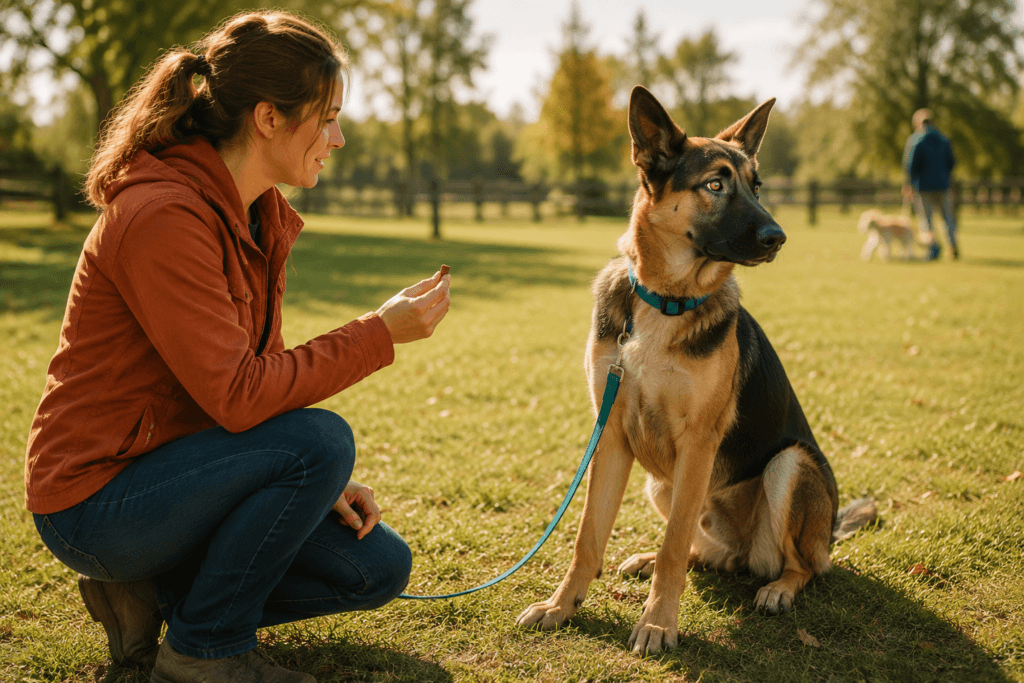
Somewhere between 6 and 18 months, many owners hit a confusing wall: a puppy who seemed nearly fully trained suddenly acts like they’ve forgotten everything. This adolescent phase is driven by hormonal shifts and a developmental push toward independence-testing, similar in spirit to what happens in human adolescence: the dog isn’t being defiant so much as genuinely more distractible and more inclined to test boundaries that used to feel firm.
This is one of the most common points where owners give up on training altogether, mistakenly concluding that their dog is simply “stubborn” or that positive reinforcement “stopped working.” In reality, this phase is temporary and responds to the same consistent reinforcement that worked before, it just requires more patience and often more management (leashes indoors, more supervision) during the regression itself.
- Expect previously solid behaviors (recall, loose-leash walking) to become less reliable temporarily
- Increase reinforcement rate temporarily rather than assuming the dog no longer needs rewards for known behaviors
- Avoid escalating corrections in frustration: this phase responds poorly to increased pressure and well to patient consistency
Section 4: Training an Adult or Rescue Dog, What’s Different
Adult dogs, especially rescues, often arrive with existing associations that need to be worked around or gently replaced, rather than built from a blank slate. This can actually work in your favor: many adult dogs have longer attention spans and calmer default states than puppies, which makes focused training sessions easier to run once trust is established.
The main adjustment is patience with unlearning. If a behavior has been reinforced (even accidentally) for years, expect it to take longer to shift than a brand-new puppy habit would. A dog who’s jumped on guests for five years to get attention has had five years of that behavior working, replacing it takes consistent redirection over weeks, not days.
Rescue dogs specifically may also need a decompression period, often referred to informally as the “3-3-3 rule” (roughly 3 days to decompress, 3 weeks to start settling into routine, 3 months to feel fully at home), before training progress accelerates. Expecting fast results in the first few days often leads to unnecessary frustration on both sides.
It’s also worth remembering that many adult and rescue dogs already know some cues, just not the ones you’re using, or not in the context you’re using them. A dog who ignores “sit” at home might actually respond fine to a hand signal, or might have been trained with a completely different word in a prior home. Testing a few common cue variations before assuming a dog knows nothing can save weeks of unnecessary re-teaching from scratch.
Section 5: Training Senior Dogs, What Actually Needs to Change
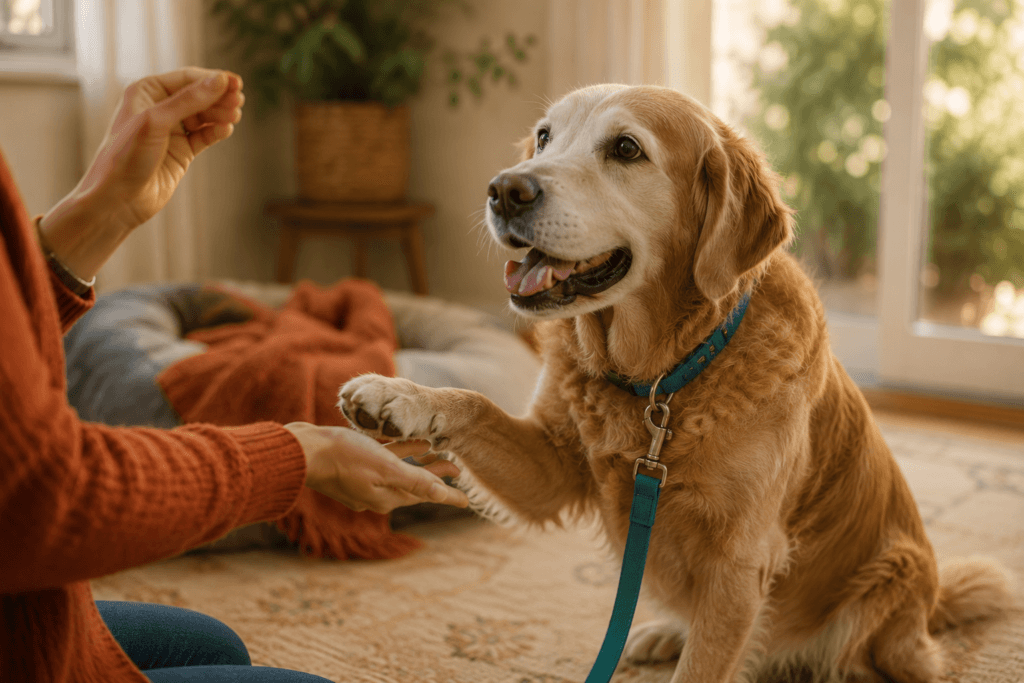
Senior dogs can absolutely continue learning new behaviors, but physical considerations become more relevant than they were earlier in life. Joint stiffness may make certain positions (like a full “down”) uncomfortable; reduced hearing may require a shift toward hand signals; reduced vision may mean relying more on verbal cues. None of these reduce a senior dog’s capacity to learn, they just change what’s comfortable to ask for.
- Keep sessions shorter (2–3 minutes) and end on an easy win rather than pushing for one more rep
- Watch for signs of discomfort (reluctance to sit or lie down) rather than assuming reduced compliance means reduced understanding
- Consider transitioning cues to hand signals gradually if hearing loss is suspected, pairing the visual cue with the verbal one before phasing the verbal cue out
How to Tell Which Stage Your Dog Is Really In
Age in years doesn’t always map neatly onto developmental stage, especially across different breeds and sizes. Small breeds often physically and behaviorally mature faster than large breeds, and large or giant breeds can still show adolescent-like behavior well past a year old. Rather than relying purely on a birthday, it helps to watch for behavioral signals alongside age as a general guide.
- Puppy stage: still primarily motivated by novelty and play, limited impulse control, learning basic household rules for the first time
- Adolescent stage: previously reliable behaviors becoming inconsistent, increased interest in environmental distractions over the handler, testing of boundaries that used to hold
- Adult stage: behavior patterns are largely established, learning new things is more about habit replacement than fresh learning, generally more consistent focus
- Senior stage: any noticeable slowing in response time, increased need for rest between activities, possible sensory changes affecting how cues are best delivered
A large-breed dog might not fully exit the adolescent stage until closer to two years old, while a small-breed dog may settle into adult behavior patterns by 12–14 months. Matching your training approach to your dog’s actual behavioral stage, not just their age on paper, tends to produce better results than following a rigid one-size-fits-all timeline.
A Realistic Example: Two Very Different Starting Points
Consider two dogs arriving in new homes on the same day: an 8-week-old puppy with zero prior experience, and a 4-year-old rescue with an unknown history. The puppy’s first week focuses on the basics, name recognition, the beginnings of house training, gentle exposure to household sounds and textures. Short sessions, high treat frequency, and a huge amount of patience for accidents and mistakes define this stage.
The rescue’s first week looks completely different. Rather than jumping into formal training, the priority is decompression, letting the dog settle into the new environment, observing what seems to worry or excite them, and building trust through predictable routines before asking for much at all. Formal training sessions might not start in earnest until week two or three, once the dog is eating normally, sleeping through the night, and showing signs of comfort in the home. By week four, the rescue may already be picking up basic cues faster than the puppy did, simply because adult dogs often generalize learning more efficiently once they’re settled enough to focus.
Neither path is faster or slower in any absolute sense, they’re just different starting points requiring different early priorities before the same core training principles apply to both.
Section 6: Common Myths About ‘Old Dogs’ and Training
The belief that older dogs can’t learn likely persists because owners expect faster results than realistic, get frustrated, and give up early, not because senior dogs are actually incapable. Positive reinforcement works at any age; sessions may just need to be gentler and shorter to account for physical comfort (joint stiffness, reduced stamina) rather than reduced learning capacity.
A related myth: that rescue dogs with unknown histories are inherently harder to train than dogs raised from puppyhood. In practice, many rescue dogs progress quickly once basic trust is established, precisely because they’re often highly motivated to figure out what earns rewards and affection in a new, stable environment.
Section 7: Adjusting Session Length, Rewards, and Pace by Age
- Puppies (8 weeks–6 months): 2–5 minute sessions, multiple times daily, high-value treats, huge patience for mistakes
- Adolescents (6–18 months): slightly longer sessions, expect regression during this stage, it’s developmental, not a failure
- Adults (18 months+): longer sessions possible, focus on replacing existing habits rather than building from scratch
- Seniors: shorter, gentler sessions, account for hearing/vision/mobility changes, keep it low-pressure and fun
Section 8: What Stays Exactly the Same at Every Age
Despite all these adjustments, the core mechanics of positive reinforcement don’t change based on age at all. Marking the exact moment of correct behavior, rewarding consistently while a behavior is new, and fading rewards gradually once it’s reliable, these principles apply identically to an 8-week-old puppy and an 11-year-old senior. What changes is pacing and physical accommodation, not the underlying method.
This is genuinely reassuring news for anyone feeling overwhelmed by all the age-specific nuance above: you don’t need a different training philosophy for every life stage, just a different rhythm. The same clear communication, consistent rewards, and patient repetition that teaches a puppy to sit will teach a senior dog a new trick, or help a rescue dog unlearn a years-old habit. The method is the constant; the timeline is the variable.
Whatever stage your dog is at, if you’re still rewarding every single correct response, it’s worth reading how to wean your dog off treats without losing the reliability you’ve built.
Section 9: When to Get Extra Support
If an adult or rescue dog’s unwanted behavior is rooted in fear, trauma, or aggression rather than simple habit, a certified professional trainer or veterinary behaviorist can help, positive reinforcement principles still apply, but the specific protocol for fear-based behavior benefits from expert guidance, particularly when there’s any bite history or escalating intensity involved.
FAQ: Honest Answers to Real Questions About Training by Age
“Is it harder to train a rescue dog?”
Not necessarily harder, just different. Expect an adjustment period as trust builds before training progress accelerates, often 2–4 weeks for a dog to settle enough to focus fully.
“At what age should puppy training start?”
Immediately upon bringing your puppy home, typically around 8 weeks. Waiting until vaccinations are complete for formal group classes is fine, but basic reward-based learning at home can start on day one.
“Can senior dogs still learn new commands?”
Yes, senior dogs learn well with positive reinforcement; just keep sessions to 2–3 minutes and account for any physical limitations like hearing loss or joint pain.
“Why does my adolescent dog suddenly seem to have forgotten everything?”
This is the adolescent regression phase, common between 6–18 months, driven by hormonal changes and increased independence-testing. It’s temporary, stay consistent rather than assuming training failed.
“Should I use different reward types for older dogs?”
Not necessarily different types, but often lower-intensity ones, food-motivated seniors still respond well to treats, but calm praise and gentle physical affection often carry equal weight for a dog no longer chasing high-arousal rewards.
“How long does the adolescent phase actually last?”
It varies by dog and breed, but many owners see it resolve somewhere between 18 months and 2 years, with larger breeds sometimes taking longer to fully mature out of it than smaller ones.
“Is there an age where it becomes too late to socialize a dog?”
The critical window (roughly 3–14 weeks) is the most efficient time for socialization, but adult dogs can still build new positive associations with careful, gradual exposure, it simply takes more repetition than it would have during the critical window.
“Do small and large breeds mature at different rates?”
Yes, small breeds often physically and behaviorally mature faster, sometimes settling into adult behavior by 12–14 months, while large and giant breeds can remain in an adolescent-like phase well past 18 months to two years.
The Bottom Line
Whatever stage your dog is at, the fundamentals are the same ones covered throughout this whole series, reward what you want to see more of, and adjust the pace to fit the dog in front of you, not a generic timeline. A puppy, an adolescent, a newly adopted adult, and a graying senior are all capable of learning; they just need the approach shaped around where they actually are, not where a training book assumes every dog should be.
If there’s one thing worth taking away from all the age-specific detail above, it’s this: age changes the packaging, not the substance. The dog in front of you, whatever their age or history, is still fully capable of learning through the same reward-based principles that work for every dog. The only real question is how much patience and adjustment that particular stage calls for, and now you have a clearer sense of what that looks like at every point along the way.

| Download the Free 5-Step Positive Reinforcement Starter KitWant a simple printable tracker that works whether you’re starting with a brand-new puppy or a newly adopted adult dog? Enter your email below and we’ll send it straight to your inbox. |
Still deciding how much structure your dog actually needs? Our roundup of the best dog training apps and online courses breaks down which formats work best at each life stage.
Resources & Series Links
Positive Reinforcement 101 Series