

The Short Answer: Sometimes, But Only for One Specific Reason.
If your dog barks and lunges at every dog, bike, or stranger on your walks, you’ve probably already searched “best dog training app” and found a handful of roundups, including ours, listing five or six options with star ratings. What most of those lists don’t get into is that reactivity work is a different category of problem than teaching “sit,” and most apps simply weren’t built for it.
This isn’t another ranked list. It’s the question most owners actually need answered first: whether an app can help with reactivity at all, which one feature separates the apps that can from the ones that can’t, and what to expect if you go that route instead of hiring someone in person.
It’s also worth saying upfront why this even needs its own article instead of a paragraph in the main roundup. Reactivity gets treated as just another item on a feature checklist in most “best apps” content, filed next to potty training and recall like it’s the same kind of problem. It isn’t. A dog who won’t come when called is frustrating. A dog who’s screaming and lunging at the end of the leash while a stranger stares at you is a different kind of stressful, and the stakes of picking the wrong tool are higher too.
Why Most Training Apps Fall Short Here
A typical training app is built around a video library and a curriculum: watch a lesson, practice the cue, move to the next lesson. That model works fine for obedience basics, since the behavior is visible and predictable the moment you sit down to film it. Reactivity doesn’t cooperate that way. What actually happens during an episode, how far away the trigger was when your dog first noticed it, how fast things escalated, whether recovery took ten seconds or two minutes, is information only you can observe in the moment. A pre-recorded lesson can walk you through the “Look at That” game in the abstract. It can’t tell you whether your dog was already too close to the trigger when the barking started.
Here’s what that looks like in practice. You watch a video explaining threshold distance, you understand the concept, and you go out and try it. Your dog reacts anyway. Was your starting distance too short? Did a second trigger appear that you didn’t account for, like a jogger passing right as the first dog approached? Was your dog already a little more on edge that day because of something unrelated, a vet visit that morning, a bad night’s sleep? A video course has no way to see any of that. It gave you the concept and then left you to run the experiment alone, with no one checking whether you set it up correctly. That gap, between understanding a technique and correctly applying it to your specific, unpredictable dog in real conditions, is exactly where reactivity training differs from most of what training apps are built to teach.
The One Feature That Actually Matters: Live Feedback
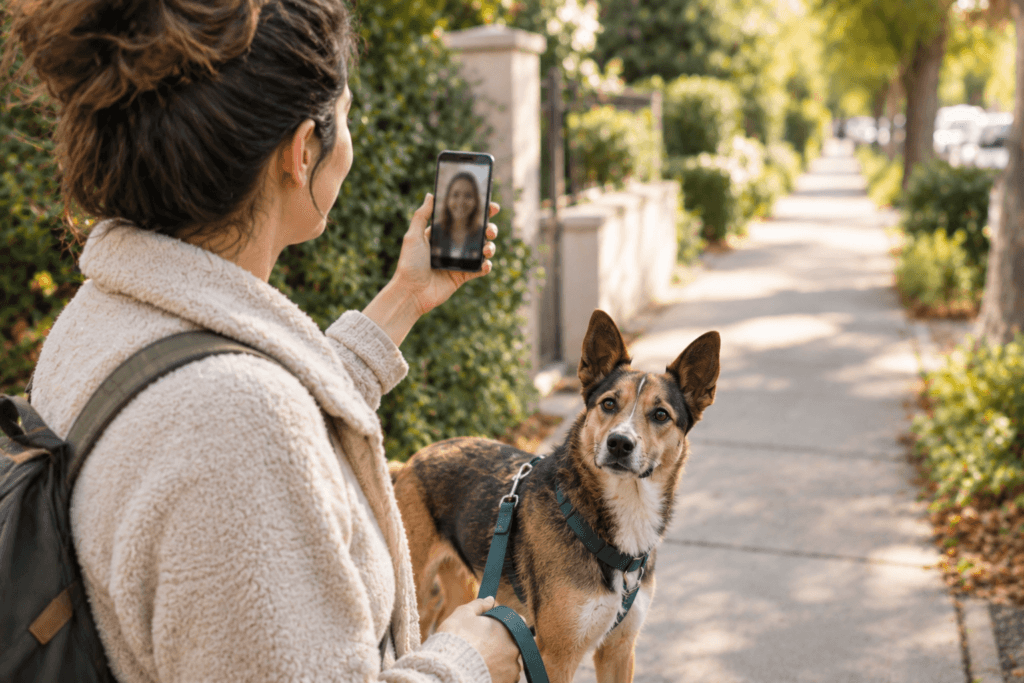
This is why GoodPup’s live-coaching model, and not the video-library apps, is the one worth taking seriously for reactivity specifically. A trainer watching your dog react in real time, even over a video call, can catch the exact moment your dog crossed from noticing the trigger into being over threshold. That’s the single most important skill in reactivity work, and it’s genuinely hard to self-diagnose from a phone screen. Our full Leash Reactivity 101 guide covers what that threshold looks like in body language, but reading about it and catching it live, in your own dog, in the moment, are two different skills.
If an app doesn’t offer that kind of real-time human observation, whether through a video call, a live class, or coaching that reviews footage of an actual reactive episode rather than a staged demo, it can teach you the techniques without the harder part: knowing whether you’re applying them correctly to your specific dog.
What a Live-Coaching Session Actually Looks Like
If you’ve never used a live video-coaching format before, it’s worth knowing roughly what to expect, since it’s a different experience than watching a lesson on your own schedule. Sessions are typically scheduled in advance rather than on-demand, which matters for reactivity work specifically: you may need to plan a session around a time when you can actually walk your dog past a controlled trigger, like a quiet street where a neighbor’s calm dog sometimes passes, rather than just logging on from the couch.
During the session itself, you’re usually holding your phone or wearing a camera while your trainer watches remotely and talks you through adjustments in real time: move back another ten feet, mark that calm glance right now, that’s close enough for today. The value isn’t the lesson content, which often overlaps heavily with free material you could find elsewhere. It’s the correction happening in the moment a mistake is being made, rather than a week later when you rewatch your own footage and try to guess what went wrong.
Between live sessions, most programs also expect you to practice the assigned exercises on your own, which means the live component supplements your daily work rather than replacing it. An owner expecting the trainer to do the training for them, rather than coach them through doing it themselves, is usually disappointed by any format, live or otherwise. The dog is learning from you, every day, not from the trainer, once a week.
What a Self-Guided App Can Still Do Well
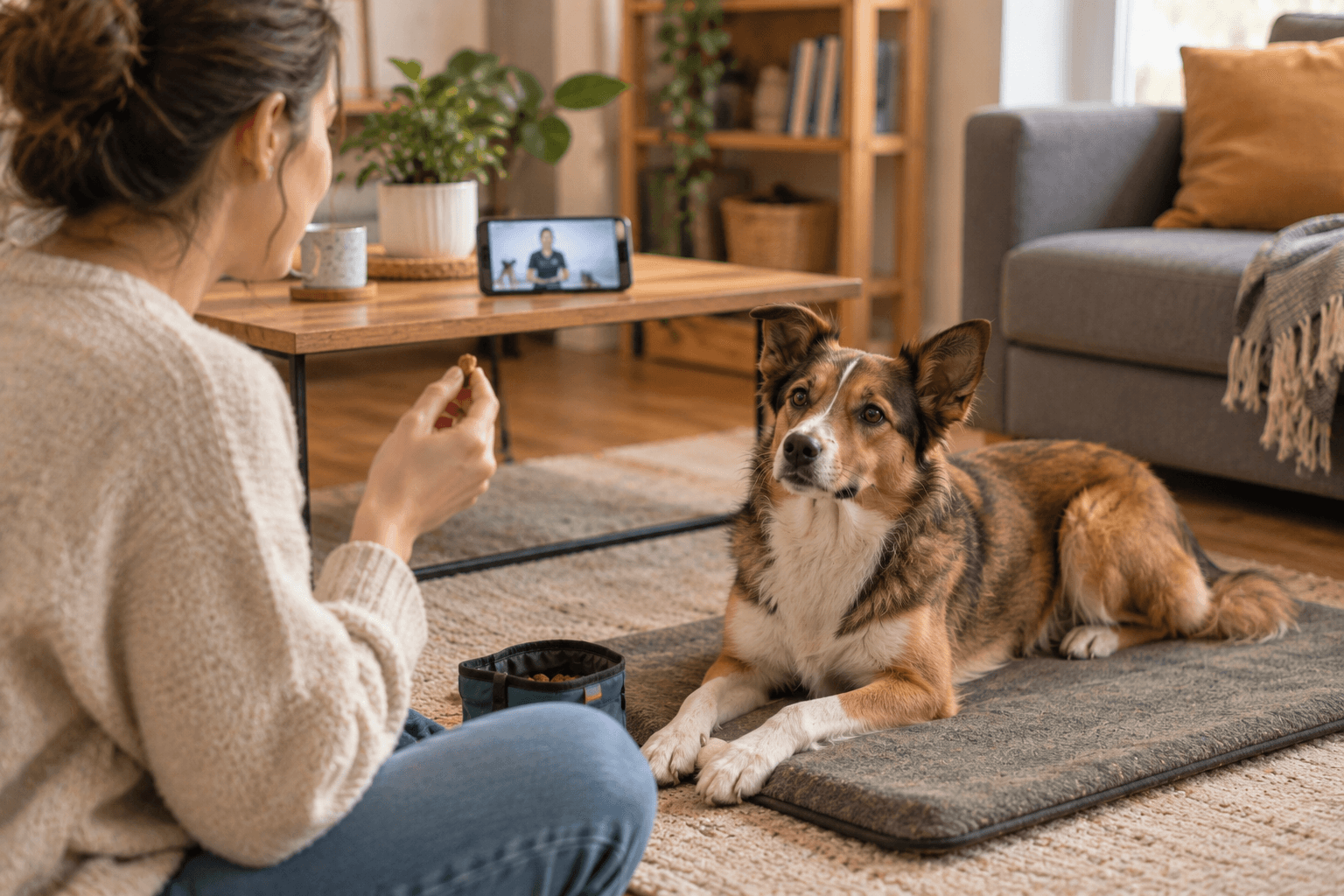
None of this makes a video-based app useless if your dog is reactive. The building blocks, a rock-solid “look” cue, engagement practice in a quiet room before adding distractions, duration work on a mat or settle cue, are things a good video course teaches perfectly well, and they’re genuinely useful groundwork before you ever step outside with a trigger present. Where a self-guided app runs out of road is the actual application: taking that “look” cue and using it correctly at thirty feet from a barking dog, in real time, under real stress.
Specific groundwork that translates well from a video app to real reactivity practice includes name recognition under mild distraction, hand-targeting as a quick attention reset, and building duration on a settle so your dog can hold still and calm for longer stretches. All three show up constantly in reactivity protocols once you’re outside with a trigger present, and all three are things you can build safely at home with no trigger involved at all, which is exactly the kind of low-risk, repeatable practice a video app handles well.
A reasonable way to use one of these apps is as a warm-up, not a full solution. Build the foundation skills at home through the app, then treat the harder, trigger-present work as something that benefits from live coaching or an in-person trainer, rather than expecting the same app to carry you through both phases.
Questions Worth Asking Before You Subscribe
Before paying for any live-coaching program specifically for reactivity, a short list of questions tends to separate a genuinely useful service from one that just adds “live” to its marketing without changing much underneath.
- How long is an actual session, and is it truly one-on-one, or a group class where your dog gets a few minutes of direct attention among several others?
- Can you message your trainer between scheduled sessions if something comes up mid-week, or is contact limited strictly to the live call itself?
- Does the same trainer work with you consistently, or does the program rotate you between different staff who don’t know your dog’s history session to session?
- What happens if a session doesn’t go well, is there a way to reschedule or get follow-up support, or is that session simply used up regardless of outcome?
None of these questions have a universally right answer, but a program that can’t answer them clearly before you pay is telling you something. Consistency of trainer matters more for reactivity than for basic obedience specifically, because so much of the value is a trainer building a working knowledge of your individual dog’s triggers and thresholds over multiple sessions, not just reciting a general protocol each time.
A Few Marketing Claims Worth Being Skeptical Of
Reactivity is one of the more anxiety-inducing problems an owner can search for, which makes it a target for overpromising. A few specific claims are worth treating as a warning sign, regardless of which app is making them.
That skepticism has backing beyond opinion. Veterinary behaviorists describe managing a fearful or reactive dog as a combination of environmental management plus desensitization and counterconditioning, not the vague “behavior modification” language a lot of marketing pages lean on.
- “Fix reactivity in a week” style promises. This work is measured in weeks and months of consistent practice, not days, and a program implying otherwise is selling urgency, not accuracy.
- Generic “behavior modification” language that never mentions desensitization, counterconditioning, or threshold distance by name. Those are the actual mechanisms. An app that can’t name them probably wasn’t built by someone who works with reactive dogs regularly.
- No option to show a trainer real footage of your dog’s actual reaction. If the coaching never sees your dog react, it’s coaching in theory, not coaching on your case.
- Pressure to commit to a long package before your first session even happens. A legitimate program is usually confident enough to let you try one session before asking for a multi-month commitment.
So, Worth It or Not?
If your dog’s reactivity is mild, an occasional bark at a passing dog that settles quickly, a video-based app paired with the technique in our Leash Reactivity 101 guide is a reasonable, affordable place to start. If it’s more intense, sustained barking, lunging, real difficulty settling, or anything involving a bite history, the live-feedback model is worth the higher price, and in some cases an in-person certified trainer is worth it over any app at all, live coaching included. Video coaching still has a real limitation: a trainer watching through a phone screen cannot physically intervene, and for a dog with any bite risk, that’s not a small gap.
The deciding factor isn’t the app’s star rating. It’s whether the format actually lets a trained person watch your dog react, and whether the severity of your specific situation is something a remote format can safely handle at all.

FAQ: Honest Answers to Real Questions About Apps and Reactivity
“Can I use an app instead of a trainer for a dog with a bite history?”
No. Any bite history needs an in-person certified trainer or veterinary behaviorist involved directly, not a remote app, regardless of how good its coaching is.
“Is GoodPup the only app worth trying for reactivity?”
It’s the one in our roundup built specifically around live coaching, but the underlying requirement, real-time human feedback on your dog’s actual behavior, is what to look for in any option, not the brand name itself.
“How long before an app-based approach shows results?”
Most owners see early progress, faster recovery time after an episode, not fewer episodes yet, within the first month of consistent practice, with more noticeable change over two to three months. That matches the general timeline in our full reactivity guide.
“Can a video-only app make reactivity worse?”
Indirectly, yes, if the advice leads you to practice too close to a trigger without a live person to catch it. Following a “Look at That” tutorial at the wrong distance can rehearse the reactive response instead of preventing it.
“What should I have ready before starting an app-based program?”
High-value treats your dog rarely gets otherwise, a rough sense of your dog’s threshold distance from recent walks, and realistic expectations that early sessions are about gathering information, not instant results.
“What if my dog performs completely differently on camera than in real life?”
This is common enough that a good trainer will ask about it directly. Some dogs are calmer with a phone pointed at them and less distracted; others fixate on the phone itself as a new, mildly odd object. Mention this to your trainer early so the session plan accounts for it rather than assuming your dog’s on-camera behavior is representative of every walk.
“Are group video classes helpful for reactive dogs, or only one-on-one sessions?”
One-on-one is generally the safer, more effective starting point for reactivity specifically, since a group format means less direct attention on your dog’s individual threshold and triggers. Group classes can be a reasonable later step once your dog has more foundation, but they’re not the place to start with an unpredictable reactive dog.
“How do I check whether a live-coaching trainer is actually certified?”
Ask directly for their certifying body and credential, CPDT-KA and IAABC are the two most recognized in this space, and search for that credential independently rather than trusting a badge displayed on the app’s own marketing page. A real certification is checkable through the certifying organization’s own public directory.
“My dog has been using a video-only app for a while with no progress. Should I switch to live coaching?”
If you’ve been consistent for at least a few weeks and genuinely aren’t seeing any change, that’s a reasonable point to switch rather than assume you just need more time. A stall after real, consistent effort often means the plan itself needs an adjustment a video course can’t make on its own, which is exactly the situation live feedback is meant to solve.
The Bottom Line
An app can play a real role in reactivity training, but the deciding factor isn’t which one has the best reviews. It’s whether an actual person can watch your dog react and adjust the plan accordingly, and whether your dog’s specific situation is safe enough to work through remotely at all. If you haven’t already, our Leash Reactivity 101 guide covers the full technique this kind of coaching is built around, and our Best Dog Training Apps & Online Courses roundup has the full side-by-side comparison if you want to see how GoodPup stacks up against the video-library options.
Resources & Series Links
Positive Reinforcement 101 Series