
| This post contains affiliate links. If you buy through our links, we may earn a small commission at no extra cost to you. We only recommend products we actually use and trust. |
You just brought home your puppy. You want to train them right. But every time you search for advice, you hear terms like “positive reinforcement,” “operant conditioning,” and “marker cues”, and honestly? It sounds complicated.
Here’s the good news: it’s not. By the end of this article, you’ll understand positive reinforcement in plain English. No psychology degree required. Just three simple examples you can use today, starting with the next time your dog walks through the room.
What Is Positive Reinforcement? (The 3-Sentence Definition)
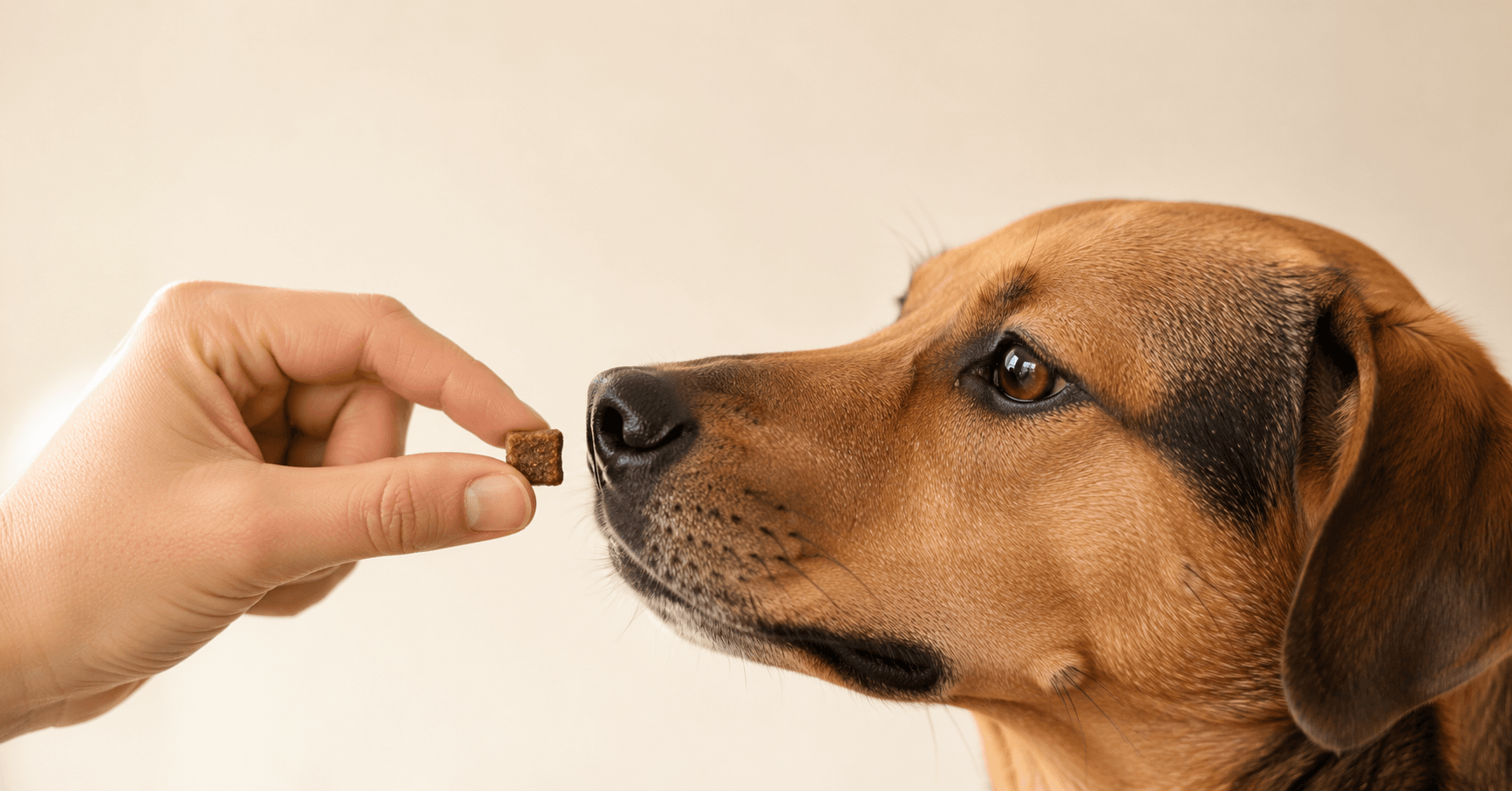
Positive reinforcement means adding something your dog likes after a behavior to make that behavior happen more often.
In plain English: reward the good stuff, and your dog will do more good stuff.
That’s it. No force. No fear. Just good things following good choices.
| How it works: ▶ Dog sits You say “Yes!” and give a treat Dog sits more often It’s that direct. The reward follows the behavior, and the brain makes the connection: “sitting = something good happens.” Over time, sitting becomes the dog’s default behavior because it’s the one that pays off. |
Example #1: Teaching ‘Sit’ (The Classic Starting Point)
Teaching “sit” is the first thing most people try with a new dog, and it’s the perfect entry point into positive reinforcement. It’s fast, visible, and genuinely satisfying to watch it click.
What you need:
- A quiet, low-distraction room (kitchen or living room works perfectly)
- 10-15 small, soft, high-value treats, boiled chicken, cheese, or commercial soft treats about the size of a pea
- 2 minutes of calm, focused attention
The 5-Step Lure Method:
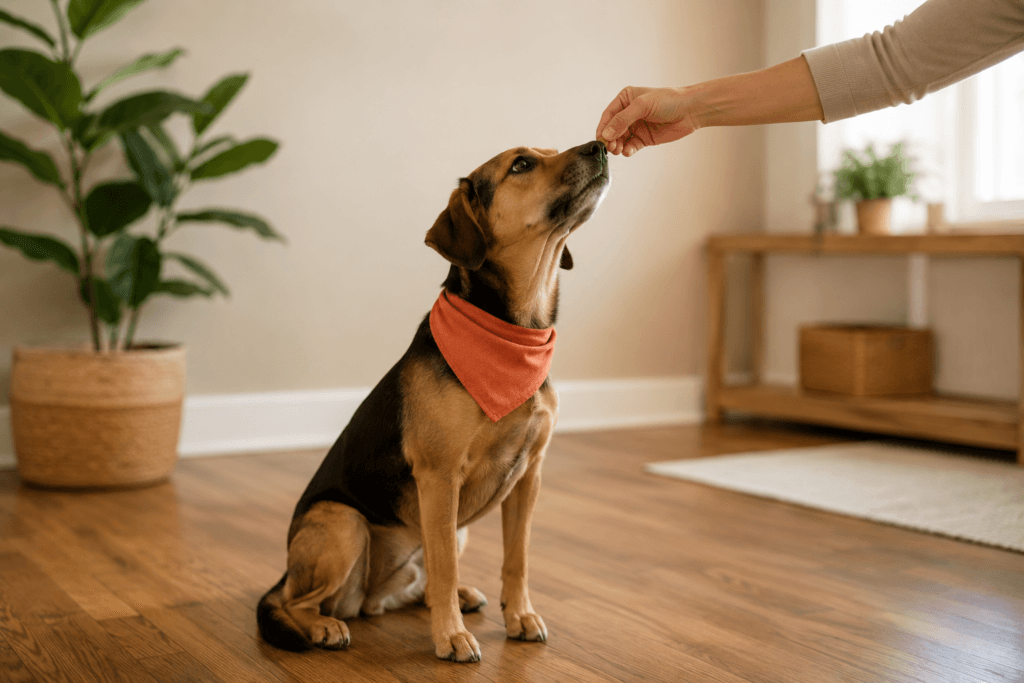
- Hold a treat directly at your dog’s nose level. Let them sniff it but don’t release it yet.
- Slowly move the treat upward and slightly back over their head. Their head will follow the treat upward.
- As their head goes up, their hips will naturally drop down. Don’t push. Just wait. Let the treat do the work.
- The MOMENT their rear touches the floor, say “Yes!” clearly and give the treat immediately. Timing matters: the treat must arrive within 1-2 seconds of the sit.
- Release them with a word like “Okay!” and repeat 5-8 more times.
Why this works:
The dog isn’t following a command yet, they’re following a lure. But every time their rear touches the floor, something wonderful happens. Their brain starts making the connection: “sitting = treat.” After enough repetitions, the sit happens faster and faster, until eventually you can say the word “Sit” before the lure and they’ll go straight down.
| Common Beginner Trouble: If your dog jumps up instead of sitting, you’re holding the treat too high. Bring it back closer to nose level. The lure only works when it naturally pulls their head upward, not so far back that they feel like jumping is the only option. |
Realistic timeline: Most puppies learn a reliable sit in 3-5 short sessions. Adult dogs often pick it up faster. See results, then add the verbal cue.
Example #2: Loose Leash Walking (Solving a Real Frustration)
This one deserves a special mention because it’s the behavior that most frustrates first-time owners, and the one where punishment-based methods are most likely to fail.
The problem:
Your dog pulls on the leash constantly. It’s exhausting. Maybe a little embarrassing. And if you have a larger dog, it might even be causing you mild shoulder injuries.
Why punishment doesn’t work here:
When you jerk the leash back or use a prong collar, you’re telling the dog what NOT to do. But you haven’t told them where you actually want them to be. The pulling behavior gets suppressed temporarily, but it doesn’t get replaced with anything. The moment the correction stops, the pulling often returns.
The positive reinforcement approach:
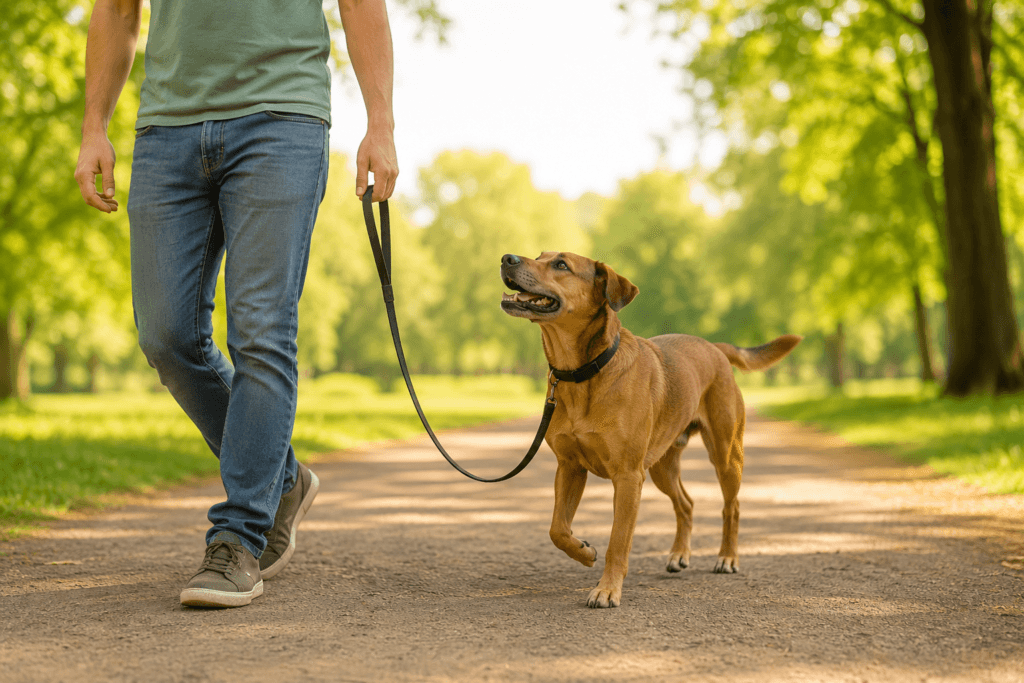
- Start inside with no distractions. Put your dog on a loose leash in the hallway or living room.
- Take ONE single step. Just one.
- If the leash stays loose during that step, say “Yes!” and deliver a treat immediately.
- If your dog pulls, stop moving. Don’t say anything. Don’t yank. Just stand still like a tree. Wait. The moment the leash loosens, even slightly, mark it with “Yes!” and treat.
- Gradually add more steps as your dog gets the idea, then work up to more distracting environments.
The breakthrough concept your dog is learning:
| Loose leash we move forward (walking is fun!) Pulling on leash we stop (nothing interesting happens) |
One owner reported: “Within a week, my 60-pound Labrador went from practically dislocating my shoulder to walking politely beside me.” That’s not a fluke. That’s positive reinforcement working exactly the way it’s supposed to.
| Related reading: Loose-Leash Walking with Positive Reinforcement | Best Training Gear Reviews 2026 | Best Dog Training Apps & Online Courses |
Example #3: Name Recognition (The Foundation of Everything Else)
This one doesn’t get enough attention, but it’s arguably the most important behavior you’ll ever teach. If your dog doesn’t respond reliably when you say their name, every other command becomes harder.
Why name recognition matters:
Your dog’s name is the equivalent of saying “hey, pay attention to me for a second.” Before you can ask them to sit, come, or stop jumping on your guests, they need to be tuned in to you. That starts with their name.
The Name Game:
- Say your dog’s name once in a happy, neutral tone. Not yelling. Not stern. Just: “Buddy.”
- The moment they look at you, even just a flicker of eye contact for a split second, say “Yes!” and give a treat immediately.
- Repeat this 10-15 times in a row. This takes about 90 seconds.
- Once they’re responding reliably indoors, add mild distractions: start in another room, then with toys on the floor, then outside.
The magic you’re creating:
Every time your dog hears their name and something good happens, the connection strengthens. After enough repetitions, the name itself becomes exciting. Buddy hears “Buddy!” and thinks: “that means something great is about to happen.” That’s exactly what you want.

| Critical, What NOT to do: Never call your dog’s name followed immediately by something unpleasant. Don’t say “Buddy!” and then clip their nails, give them a bath, or end playtime. If their name starts predicting bad things, they’ll stop responding to it, and the behavior you’ve built can take weeks to repair. |
Realistic timeline: Most dogs develop reliable indoor name recognition in 2-3 days of short practice sessions. Adding outdoor reliability takes another week or two, because the distractions outside are much more exciting than you are (at first).
The 3 Most Common Misconceptions About Positive Reinforcement
Before we go further, let’s clear up three things that stop people from committing to this approach. You may have heard all three. You may have thought them yourself. Here’s the honest truth for each one.
| Misconception | The Truth |
| “It’s just bribing your dog.” | A bribe is visible BEFORE the behavior, to get the dog to do something. Reinforcement comes AFTER, once the dog has already offered the behavior on their own. With positive reinforcement, the dog learns to offer the behavior first, then receives the reward. The dog is working FOR the reward, not being lured by it. |
| “My dog will only listen when I have treats.” | Once a behavior becomes solid and reliable, you gradually fade treats to intermittent rewards. Variable reinforcement, not knowing exactly WHEN a treat is coming, actually makes behaviors stronger and more persistent, not weaker. Think about why slot machines are so compelling: it’s the unpredictability. |
| “It doesn’t work for stubborn dogs.” | Every dog is motivated by something. It might not be food, it might be play, a specific toy, access to sniff something interesting, or the opportunity to run. Find what your dog genuinely values and use THAT as the reinforcer. “Stubborn” usually just means “wrong reward for this dog in this context.” |
How to Start Today: The 5-Minute Plan
Don’t wait until you have everything figured out. Here’s the only thing you need to do right now:
- Grab 10 tiny treats. Boiled chicken, small pieces of cheese, freeze-dried liver, or whatever your dog goes crazy for. Each piece should be about the size of a pea.
- Choose one behavior: Name recognition OR capturing calm (saying “Yes!” when your dog spontaneously lies down or looks at you calmly).
- Do 2 minutes of training right now. Say the name, mark the eye contact, deliver the treat. Ten reps. That’s it.
- End on a success, even a small one. Your dog looks at you? Mark it. They sit? Mark it. Good enough.
- Repeat once more after dinner tonight.
| That’s it. You’ve just done positive reinforcement. You’re already ahead of most first-time owners. |
The Science (In Plain English)
Here’s what’s actually happening in your dog’s brain when you use positive reinforcement correctly:
- Your dog does something, like sitting, and immediately receives a reward.
- That reward triggers the release of dopamine: a brain chemical associated with pleasure and motivation.
- Dopamine feels good. Your dog wants to feel that again.
- Over time, the neural pathway for that behavior gets physically stronger, like a trail in the woods that gets wider every time someone walks it.
This is why positive reinforcement creates lasting behavior change rather than temporary suppression. You’re not just stopping a behavior you dislike, you’re actively growing the behavior you want, at the brain level.
Compare this to punishment: when a dog is corrected for pulling on the leash, they might stop pulling in that moment. But the neural pathway for sitting nicely hasn’t been built. The behavior isn’t replaced, it’s just suppressed. Remove the threat of correction, and the pulling often returns.
| Want to read the peer-reviewed research? A 2017 review in the Journal of Veterinary Behavior examined 17 separate studies on this exact question. Spoiler: the evidence strongly favors reward-based training across virtually every metric researchers have studied. |
What About Corrections? (Honest, No-Judgment Answer)
Some trainers and training methods still use leash pops, prong collars, or other aversive techniques. If you’ve used these before or are tempted to try them, we’re not here to shame you. Most owners who use corrections simply weren’t taught anything different.
Here’s our gentle, evidence-based position:
If a method is safe, effective, and doesn’t rely on force or fear to work: why add force or fear? The question isn’t whether aversive methods can work. Under some conditions, they can. The question is whether there’s a better alternative. For the vast majority of training scenarios, there is.
Tens of thousands of force-free trainers have successfully trained everything from Chihuahuas to Mastiffs, from reactive rescue dogs to working service animals, using reward-based methods exclusively. The results are consistent, sustainable, and come with a side benefit that punishment can’t offer: a dog who genuinely wants to engage with you.
| “If you’ve used corrections before, you’re not a bad owner. You just didn’t have access to better information. Now you do.” |
Frequently Asked Questions
Q: How many treats is too many?
A: In early training, more is better. You want your dog to be highly reinforced for getting things right. As behaviors become solid, you’ll naturally reduce treat frequency through intermittent reinforcement. A good guideline: if your dog seems full or uninterested, you’ve been training too long or your treats are too large. Keep pieces tiny, pea-sized at most.
Q: What if my dog isn’t food motivated?
A: Some dogs aren’t particularly interested in food during training, and that’s okay. Try upgrading the treat value first (boiled chicken and freeze-dried liver are usually irresistible). If food still isn’t working, try toys, play, praise, or access to something your dog loves like a sniff walk or a game of fetch. Find what lights your dog up and use that.
Q: How long until I see results?
A: Simple behaviors like name recognition and sit typically show clear progress within 3-5 short daily sessions. More complex behaviors like loose leash walking can take 1-3 weeks of consistent practice. The key word is ‘consistent’, 5 minutes daily beats 30 minutes once a week, every time.
Q: Do I need a clicker, or can I just use ‘Yes’?
A: Either works. A clicker is consistent and precise, it makes the exact same sound every time, which removes any variation in your voice. But ‘Yes!’ said in a clear, upbeat tone does the same job and you never have to worry about having it in your pocket. Start with ‘Yes!’ and upgrade to a clicker later if you want to.
Q: What if my dog does something dangerous in the moment?
A: Use a non-emotional interruption like ‘Ah!’ or ‘Oops,’ redirect your dog to a safer behavior, and then reward the redirection. If your dog is eating something toxic, get the object out first, treat that as an emergency, not a training moment. You can use a positive exchange trade (‘Leave it, take this instead’) once the immediate danger has passed.
Q: Can I use positive reinforcement with an older rescue dog?
A: Absolutely, and older dogs often learn faster than puppies, they have better attention spans and are less easily distracted. The timeline might be slightly different if the dog has a history of punishment-based training, but the method works beautifully with dogs of any age. Some rescue dogs thrive on reward-based training precisely because it’s the first time in their lives good choices have been acknowledged.
Q: What if I accidentally reinforce the wrong behavior?
A: It happens to everyone, especially beginners. If you mark the wrong thing, simply don’t repeat that pattern and move on. Dogs have incredibly forgiving neural plasticity. One accidental reinforcement of an unwanted behavior won’t create a permanent habit. It only becomes a habit if you consistently reinforce it across many repetitions. Relax, laugh it off, and try again.
The Takeaway
Positive reinforcement is not complicated. Reward the behavior you want, and that behavior happens more often. That’s the whole idea.
You don’t need to be perfect. Every good choice you reward is a step forward. Every training session you show up for, even a 2-minute one, is building the dog you want to have.
Your dog isn’t trying to be difficult. They’re just trying to figure out what works. Teach them that good choices pay off, and watch what happens.
If you want to go beyond the basics and see the actual research behind why this approach works so reliably, our breakdown of the science behind positive reinforcement covers the studies in plain language.
| Continue Reading, Positive Reinforcement 101 Series: 5 Reasons Positive Reinforcement Works Better Than Punishment The Beginner’s Toolkit, Essential Gear for Positive Reinforcement Training the complete Positive Reinforcement 101 series |
| Free Printable Training Library Want a free printable training log to track your daily sessions? Enter your email below and we’ll send it straight to your inbox, along with our complete Positive Reinforcement 101 Starter Kit: the gear checklist, the 5-day beginner plan, and the treat pouch comparison chart. Want a free printable Training Cheat Sheet? Enter your email below to download instantly. |